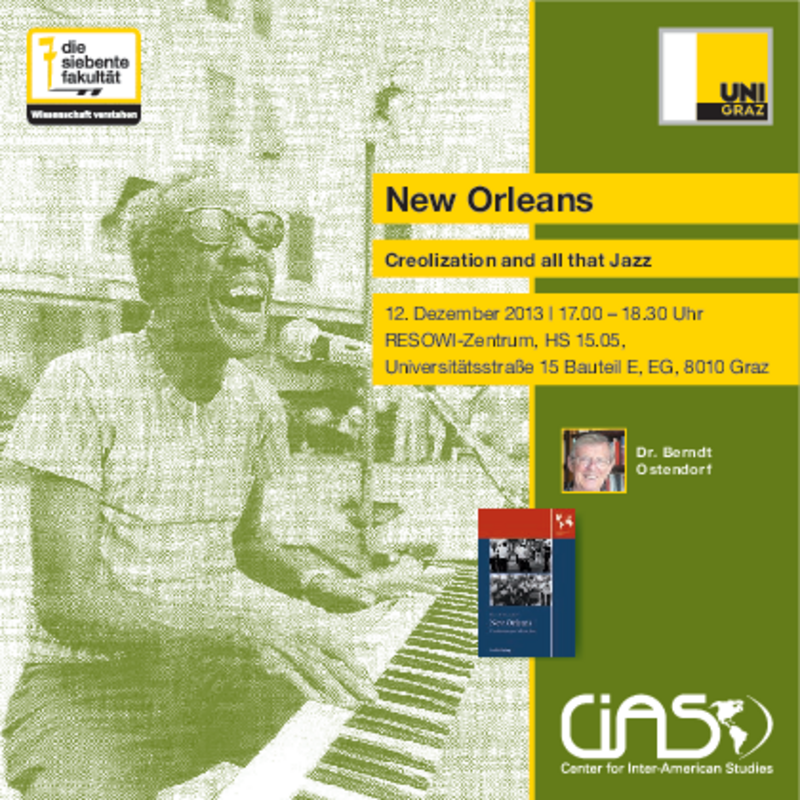
New Orleans
Berndt Ostendorf: Professor emeritus of North American Cultural History at the Amerika Institut
Only a few American cities are the production centers of cosmopolitan culture.
New Orleans, the northernmost Caribbean metropolis, must be counted
among them. It is marked by a unique sense of place; and it clearly is
a place for the senses. Yet, after Katrina many prominent Americans have
suggested giving up the city or large parts of it. It is telling that the cultural
capital of New Orleans remains largely invisible to the American public,
but is admired throughout the world. Most of it (food, sex, music, religion,
architecture) belongs to the world of the senses and is embedded in the
popular expressive arts: therefore the city has acquired the role of the sensual
other, the Big Easy, that lacks civic (and moral) legitimacy. Much of the
cultural capital of the city is buried in a complex, tripartite racial history,
which threatens the binary logic of North American racism with all sorts of
sensual transgressions. Over time the city has shored up a ethno-nostalgic
heritage and a contradictory cultural history of race relations that needs to
be rescued from oblivion, for it treasures those sedimentations and resonances,
which give New Orleans its uncanny, urban aura.