BB: Autonomy of Journalism and the Journalist’s Action in the SF Republic of Yugoslavia
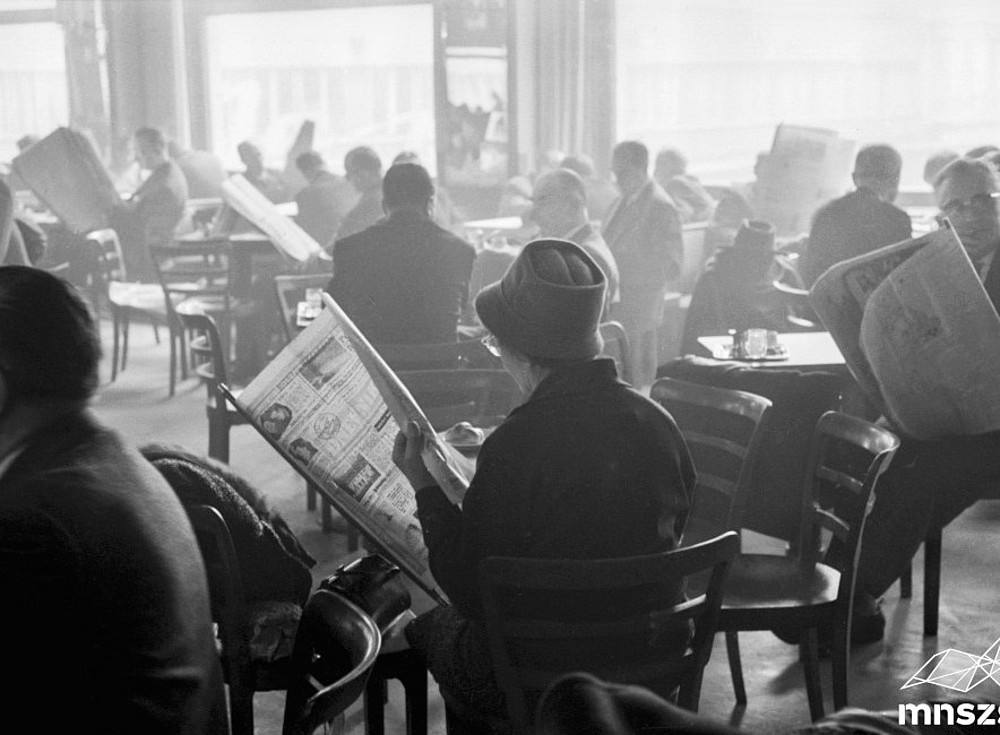
Schwarz-weißes Foto - Menschen in einem Kaffeehaus
The lecture will present the results of extensive doctoral research on the autonomy of journalism and journalist’s action in the Socialist Federal Republic of Yugoslavia (1963–1992). The research examines the relations between the internal logic of journalistic institutions and the external logic of the socio-political system, demonstrating that the autonomy of journalism is neither univocal nor predetermined. Instead, empirically, it is a process that is continuously redefined in dialogue with historical events, and social, political, and institutional changes. Autonomy, together with the concept of action (prâxis), represents a conceptual tool for an in-depth study of the position, significance, and role of journalism in Yugoslavia.
The analysis is based on a combination of archival sources (Archive of the Republic of Slovenia, Archive of Yugoslavia in Belgrade, Historical Archive of Belgrade) and oral history, in the form of in-depth semi-structured interviews with journalists who were professionally formed in the SFRY and actively experienced this period. The interviews were conducted in Slovenia (43), Croatia (12), and Serbia (14); however, the analysis focuses on findings from Slovenia. Oral history research, as the central method for presenting the results, highlights aspects of journalistic practice that constitute the mechanism of active (co-)creation of the journalistic field and, consequently, autonomy. This approach regards journalists as “historical actors in time and space”. Special attention is given to the genealogical reconstruction of autonomy over three decades (the 1960s, 1970s, and 1980s, including the disintegration of Yugoslavia), during which political fractions, modernisation processes (the so-called self-institutionalisation of journalism), Yugoslavia's foreign policy positioning, and reforms in the field of self-governing socialism (e.g., the functioning of workers' councils) were closely intertwined with journalistic practice and the development of professional standards in journalism.
The research results show that, in their pursuit of professional integrity and credibility, Yugoslav journalistic institutions significantly (self-)shaped the space of autonomy that existed within the one-party system. This contradiction – the possibility of autonomous action within a strongly ideologically marked system – creates space for critical reflection on the role of journalism as a (co-)creator of socio-political reality. The lecture will therefore offer an original scientific contribution to the understanding of Yugoslav journalism and encourage reflection on the broader question of journalistic autonomy in comparable political and historical contexts.
Nina Žnidaršič (1993) is a research assistant at the Institute of Criminology at the Faculty of Law – Ljubljana. From 2020 to 2024, she was a junior researcher at the Social Communication Research Centre at the Faculty of Social Sciences in Ljubljana, where she is currently completing her doctoral dissertation Autonomy of Journalism and the Journalist’s Action in the Socialist Federal Republic of Yugoslavia. She completed her undergraduate studies in Journalism and her postgraduate studies in Sociology at the same faculty; she also studied Sociology and Philosophy at the Faculty of Arts in Ljubljana. She has presented her reflections at national and international conferences and doctoral schools and was a visiting fellow at the Institute of Contemporary History in Ljubljana from October to December 2023. She is currently engaged in theoretical and empirical research on the rise of illiberal democracies at the Institute of Criminology at the Faculty of Law – Ljubljana.