



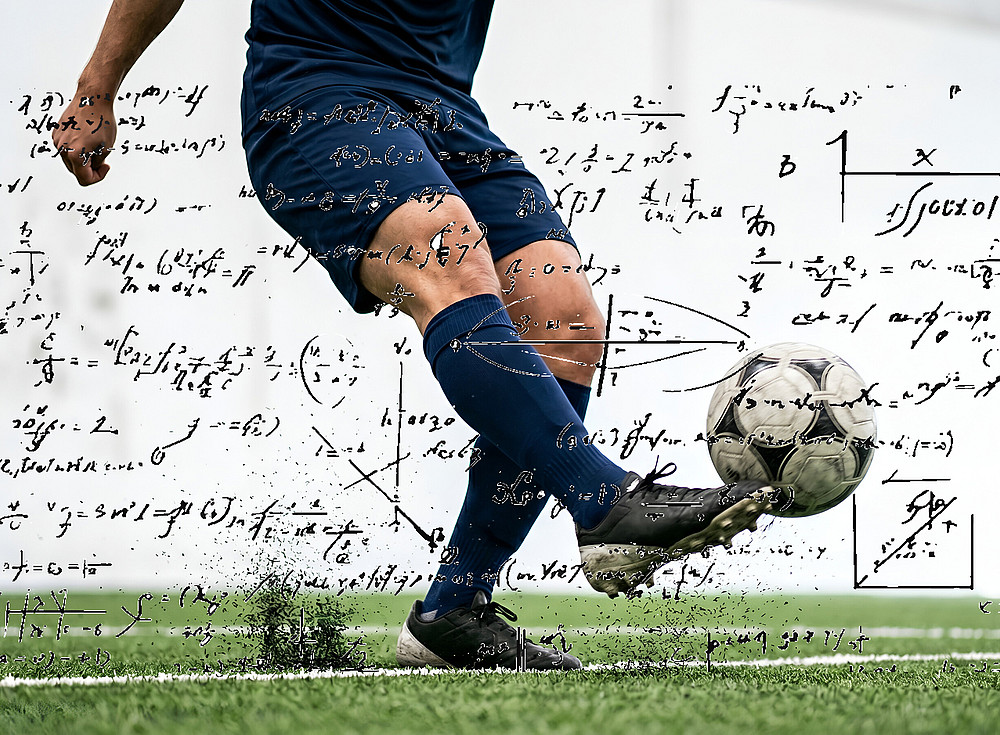
One will win: the purely theoretical probability for each of the 48 teams competing in the World Cup is around two per cent. “For a more realistic calculation, one must of course factor in the playing strength of the respective teams, their direct opponents and the course of the tournament,” adds Michael Fischer, a specialist in mathematics education at the Department of Mathematics at the University of Graz. The so-called Bradley-Terry model is recommended for this purpose, as it is also suitable for use in the classroom. Students can, for example, estimate the playing strengths of the national teams based on FIFA rankings or market values. “If you vary the assumptions slightly, you often arrive at very different results. This promotes an understanding of data analysis, probabilities and uncertainty,” says the mathematician, seeing this as a good opportunity to use the world’s most important triviality as a learning motivation for complex future topics.
Fischer, who quite unscientifically predicts that Austria will be world champions, has published a research article on this topic together with Christoph Lieben: “Football matches are (not) random experiments – modelling and simulation using the Bradley-Terry model”, DOI: 10.37626/GA9783959873307.0