Begin of page section:
Page sections:

  • Go to contents (Accesskey 1)
  • Go to position marker (Accesskey 2)
  • Go to main navigation (Accesskey 3)
  • Go to sub navigation (Accesskey 4)
  • Go to additional information (Accesskey 5)
  • Go to page settings (user/language) (Accesskey 8)
  • Go to search (Accesskey 9)

End of this page section. Go to overview of page sections

Begin of page section:
Page settings:

English en
Deutsch de
Search
Login

End of this page section. Go to overview of page sections

Begin of page section:
Search:

Search for details about Uni Graz
Close

End of this page section. Go to overview of page sections


Search

Begin of page section:
Main navigation:

Page navigation:

  • University

    University
    • About the University
    • Organisation
    • Faculties
    • Library
    • Working at University of Graz
    • Campus
    Developing solutions for the world of tomorrow - that is our mission. Our students and our researchers take on the great challenges of society and carry the knowledge out.
  • Research Profile

    Research Profile
    • Our Expertise
    • Research Questions
    • Research Portal
    • Promoting Research
    • Research Transfer
    • Ethics in Research
    • Commission for Scientific Integrity
    Scientific excellence and the courage to break new ground. Research at the University of Graz creates the foundations for making the future worth living.
  • Studies

    Studies
    • Prospective Students
    • Students
    • Registration for Study Programme (Winter semester 2026/27)
    • Welcome Weeks for First Year Students
  • Community

    Community
    • International
    • Location
    • Research and Business
    • Alumni
    The University of Graz is a hub for international research and brings together scientists and business experts. Moreover, it fosters the exchange and cooperation in study and teaching.
Topics
  • Sustainable University
  • Researchers answer
  • Work for us
Close menu

End of this page section. Go to overview of page sections

Begin of page section:
You are here:

University of Graz News The Arctic up close: ORF special feature on the University of Graz’s research station in S

End of this page section. Go to overview of page sections

Friday, 24 July 2026

The Arctic up close: ORF special feature on the University of Graz’s research station in S

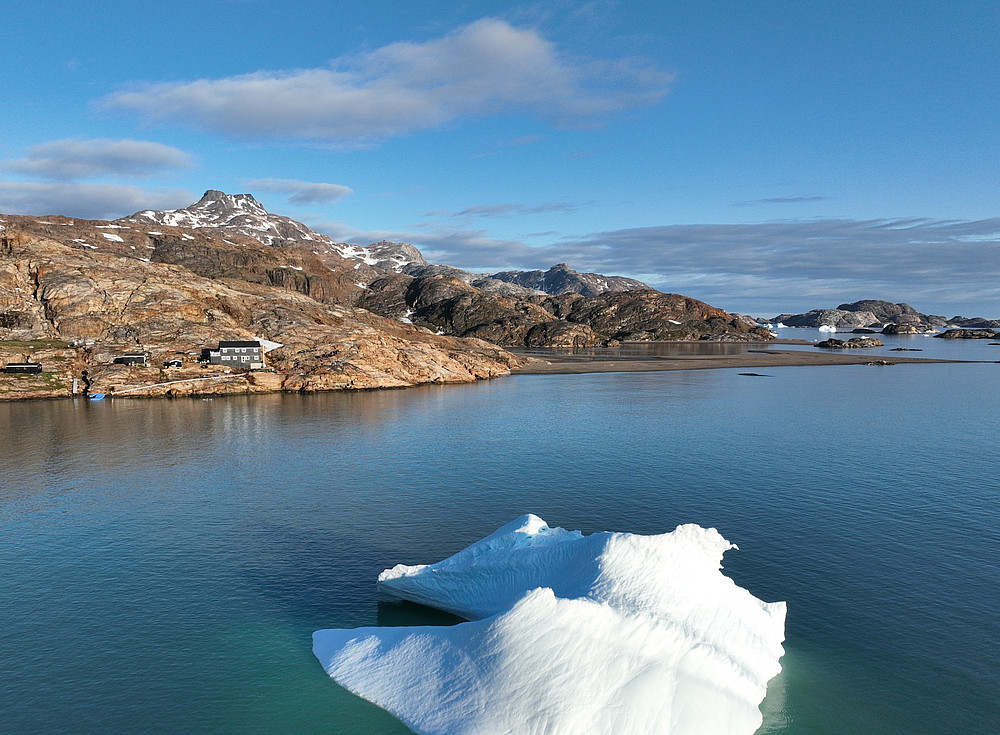
An iceberg in the foreground, lapped by turquoise-blue meltwater; in the background, steep, partly snow-capped rocky mountains, a small research station on the shore and a long wooden jetty jutting out into the sea – crisp, cool colours against a cloudless sky, captured from a bird’s-eye view.

The Sermilik Research Station in eastern Greenland. Photo: University of Graz/Trügler

Students from the University of Graz are spending two weeks conducting research at the Univerisity of Graz research station at the Sermilik Fjord in Greenland, which has been operational for three years. They are measuring glacial runoff, tracking ice melt in real time and installing weather stations. ORF is following the expedition and will be reporting on the special feature ‘Arctic Adventure’ across its various channels from 20 July.

Research amidst fjords, glaciers and Arctic landscapes: For the past three years, the University of Graz has been operating a research station in Sermilik Fjord, right next to an existing facility run by the University of Copenhagen. Located a day’s walk from the nearest village, the station can accommodate up to 30 researchers during the summer. In terms of research facilities, the station is one of the five largest EU facilities of its kind in the Arctic. A research group from the University of Graz, together with students, is currently on site at Sermilik Fjord.

ORF journalist Paul Sihorsch is accompanying the current expedition to the research station and will be reporting from the Sermilik Station for a week from 20 July as part of a multimedia special entitled “Adventure Arctic”. The science editorial team will be sharing insights into research and life in the Arctic via radio, TV and online. On 23 July, Ö1 will dedicate an entire theme day to the Arctic – featuring music from the polar region, fascinating insights into research and discussions on geopolitical issues.

Further details: https://oe1.orf.at/arktis

Water flows and time-lapse

Among other things, during their stay at the outlet of the Mittivakkat Glacier, Students and Scientists will measure water flows, set up sensors to record ice melt in real time, and install automated weather stations and time-lapse cameras to document changes in the ice. Preparations for next year’s research projects are already underway this year.

For researchers from Austria, the station’s location is of interest for several reasons: the glaciers of East Greenland resemble those in the Austrian Alps, but are largely free from human influence. Here, the interaction between the atmosphere and the glacier can be studied without interference. Any change to the Greenland ice sheet has a direct impact on the climate in Europe. In addition to glaciology, the University of Graz’s research focuses on meteorology, climate change, the interaction between the Arctic and the atmosphere, and much more.

Insights into research

Listen to all the radio programmes on Ö1: https://oe1.orf.at/arktis

TV reports

Paul Sihorsch on research at the University of Graz’s research station – Latest news following ‘Eins’ on 23 July 2026 – ORF ON

“Guten Morgen Österreich”

In the realm of ice: Austrian research in Greenland – Guten Morgen Österreich, 21 July 2026 – ORF ON

Glacier research in Greenland – “Guten Morgen Österreich” broadcast on 22 July 2026 – ORF ON

Everyday research life in the Arctic – “Guten Morgen Österreich” broadcast on 23 July 2026 – ORF ON

Everyday research life in the Arctic – “Guten Morgen Österreich” broadcast on 23 July 2026 – ORF ON

Online article on science.orf.at

Europe’s heatwave brings cold to the Arctic, science.orf.at

created by Roman Vilgut

Related news

Surprise, spectacle, science: Astrophysicists observed a partial solar eclipse

The star of the show was the sun, and the programme featured a natural spectacle: the partial solar eclipse on the evening of 12 August 2026 drew crowds to Graz’s Schloßberg. The ‘sun-downer’ was accompanied by a dash of science from astrophysicists at the University of Graz.

Discussions on Europe’s digital future are taking place in Graz

Exactly three months before the event, the Technology Impact Summit (TIS) team is unveiling the programme for this year’s think tank event.

Preserving cultural heritage: Graz researchers make Roman inscriptions legible again

Researchers from the University of Graz and Graz University of Technology are working to save inscriptions carved in stone in Styria during Roman times from disappearing. They have developed a simple and cost-effective method to make inscriptions on tombs and votive altars – which have been weathered or damaged – legible again. They are currently testing the method on Roman stones at several sites across Styria. The aim is to provide other historians with a tool to preserve cultural heritage when expensive research equipment is not available. The method was recently published in the research journal Heritage Science.

When the sun goes dark: Enlightening for science and the people of Graz

When the moon partially passes in front of the sun in Graz on 12 August 2026, the event will once again captivate many people. This includes Manuela Temmer, an astrophysicist at the University of Graz. The scientist confirms that this celestial phenomenon offers significant value for research: “During a solar eclipse, the corona can be observed more clearly than with any instrument.”

Begin of page section:
Additional information:

University of Graz
Universitaetsplatz 3
8010 Graz
Austria
  • Contact
  • Web Editors
  • Moodle
  • UNIGRAZonline
  • Imprint
  • Data Protection Declaration
  • Accessibility Declaration
Weatherstation
Uni Graz

End of this page section. Go to overview of page sections

End of this page section. Go to overview of page sections

Begin of page section:

End of this page section. Go to overview of page sections