



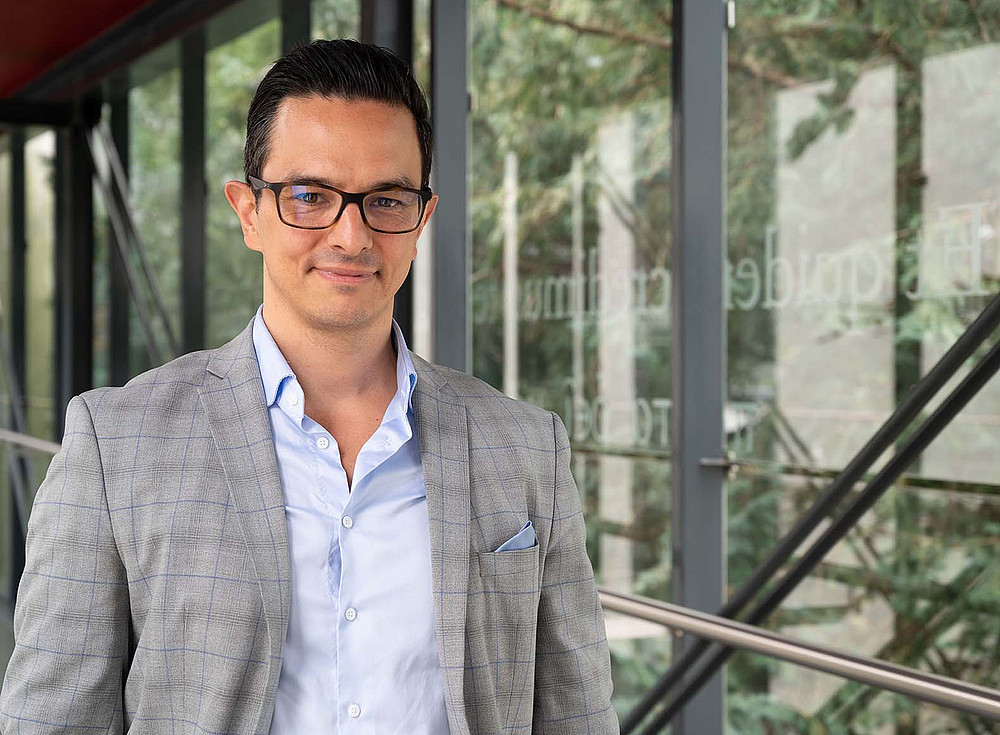
Giovanni Rubeis explores these questions in his recently published book “Ethics of AI in Medicine” (Springer). He is Head of the “Health Care Ethics” unit at the Institute for Moral Theology at the University of Graz.
Professor Rubeis, is AI beneficial or dangerous for medicine?
Giovanni Rubeis: Under certain circumstances, it can be both. Its impact depends crucially on who designed it, why and how. What data was it trained on, and for what purpose was the system developed? The quality of an AI’s performance depends heavily on human-made factors. That is why ultimate responsibility must always remain with us humans.
Nowadays, you can ask ChatGPT for a diagnosis and receive prompt answers that are easy to understand and sound sympathetic. How are Large Language Models (LLMs) changing the relationship between healthcare professionals and patients?
Rubeis: We’ve known about ‘Dr Google’ for decades. These days, LLMs are a good first point of contact for many people when they have health problems. The advantages may seem obvious at first glance: the AI can access a vast amount of data, has all the time in the world for the ‘conversation’, and always remains friendly in its choice of words. Doctors, psychologists or physiotherapists simply cannot manage this to the same extent. At the same time, these experts bear the responsibility for ensuring that every patient always understands the significance, risks and alternatives of a treatment. It is therefore not always welcome when patients turn to ChatGPT and similar tools. Ultimately, however, AI cannot fulfil the promise of an empathetic relationship. That is why the trusting interpersonal level remains a vital element in medicine, one that must be consciously nurtured by both sides.
Can ‘Dr AI’ counteract human prejudices, or so-called ‘bias’?
Rubeis: Bias does not arise of the AI’s own accord. Prejudices are embedded in the training data we feed it, or in the way we design the algorithm. If, for example, certain skin colours or gender-specific symptoms are under-represented, the results will be skewed. It is therefore up to the people developing AI to bear the aim and purpose in mind. It is also clear that diverse data and technical verification procedures can reduce bias, but cannot eliminate it entirely.
Where do you see societal risks if AI becomes disproportionately prevalent in the healthcare sector?
Rubeis: The use of AI solely for the sake of cost reduction could jeopardise patient welfare. An expansion of a two-tier healthcare system is conceivable. Those who can afford it will be seen by a human; everyone else will be treated by the AI. If the AI makes a mistake, the system could ‘get away with’ these misdiagnoses because it remains financially viable nonetheless. That is why ethical considerations must be factored into development from the very start. From a purely economic perspective, this approach may initially be more labour-intensive and costly, but it saves on the costs of compensating for any consequential damages.
The German edition of your book was translated from the English by an AI under your supervision. What surprised you about that?
Rubeis: Above all, the wildly fluctuating quality of the translation. Some passages were excellent, but two sentences later there were glaring errors. These arose, amongst other things, because the system also translated technical terms such as ‘informed consent’ into German. That really highlights how important good prompts are. Ultimately, I had to check and revise the German text in its entirety. Nevertheless, I’m glad the publisher took a chance on this experiment: it allowed me to experience first-hand what AI is already capable of and where it currently still falls short.
>> More on the book “Ethics of AI in Medicine”, published by Springer
>> Anyone interested in ethical issues can explore them in greater depth on the Master’s programme in “Applied Ethics”.