



Begin of page section:
Page sections:

  • Go to contents (Accesskey 1)
  • Go to position marker (Accesskey 2)
  • Go to main navigation (Accesskey 3)
  • Go to sub navigation (Accesskey 4)
  • Go to additional information (Accesskey 5)
  • Go to page settings (user/language) (Accesskey 8)
  • Go to search (Accesskey 9)

End of this page section. Go to overview of page sections

Begin of page section:
Page settings:

English en
Deutsch de
Search
Login

End of this page section. Go to overview of page sections

Begin of page section:
Search:

Search for details about Uni Graz
Close

End of this page section. Go to overview of page sections


Search

Begin of page section:
Main navigation:

Page navigation:

  • University

    University
    • About the University
    • Organisation
    • Faculties
    • Library
    • Working at University of Graz
    • Campus
    Developing solutions for the world of tomorrow - that is our mission. Our students and our researchers take on the great challenges of society and carry the knowledge out.
  • Research Profile

    Research Profile
    • Our Expertise
    • Research Questions
    • Research Portal
    • Promoting Research
    • Research Transfer
    • Ethics in Research
    • Commission for Scientific Integrity
    Scientific excellence and the courage to break new ground. Research at the University of Graz creates the foundations for making the future worth living.
  • Studies

    Studies
    • Prospective Students
    • Students
    • Registration for Study Programme (Winter semester 2026/27)
    • Welcome Weeks for First Year Students
  • Community

    Community
    • International
    • Location
    • Research and Business
    • Alumni
    The University of Graz is a hub for international research and brings together scientists and business experts. Moreover, it fosters the exchange and cooperation in study and teaching.
Topics
  • Sustainable University
  • Researchers answer
  • Work for us
Close menu

End of this page section. Go to overview of page sections

Begin of page section:
You are here:

University of Graz News Commissioned by NATO: University of Graz tests high-tech textiles

End of this page section. Go to overview of page sections

Tuesday, 21 July 2026

Commissioned by NATO: University of Graz tests high-tech textiles

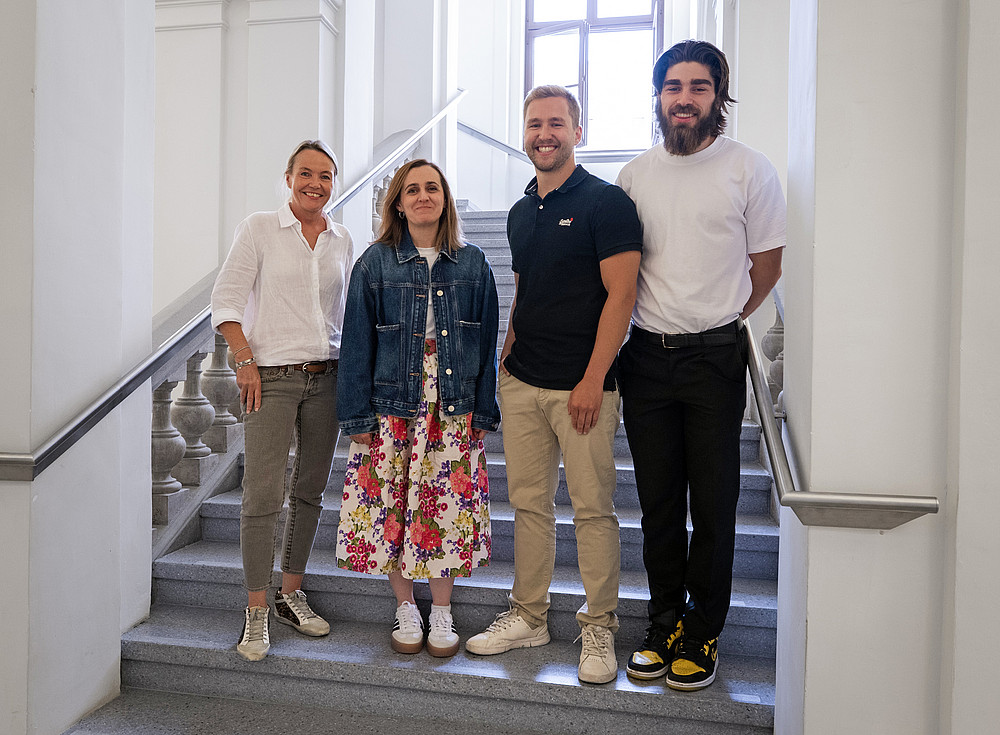
Eva Roblegg, Atida Selmani, Lukas Vergeiner and James MacFarlane Hoad are standing side by side in the stairwell at the Department of Pharmaceutical Sciences ©Uni Graz/Angele
©Uni Graz/Angele

Testing the skin compatibility of high-tech textiles for NATO: Eva Roblegg, Atida Selmani, Lukas Vergeiner and James MacFarlane Hoad; Photo: Uni Graz/Angele

As part of an international project, antimicrobial and fire-resistant fabrics with UV protection are being developed in Zagreb. Pharmacists from the University of Graz are ensuring that these fabrics are skin-friendly.

Uniforms for emergency services personnel, covers for camp beds, tarpaulins for emergency accommodation. These are potential applications for the high-tech textiles being developed as part of the ‘Secure, Antibacterial, Flame-retardant, Enhanced Guard Apparel for Resilient Defence (SAFEGUARD)’ project led by the Boskovic Institute in Zagreb. Empa, the Swiss research institute for materials science and technology in St Gallen, is testing their antimicrobial efficacy. The team led by Eva Roblegg at the Department of Pharmaceutical Sciences at the University of Graz is investigating the skin-friendliness of the fabrics.
“Our partners in Croatia are working with different types of impregnation. Contact with sweat can cause zinc, copper or iron ions, as well as tannic and phytic acid, to leach out of the coatings and irritate the skin,” explains project team member James McFarlane Hoad. Together with Atida Selmani, he is responsible for culturing skin cells, which are used to investigate potential side effects of the textiles in the laboratory. “The challenge is that the material must be heat-resistant, washable and sweat-resistant, and must not release any harmful substances even over a period of several weeks,” reports Hoad. The current progress is already promising. 

In addition to designing drug delivery systems, Eva Roblegg’s research group is working on the development and implementation of various cell culture models, which serve as a platform for investigating novel therapeutic approaches and biomedical materials. This expertise in the field of cell-based test systems is also crucial for the SAFEGUARD project, which is funded by the NATO Science for Peace and Security Programme.

created by Dagmar Eklaude

Related news

The Arctic up close: ORF special feature on the University of Graz’s research station in S

Students from the University of Graz are spending two weeks conducting research at the Sermilik Fjord in Greenland, which has been operational for three years. They are measuring glacial runoff, tracking ice melt in real time and installing weather stations. ORF is following the expedition and will be reporting on the special feature ‘Arctic Adventure’ across its various channels from 20 July.

Medicine for ants: Caffeine prolongs the life of infected insects

Black coffee stimulates us and acts against bacteria. So, can caffeine also be good for insects? Yes, confirm biologists of the University of Graz. When ants suffer from a fungal disease, they consume more caffeine and remain active for longer.

How formulas are making medicine more personalised

When Federica Caforio talks about the heart, it doesn’t sound like an operating theatre, but rather like equations, parameters and simulations. Yet this is precisely where the medical promise of her research lies: one day, clinical data will be used to create a digital twin of the heart – a virtual model that will enable a better understanding of diseases and allow for more personalised treatment plans. She will be presenting her research at the ‘ECMTB 2026’ mathematics conference.

University Spin-Off Company “Innovation Hub Graz” works to make Spin-Offs investor ready

The Medical University of Graz, University of Graz and TU Graz are once again joining forces to establish a joint Innovation Hub Graz (iHub Graz). At this transfer centre, selected, particularly promising university spin-offs are specifically prepared to be investor ready.

Begin of page section:
Additional information:

University of Graz
Universitaetsplatz 3
8010 Graz
Austria
  • Contact
  • Web Editors
  • Moodle
  • UNIGRAZonline
  • Imprint
  • Data Protection Declaration
  • Accessibility Declaration
Weatherstation
Uni Graz

End of this page section. Go to overview of page sections

End of this page section. Go to overview of page sections

Begin of page section:

End of this page section. Go to overview of page sections