



Begin of page section:
Page sections:

  • Go to contents (Accesskey 1)
  • Go to position marker (Accesskey 2)
  • Go to main navigation (Accesskey 3)
  • Go to sub navigation (Accesskey 4)
  • Go to additional information (Accesskey 5)
  • Go to page settings (user/language) (Accesskey 8)
  • Go to search (Accesskey 9)

End of this page section. Go to overview of page sections

Begin of page section:
Page settings:

English en
Deutsch de
Search
Login

End of this page section. Go to overview of page sections

Begin of page section:
Search:

Search for details about Uni Graz
Close

End of this page section. Go to overview of page sections


Search

Begin of page section:
Main navigation:

Page navigation:

  • University

    University
    • About the University
    • Organisation
    • Faculties
    • Library
    • Working at University of Graz
    • Campus
    Developing solutions for the world of tomorrow - that is our mission. Our students and our researchers take on the great challenges of society and carry the knowledge out.
  • Research Profile

    Research Profile
    • Our Expertise
    • Research Questions
    • Research Portal
    • Promoting Research
    • Research Transfer
    • Ethics in Research
    • Commission for Scientific Integrity
    Scientific excellence and the courage to break new ground. Research at the University of Graz creates the foundations for making the future worth living.
  • Studies

    Studies
    • Prospective Students
    • Students
  • Community

    Community
    • International
    • Location
    • Research and Business
    • Alumni
    The University of Graz is a hub for international research and brings together scientists and business experts. Moreover, it fosters the exchange and cooperation in study and teaching.
  • Spotlight
Topics
  • Sustainable University
  • Researchers answer
  • Work for us
Close menu

End of this page section. Go to overview of page sections

Begin of page section:
You are here:

University of Graz News When parents find it difficult to have a say

End of this page section. Go to overview of page sections

Thursday, 05 March 2026

When parents find it difficult to have a say

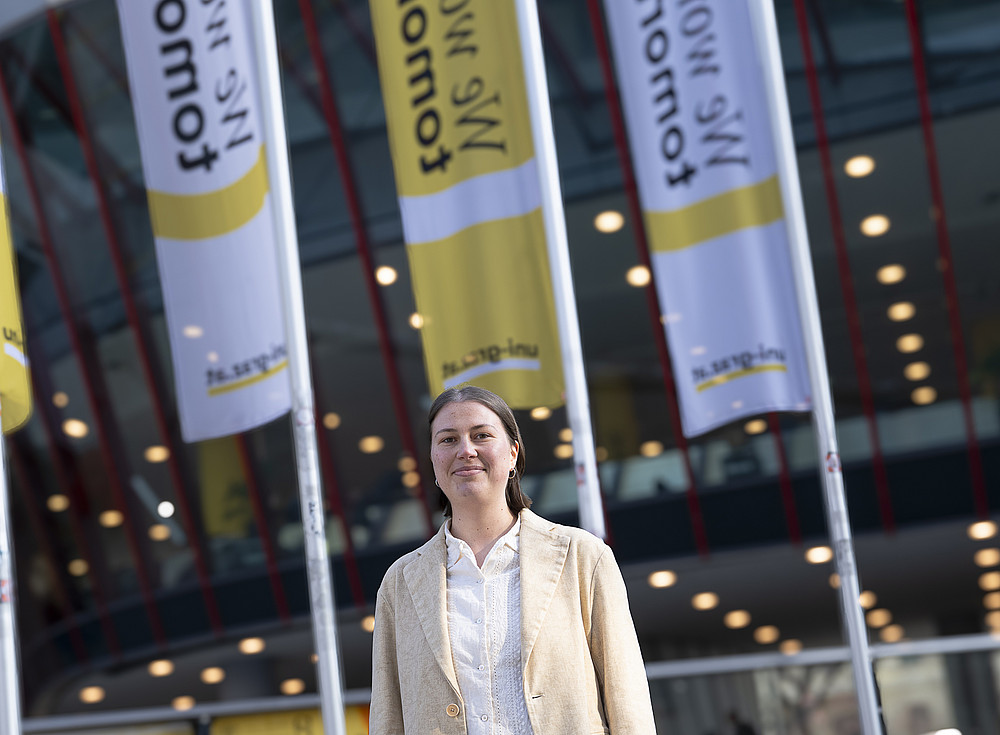
A person wearing a light beige blazer and white blouse stands outdoors in front of a modern glass building, with several towering yellow and white flags bearing inscriptions in the background and many round ceiling lights in the foyer of the building. ©Uni Graz/Tzivanopoulos

In her dissertation, Marie Tschurtschenthaler takes a closer look at communication between school administrators and parents who do not speak German as their first language. Photo: University of Graz/Tzivanopoulos

In her dissertation, translation scholar Marie Tschurtschenthaler examines how communication between compulsory schools and parents whose first language is not German works – and what role professional language mediation plays in this. Initial insights show that it is not just about language, but also about resources, responsibilities and the institutional framework.

Parent-teacher conferences, brief conversations when dropping off or picking up children, information about field trips, sick notes or appointments: everyday school life thrives on communication. But what happens when parents do not speak enough German – or when information could be translated, but other obstacles arise? This is precisely what Marie Tschurtschenthaler addresses in her dissertation at the Institute for Translation Studies at the University of Graz. The focus is on communication between Austrian compulsory schools and parents whose first language is not German – and the importance of interpreting and translating in this context. At the same time, the work highlights how the school as an institution affects parental participation.

22 languages in one location

The situation is examined on the basis of two primary schools in Graz. According to Tschurtschenthaler, up to 22 different languages are represented there. "This diversity encounters a school system that is legally clearly oriented towards German as the standard language of instruction and institutional communication," she explains. In practice, this is particularly evident in situations that actually happen "on the side": a doctor's appointment the next day, a child falling ill at school, information about a school trip arriving in writing, or a parent-teacher meeting becoming necessary. If adequate language mediation is not available, key information can be lost – with consequences for parents, children and school staff. "If this is not possible at the parent-teacher level, then in many cases the child itself is used as an interpreter," explains Tschurtschenthaler. 

Digital tools help – but not always

Many now rely on digital communication channels. In the primary schools surveyed, for example, an app with a translation function in numerous languages is used. This can make many things easier – but it also has its limitations: automatic translations work differently depending on the language, and not all parents can use digital services in the same way. "In some cases, there is a lack of basic knowledge, such as the right devices, limited digital skills or even literacy," explains the South Tyrolean.

When children translate 

When professional solutions are lacking, children, older siblings or multilingual people from the school environment are often called upon to help. This is not only a question of the burden on those involved, but also of appropriateness – especially when it comes to sensitive topics. Schools try to find pragmatic solutions, "but the effort involved is often very high and people are taken away from their actual work".

Video interpreting

A key resource is video interpreting, which has been used as official support in schools since 2021. Depending on the language, interpreters can be requested by schools via a platform and connected at short notice in some cases. This creates opportunities, especially for important conversations. At the same time, the digital setting is not always ideal in sensitive cases and trust is sometimes more difficult to build, according to the doctoral candidate. 

In her research, Tschurtschenthaler combines perspectives from teaching and translation studies. Methodologically, she specifically observed parents' evenings in autumn 2024 and conducted interviews with school administrators, teachers, integration teachers, school social workers, administrative staff and parents throughout the 2024/25-2025/26 school years. She spoke to a total of around 25 people in her survey; further parent interviews are planned in order to bring perspectives even closer together.

Her goal is to "raise awareness of an issue that has long affected many schools." "I want to highlight the discrepancy between expectations and reality," explains the young researcher. She also wants to use the results to derive guidelines for successful communication – always with the caveat that good solutions require resources: time, personnel, training and access to professional language mediation.


created by Konstantin Tzivanopoulos

Related news

Higher Education Strategy 2040: Austria’s universities on course for the future

Austria has 77 higher education institutions, which is above the EU average – but does this really make sense? The new Higher Education Strategy 2040 focuses on cooperation rather than mergers. As one of the six largest universities in Austria, the University of Graz plays a central role in this.

Climate research in Greenland: Old data provides new insights

The polar explorer and University of Graz professor Alfred Wegener left behind a unique collection of climate data from Greenland. A research team from the University of Graz is now analysing this 100-year-old treasure trove of data and comparing it with current measurements.

Diversity in nature and science: How we talk about plants and each other

Ginkgo, kiwi, hemp: they exist as male and female plants. Anyone who paid attention in biology class will confirm this. But is this categorisation, established by Carl von Linné almost 300 years ago, still valid today? An interdisciplinary team at the University of Graz is questioning these attributions and using this as a starting point to provide food for thought for gender-sensitive interaction between students, scientific and teaching staff.

Around the world in eight stops: the Long Night of Research at the University of Graz

On 24 April from 5 pm, you can take a short trip around the globe at the University of Graz, discovering pecularities of foreign countries or new local features in the entrance hall of the University Library. The itinerary takes you through introduced animal species, political attitudes and the omnipotence of algorithms. There will also be a programme in the historic reading hall, as well as at the UniGraz@Museum and the University Archive.

Begin of page section:
Additional information:

University of Graz
Universitaetsplatz 3
8010 Graz
Austria
  • Contact
  • Web Editors
  • Moodle
  • UNIGRAZonline
  • Imprint
  • Data Protection Declaration
  • Accessibility Declaration
Weatherstation
Uni Graz

End of this page section. Go to overview of page sections

End of this page section. Go to overview of page sections

Begin of page section:

End of this page section. Go to overview of page sections