Between 1906 and 1930, the polar explorer Alfred Wegener undertook three fascinating expeditions to Greenland, which was then unexplored. He never returned from his final journey. However, as a professor of meteorology and geophysics at the University of Graz, he left behind numerous pages of notes on glaciers and the weather on the world’s largest island. From today’s perspective, these are particularly interesting, as Greenland was experiencing a warm phase at the time.
The records lay in the archives for around a hundred years until a group of researchers brought them back to life. Using artificial intelligence, these historical data were digitised. At the same time, a monitoring network was set up at the same research site to compare the meteorological and glaciological measurements.
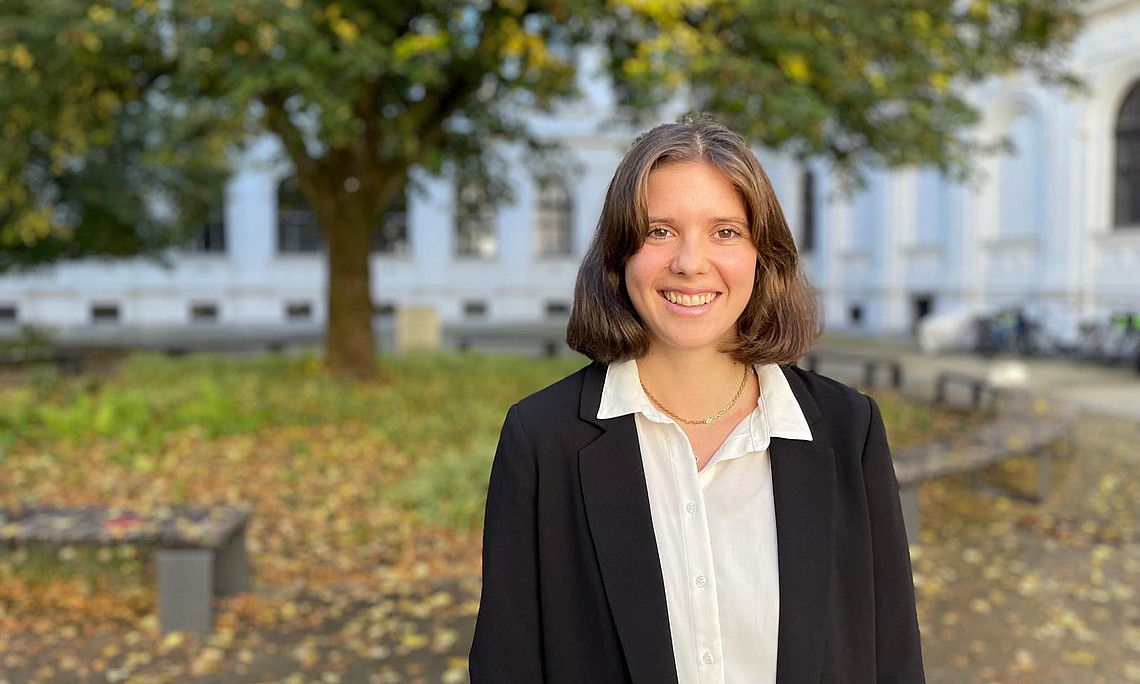
“In the first step, we compared which weather systems are particularly common during warm periods in the last century and how they affect local temperatures,” says Florina Schalamon, a PhD student on the research project. To this end, data from climate models covering the years 1900 to 2015 were analysed. Weather systems – low-pressure systems, high-pressure systems and their fronts – determine which air masses are transported to a location and thus whether warm or cold, humid or dry air prevails there.
Warming phase
What makes Wegener’s data so valuable? His expedition took place during an initial warming phase, and there has been a further warming phase since the mid-1990s. Although both periods saw a comparable temperature rise of just under 3 °C in West Greenland, the frequency of the respective weather systems differed significantly between the periods. However, the influence of individual weather systems on local temperature remained stable. “If, in Wegener’s time, a low-pressure system off the west coast of Greenland caused air to be transported from the south, this also leads to similar temperature variations today,” explains Schalamon.
The study highlights the central role that changes in atmospheric circulation play in understanding climate change in Greenland – a place whose melting ice sheet influences the climate far beyond its borders.
In the next step, the researcher is working with historical and current measurement data from the research area. What makes Wegener’s data trove special is also the sheer volume of data. “We are not solely reliant on model data to calculate backwards, but know that on day X at time Y, the temperature was Z degrees Celsius,” says the researcher. “That is fantastic for climate research.” And it can also help to verify existing climate models.
Digitisation
But first, further records from the polar pioneer would need to be digitised. “AI systems are helpful, but they must be rigorously checked,” explains the researcher. For instance, the systems often confuse the numbers 3 and 5 in the records and do not recognise every minus sign. For further research projects using Wegener’s records, the data would need to be fully digitised, says Schalamon. Yet the value of the 100-year-old measurement series for science is undisputed.
You can find out what the researchers at the University of Graz are investigating in the Arctic and what role the new research station in Sermilik Fjord plays in this during the Long Night of Research on 24 April 2026. And anyone wishing to follow in Alfred Wegener’s footsteps can study the Bachelor’s degree in Geography at the University of Graz and perhaps even travel to Greenland themselves.
To the paper
The role of large-scale atmospheric patterns for recent warming periods in Greenland from 1900–2015; Florina Roana Schalamon, Sebastian Scher, Andreas Trügler, Lea Hartl, Wolfgang Schöner, Jakob Abermann