



Begin of page section:
Page sections:

  • Go to contents (Accesskey 1)
  • Go to position marker (Accesskey 2)
  • Go to main navigation (Accesskey 3)
  • Go to sub navigation (Accesskey 4)
  • Go to additional information (Accesskey 5)
  • Go to page settings (user/language) (Accesskey 8)
  • Go to search (Accesskey 9)

End of this page section. Go to overview of page sections

Begin of page section:
Page settings:

English en
Deutsch de
Search
Login

End of this page section. Go to overview of page sections

Begin of page section:
Search:

Search for details about Uni Graz
Close

End of this page section. Go to overview of page sections


Search

Begin of page section:
Main navigation:

Page navigation:

  • University

    University
    • About the University
    • Organisation
    • Faculties
    • Library
    • Working at University of Graz
    • Campus
    Developing solutions for the world of tomorrow - that is our mission. Our students and our researchers take on the great challenges of society and carry the knowledge out.
  • Research Profile

    Research Profile
    • Our Expertise
    • Research Questions
    • Research Portal
    • Promoting Research
    • Research Transfer
    • Ethics in Research
    • Commission for Scientific Integrity
    Scientific excellence and the courage to break new ground. Research at the University of Graz creates the foundations for making the future worth living.
  • Studies

    Studies
    • Prospective Students
    • Students
  • Community

    Community
    • International
    • Location
    • Research and Business
    • Alumni
    The University of Graz is a hub for international research and brings together scientists and business experts. Moreover, it fosters the exchange and cooperation in study and teaching.
  • Spotlight
Topics
  • Sustainable University
  • Researchers answer
  • Work for us
Close menu

End of this page section. Go to overview of page sections

Begin of page section:
You are here:

University of Graz News Higher Education Strategy 2040: Austria’s universities on course for the future

End of this page section. Go to overview of page sections

Friday, 17 April 2026

Higher Education Strategy 2040: Austria’s universities on course for the future

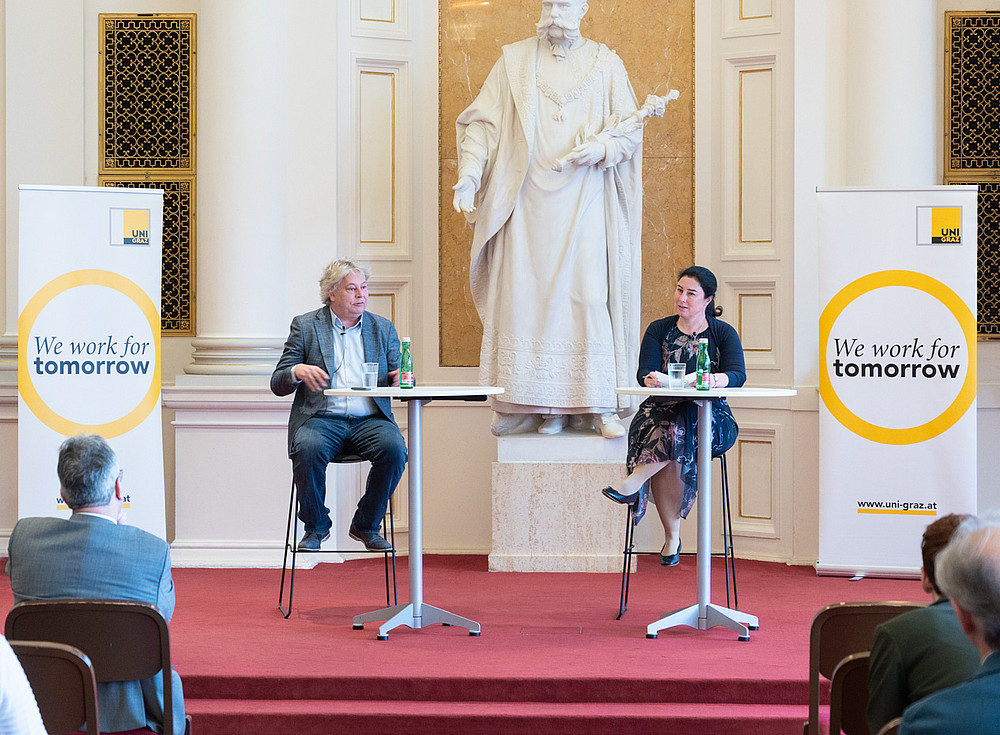
In a grand hall with a red carpet, two people are sitting on high stools at bar tables on a small stage. Behind them stands a large white statue in an ornately decorated niche. To the left and right of the stage are roll-up banners from **the University of Graz** featuring the yellow circle and the slogan **“We work for tomorrow”**. In the foreground, several members of the audience are seated on chairs, watching the event, which resembles a lecture or a panel discussion. ©Uni Graz/Angele

University researcher Martin Unger in conversation with presenter Alice Senarclens De Grancy. Photo: University of Graz/Vilgut

Austria has 77 higher education institutions, which is above the EU average – but does this really make sense? The new Higher Education Strategy 2040 focuses on cooperation rather than mergers. As one of the six largest universities in Austria, the University of Graz plays a central role in this.

Austria’s higher education landscape has evolved significantly over the past few decades. Whereas in the early 1990s there were only public universities, students can now choose from 77 higher education institutions: 23 state universities, 19 private universities, 21 universities of applied sciences and 14 teacher training colleges.

The government has now launched the Higher Education Strategy 2040. In eight working groups, representatives from the higher education institutions are collaborating with external experts on visions and goals to make Austria’s higher education sector fit for the future. “The aim is to develop the strengths of individual institutions in a targeted manner and reduce duplication,” explained Peter Riedler, Rector of the University of Graz, at the Uni.Talk information event on 16 April 2026 in the University of Graz auditorium.

As an expert, higher education researcher Martin Unger is part of a working group. He specialises in international education systems and explained in a keynote speech where Austria stands in international comparison. The figures clearly show that Austria offers many opportunities for higher education. “In terms of population, we have 8.2 higher education institutions per million inhabitants,” explained Unger. This puts Austria above the EU average of 7.9 institutions per million and significantly above countries such as Germany, Switzerland or Sweden.

And a look at student numbers reveals something else: half of all full-time students are spread across just six universities, with the University of Graz being one of them. Taking all legal forms into account, 80 per cent of all students are enrolled at just 20 higher education institutions. “We have a great many programmes, some of which are highly specialised, and these are funded in very different ways,” said Unger during his presentation. However, Unger does not see the greatest opportunity for Austria’s higher education institutions in mergers, but rather in stronger cooperation. And the Styrian Higher Education Area serves as a clear model in this regard.

created by Roman Vilgut

Related news

Climate research in Greenland: Old data provides new insights

The polar explorer and University of Graz professor Alfred Wegener left behind a unique collection of climate data from Greenland. A research team from the University of Graz is now analysing this 100-year-old treasure trove of data and comparing it with current measurements.

Diversity in nature and science: How we talk about plants and each other

Ginkgo, kiwi, hemp: they exist as male and female plants. Anyone who paid attention in biology class will confirm this. But is this categorisation, established by Carl von Linné almost 300 years ago, still valid today? An interdisciplinary team at the University of Graz is questioning these attributions and using this as a starting point to provide food for thought for gender-sensitive interaction between students, scientific and teaching staff.

Around the world in eight stops: the Long Night of Research at the University of Graz

On 24 April from 5 pm, you can take a short trip around the globe at the University of Graz, discovering pecularities of foreign countries or new local features in the entrance hall of the University Library. The itinerary takes you through introduced animal species, political attitudes and the omnipotence of algorithms. There will also be a programme in the historic reading hall, as well as at the UniGraz@Museum and the University Archive.

Studying at the University of Graz: How to enrol

Ready for a new chapter in your life with the start of your studies at the University of Graz in the winter semester 2026/27? Here you will find information on deadlines, admission procedures, registration, and everything else you need to successfully start your studies in the fall.

Begin of page section:
Additional information:

University of Graz
Universitaetsplatz 3
8010 Graz
Austria
  • Contact
  • Web Editors
  • Moodle
  • UNIGRAZonline
  • Imprint
  • Data Protection Declaration
  • Accessibility Declaration
Weatherstation
Uni Graz

End of this page section. Go to overview of page sections

End of this page section. Go to overview of page sections

Begin of page section:

End of this page section. Go to overview of page sections