



Begin of page section:
Page sections:

  • Go to contents (Accesskey 1)
  • Go to position marker (Accesskey 2)
  • Go to main navigation (Accesskey 3)
  • Go to sub navigation (Accesskey 4)
  • Go to additional information (Accesskey 5)
  • Go to page settings (user/language) (Accesskey 8)
  • Go to search (Accesskey 9)

End of this page section. Go to overview of page sections

Begin of page section:
Page settings:

English en
Deutsch de
Search
Login

End of this page section. Go to overview of page sections

Begin of page section:
Search:

Search for details about Uni Graz
Close

End of this page section. Go to overview of page sections


Search

Begin of page section:
Main navigation:

Page navigation:

  • University

    University
    • About the University
    • Organisation
    • Faculties
    • Library
    • Working at University of Graz
    • Campus
    Developing solutions for the world of tomorrow - that is our mission. Our students and our researchers take on the great challenges of society and carry the knowledge out.
  • Research Profile

    Research Profile
    • Our Expertise
    • Research Questions
    • Research Portal
    • Promoting Research
    • Research Transfer
    • Ethics in Research
    • Commission for Scientific Integrity
    Scientific excellence and the courage to break new ground. Research at the University of Graz creates the foundations for making the future worth living.
  • Studies

    Studies
    • Prospective Students
    • Students
  • Community

    Community
    • International
    • Location
    • Research and Business
    • Alumni
    The University of Graz is a hub for international research and brings together scientists and business experts. Moreover, it fosters the exchange and cooperation in study and teaching.
Topics
  • Sustainable University
  • Researchers answer
  • Work for us
Close menu

End of this page section. Go to overview of page sections

Begin of page section:
You are here:

University of Graz News What matters in the end: moral theologian takes stock of assisted suicide

End of this page section. Go to overview of page sections

Wednesday, 03 June 2026

What matters in the end: moral theologian takes stock of assisted suicide

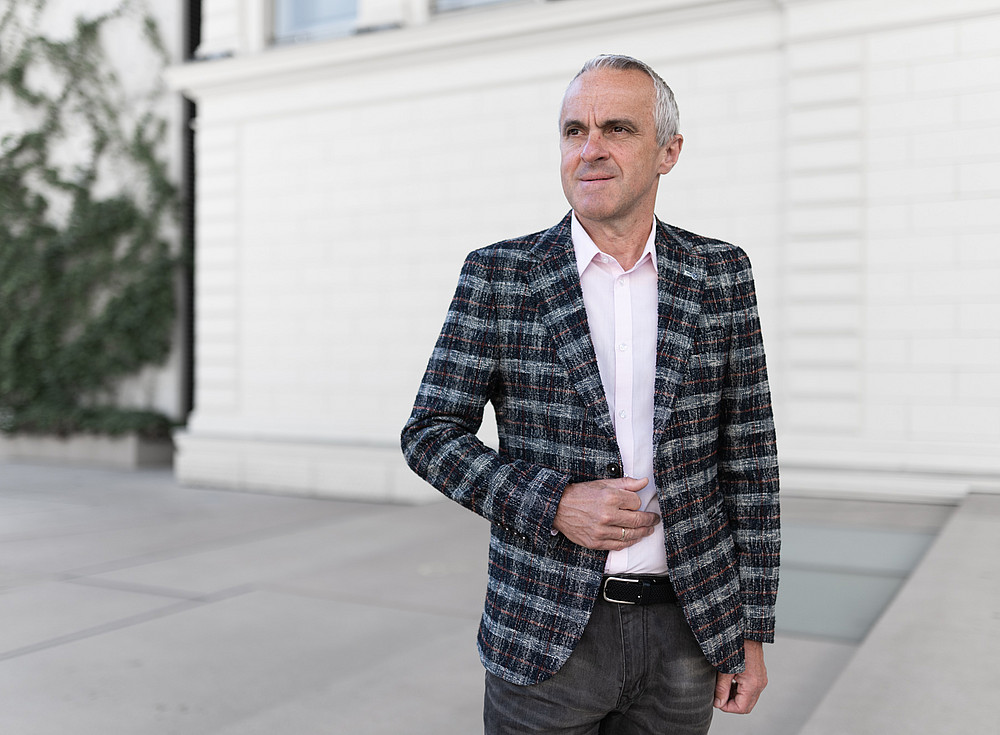
A man in a checked jacket is standing on a gently sloping flight of steps ©Uni Graz/Angele

‘Although a legal framework for assisted suicide exists in Austria, many pressing questions remain unanswered when it comes to its practical implementation,’ says Johann Platzer, a moral theologian at the University of Graz. Photo: University of Graz/Angele.

Since 1 January 2022, assisted suicide has been legal in Austria under certain conditions. This was made possible by a ruling of the Constitutional Court, which overturned the blanket ban on assisting in suicide. Four years on, it is clear that: “Although the legal framework is in place, many pressing questions remain unanswered when it comes to its practical implementation,” says Johann Platzer, a moral theologian at the University of Graz.

When is my will free?

A key concept in this context is what is known as ‘decision-making capacity’. ‘The decision by a person wishing to die to end their life must be made freely, of their own volition and without physical or psychological coercion,’ explains Platzer. The law provides for several safeguards to this end. Those concerned must first seek advice from two doctors, one of whom must be qualified in palliative care. Only after a three-month waiting period can a living will be drawn up at a notary’s office or with the Patient Advocacy Service. “This is intended to ensure the permanence of the wish to end one’s own life. The consulting doctors, the notary and the persons providing assistance – in the vast majority of cases, these are relatives – are legally obliged to verify the person’s capacity to make decisions,” explains the researcher. 

Despite all these measures, many experts harbour doubts as to whether and how free will can be reliably assessed in such an existential decision. “This situation is particularly challenging for those providing assistance, who generally have no specialised training,” explains the moral theologian. This is precisely why various sources of overwhelm and stress arise. Platzer emphasises: “What is needed here, above all for relatives, is professional counselling and support. And there is currently hardly any professional support available for affected professionals in medicine, nursing, pharmacy and law either.”

Where is the lethal substance?

Once a living will has been drawn up, the lethal preparation can be collected from a pharmacy. However, experience over the past four years shows that there are still unanswered questions here too. Because: “Not every preparation collected is actually used. Some are returned, others remain in private households – as a kind of safety net,” the researcher notes.  There are currently around 450 such preparations in circulation in Austria. This raises various questions: Where and how are they kept safe? Who monitors this, and who needs to be informed? 

Furthermore, there is a lack of comprehensive, scientific accompanying research that brings together data from notaries, palliative care organisations and pharmacies. “How many advance directives have been drawn up, how frequently assisted suicide is actually carried out, what motives play a role in this, and what burdens relatives experience, would need to be systematically investigated,” emphasises Platzer. “With a law of such far-reaching implications, such an accompanying evaluation would be particularly important.”

A self-determined end of life? 

From an ethical perspective, the researcher sees society facing a crucial question: “How can self-determination at the end of life be respected without leaving people alone in illness, loneliness or existential distress?” He argues that not only legal procedures are needed, but also counselling, comprehensive palliative care, hospice services, support for relatives and aftercare. 

The theologian is keen to emphasise: “Assisted suicide does not relieve us as a society of the responsibility to be effective in a preventative sense. On the contrary: precisely because this option now exists, information about alternatives must be provided with particular care – without pressure, without patronising, but also without indifference. It is crucial that people in extreme life situations do not feel they are being left alone.”

The topic of assisted suicide was also recently addressed at the 10th Seggau Talks on State and Church 2026, which celebrated their 20th anniversary this year. Anyone wishing to explore this and other socially contentious issues in greater depth can do so on the Master’s programme in ‘Applied Ethics’. 

created by Gerhild Leljak

Related news

Noise is the signal: new simulation method enables secure communication

Researchers from Graz, Vienna and Munich have developed a new simulation method that makes it possible to calculate quantum light using classical software – a step towards secure quantum communication.

Massacre and Memory: University of Graz addresses the wounds of history

A conference on 12 and 13 June 2026 at the Jesuit Refectory will focus on trauma in Eastern and South-Eastern Europe.

Uni Vibes: An open-air stage for science and street art

At the third Uni Vibes event hosted by the University of Graz, visitors enjoyed science, music and performances on campus. Guided tours focusing on democracy, educational sciences and the Graz Centre of Physics demonstrated how research shapes community life, urban development and culture.

Protest against budget cuts: universities send a united message in Graz

On 28 May, thousands of students, researchers and staff from all Styrian universities demonstrated in Graz against the announced budget cuts. University management and student representatives warned of severe consequences for research, teaching and the region’s standing as a centre of academic excellence.

Begin of page section:
Additional information:

University of Graz
Universitaetsplatz 3
8010 Graz
Austria
  • Contact
  • Web Editors
  • Moodle
  • UNIGRAZonline
  • Imprint
  • Data Protection Declaration
  • Accessibility Declaration
Weatherstation
Uni Graz

End of this page section. Go to overview of page sections

End of this page section. Go to overview of page sections

Begin of page section:

End of this page section. Go to overview of page sections