Begin of page section:
Page sections:

  • Go to contents (Accesskey 1)
  • Go to position marker (Accesskey 2)
  • Go to main navigation (Accesskey 3)
  • Go to sub navigation (Accesskey 4)
  • Go to additional information (Accesskey 5)
  • Go to page settings (user/language) (Accesskey 8)
  • Go to search (Accesskey 9)

End of this page section. Go to overview of page sections

Begin of page section:
Page settings:

English en
Deutsch de
Search
Login

End of this page section. Go to overview of page sections

Begin of page section:
Search:

Search for details about Uni Graz
Close

End of this page section. Go to overview of page sections


Search

Begin of page section:
Main navigation:

Page navigation:

  • University

    University
    • About the University
    • Organisation
    • Faculties
    • Library
    • Working at University of Graz
    • Campus
    Developing solutions for the world of tomorrow - that is our mission. Our students and our researchers take on the great challenges of society and carry the knowledge out.
  • Research Profile

    Research Profile
    • Our Expertise
    • Research Questions
    • Research Portal
    • Promoting Research
    • Research Transfer
    • Ethics in Research
    • Commission for Scientific Integrity
    Scientific excellence and the courage to break new ground. Research at the University of Graz creates the foundations for making the future worth living.
  • Studies

    Studies
    • Prospective Students
    • Students
  • Community

    Community
    • International
    • Location
    • Research and Business
    • Alumni
    The University of Graz is a hub for international research and brings together scientists and business experts. Moreover, it fosters the exchange and cooperation in study and teaching.
  • Spotlight
Topics
  • Sustainable University
  • Researchers answer
  • Work for us
Close menu

End of this page section. Go to overview of page sections

Begin of page section:
You are here:

University of Graz News Verbunden

End of this page section. Go to overview of page sections

Thursday, 17 October 2019

Verbunden

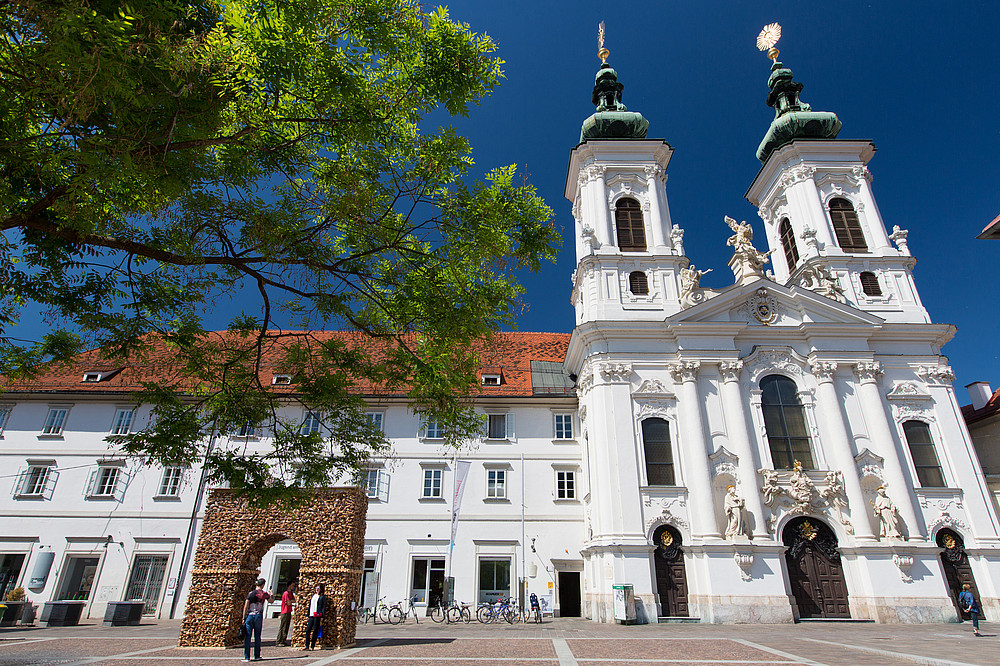
Die Mariahilferkirche in Graz. Teile der Fassadenskulpturen sind werke des Bildhauers Philipp Jakob Straub . Foto: Graz Tourismus/Harry Schiffer

Die Mariahilferkirche in Graz. Teile der Fassadenskulpturen sind Werke des Bildhauers Philipp Jakob Straub . Foto: Graz Tourismus/Harry Schiffer

Künstlernetzwerk im 18. Jahrhundert: Uni Graz zeichnet Wege und Werke der Bildhauerdynastie Straub nach

Fünf Brüder der Familie Straub, die allesamt in der väterlichen Tischlereiwerkstätte im süddeutschen Wiesensteig ihre Grundausbildung bekommen und sich dann im 18. Jahrhundert als barocke Bildhauer in Zentraleuropa einen Namen gemacht haben: Johann Baptist, Philipp Jakob, Joseph, Franz Anton und Johann Georg verließen ihre Heimat und ließen sich an verschiedenen Orten im heutigen Deutschland, Österreich, Slowenien und Kroatien nieder. Bekannt sind sie hauptsächlich für ihre sakralen Werke, darunter Skulpturen und Reliefs. Philipp Jakob Straub schuf etwa die Fassadenfiguren an der Mariahilfer Kirche in Graz, auch der Altar des Heiligen Kreuzes in der Kathedrale von Varaždin in Kroatien ist ein Zeugnis seiner Bildhauer-Kunst.

„Die Straub-Dynastie ist ein Paradebeispiel für ein funktionierendes Künstlernetzwerk im Barock. Die Brüder haben es geschafft, obwohl sie quer durch Europa verstreut waren, einen engen Kontakt zu halten“, erklären die Kunsthistorikerinnen Eva Klein und Christina Pichler. Sichtbar werde dies an ihren Werken. „Natürlich spiegeln sich in den Arbeiten der Bildhauer die regionalen Einflüsse wieder. Interessant zu beobachten ist, dass sie ihr Wissen ausgetauscht haben und somit über die Landesgrenzen hinweg einen für diese Zeit noch nie dagewesenen Kulturtransfer starteten“, betont Pichler. In einem europaweiten und von der EU mitgetragenen Projekt mit einem Gesamtbudget von rund 430.000 Euro wurde dieser Kulturaustausch gemeinsam mit PartnerInnen aus Deutschland, Kroatien und Slowenien erstmalig dokumentiert. So konnten die Schaffensphasen und die Wege der einzelnen Familienmitglieder genauestens nachgezeichnet werden. „Diese Rekonstruktion der Kommunikation erlaubt uns nun, einen Teil der Kunstgeschichte neu zu schreiben“, sagt Projektleiterin Klein.

Die Ergebnisse dieses steirischen Kulturerbes sind – neben allen anderen bislang bekannten Straub-Werken – in einem Bildband festgehalten und stehen in einer Datenbank http://www.trars.eu/ zur Verfügung.
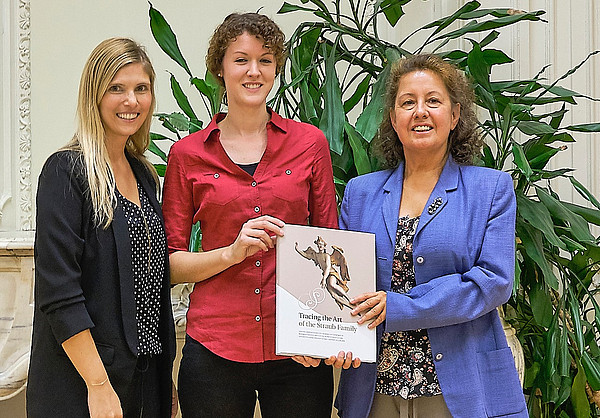
Projektleiterin Eva Klein (links) präsentierte gemeinsam mit Christina Pichler und Margit Stadlober (rechts) den Bildband über die Straub-Familie. Foto: Uni Graz
created by Konstantin Tzivanopoulos

Related news

Higher Education Strategy 2040: Austria’s universities on course for the future

Austria has 77 higher education institutions, which is above the EU average – but does this really make sense? The new Higher Education Strategy 2040 focuses on cooperation rather than mergers. As one of the six largest universities in Austria, the University of Graz plays a central role in this.

Climate research in Greenland: Old data provides new insights

The polar explorer and University of Graz professor Alfred Wegener left behind a unique collection of climate data from Greenland. A research team from the University of Graz is now analysing this 100-year-old treasure trove of data and comparing it with current measurements.

Diversity in nature and science: How we talk about plants and each other

Ginkgo, kiwi, hemp: they exist as male and female plants. Anyone who paid attention in biology class will confirm this. But is this categorisation, established by Carl von Linné almost 300 years ago, still valid today? An interdisciplinary team at the University of Graz is questioning these attributions and using this as a starting point to provide food for thought for gender-sensitive interaction between students, scientific and teaching staff.

Around the world in eight stops: the Long Night of Research at the University of Graz

On 24 April from 5 pm, you can take a short trip around the globe at the University of Graz, discovering pecularities of foreign countries or new local features in the entrance hall of the University Library. The itinerary takes you through introduced animal species, political attitudes and the omnipotence of algorithms. There will also be a programme in the historic reading hall, as well as at the UniGraz@Museum and the University Archive.

Begin of page section:
Additional information:

University of Graz
Universitaetsplatz 3
8010 Graz
Austria
  • Contact
  • Web Editors
  • Moodle
  • UNIGRAZonline
  • Imprint
  • Data Protection Declaration
  • Accessibility Declaration
Weatherstation
Uni Graz

End of this page section. Go to overview of page sections

End of this page section. Go to overview of page sections

Begin of page section:

End of this page section. Go to overview of page sections