



Begin of page section:
Page sections:

  • Go to contents (Accesskey 1)
  • Go to position marker (Accesskey 2)
  • Go to main navigation (Accesskey 3)
  • Go to sub navigation (Accesskey 4)
  • Go to additional information (Accesskey 5)
  • Go to page settings (user/language) (Accesskey 8)
  • Go to search (Accesskey 9)

End of this page section. Go to overview of page sections

Begin of page section:
Page settings:

English en
Deutsch de
Search
Login

End of this page section. Go to overview of page sections

Begin of page section:
Search:

Search for details about Uni Graz
Close

End of this page section. Go to overview of page sections


Search

Begin of page section:
Main navigation:

Page navigation:

  • University

    University
    • About the University
    • Organisation
    • Faculties
    • Library
    • Working at University of Graz
    • Campus
    Developing solutions for the world of tomorrow - that is our mission. Our students and our researchers take on the great challenges of society and carry the knowledge out.
  • Research Profile

    Research Profile
    • Our Expertise
    • Research Questions
    • Research Portal
    • Promoting Research
    • Research Transfer
    • Ethics in Research
    • Commission for Scientific Integrity
    Scientific excellence and the courage to break new ground. Research at the University of Graz creates the foundations for making the future worth living.
  • Studies

    Studies
    • Prospective Students
    • Students
  • Community

    Community
    • International
    • Location
    • Research and Business
    • Alumni
    The University of Graz is a hub for international research and brings together scientists and business experts. Moreover, it fosters the exchange and cooperation in study and teaching.
  • Spotlight
Topics
  • Sustainable University
  • Researchers answer
  • Work for us
Close menu

End of this page section. Go to overview of page sections

Begin of page section:
You are here:

University of Graz News Climate Change Graz

End of this page section. Go to overview of page sections

Friday, 06 September 2019

Climate Change Graz

In "Climate Change Graz" over a hundred researchers are working on the question how a sustainable transformation to a nearly emission-free and climate-robust society and economy can be made possible.

In "Climate Change Graz" over a hundred researchers are working on the question how a sustainable transformation to a nearly emission-free and climate-robust society and economy can be made possible.

Interdisciplinary climate research is one of the University of Graz’s Fields of Excellence

Anthropogenic climate change is widely regarded as one of the greatest challenges of the 21st century. In order to limit rising temperatures to an increase of 1.5 to 2 degrees, in line with the targets set by the Paris Agreement, CO2 emissions must be reduced by at least 50 percent by the year 2030, and around 90 percent by 2050. Making the transition to an almost emission-free and climate-stable economy and society requires a radical change of direction. In “Climate Change Graz”, one of the university’s Fields of Excellence, over a hundred researchers are exploring what economic, production-related, social, political and legislative changes are needed to make a sustainable transformation possible.

University of Graz – hotspot for climate research
Effective and ethically acceptable strategies to reduce emissions can only be developed through interdisciplinary collaboration. “Climate Change Graz” builds on many years of interdisciplinary research experience and expertise in the following areas:

  • Climate ethics and environmental law
  • Innovation and sustainability research
  • Economics of climate and environment
  • Environmental biology and chemistry
  • Meteorology and geosciences
  • Physical climate research.

Another key element is the doctoral programme “Climate change”, within which research is being conducted by over twenty researchers from eleven different countries. The focal point of the collaboration is the Wegener Center for Climate and Global Change, which is part of a close-knit international network.

One of the most significant findings so far
The higher the increase in temperature, the greater the financial cost of climate change. Over the next few decades, costs arising from weather and climate-related events in Austria could increase to four or five billion euros every year. This is just one of the many reasons why climate protection is a vital precaution for our future.

What could be achieved by 2050
E-mobility, communities that use photovoltaic power generation, and industrial enterprises that have successfully completed the transition from fossil-fuel energy – interdisciplinary climate research of “Climate Change Graz” shows how it would be possible to meet the Paris climate targets by 2050.
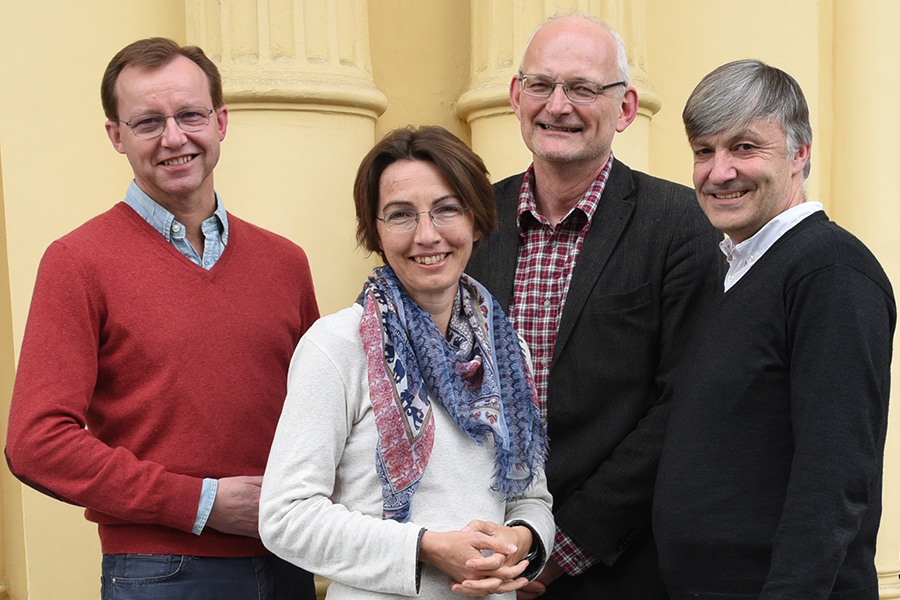
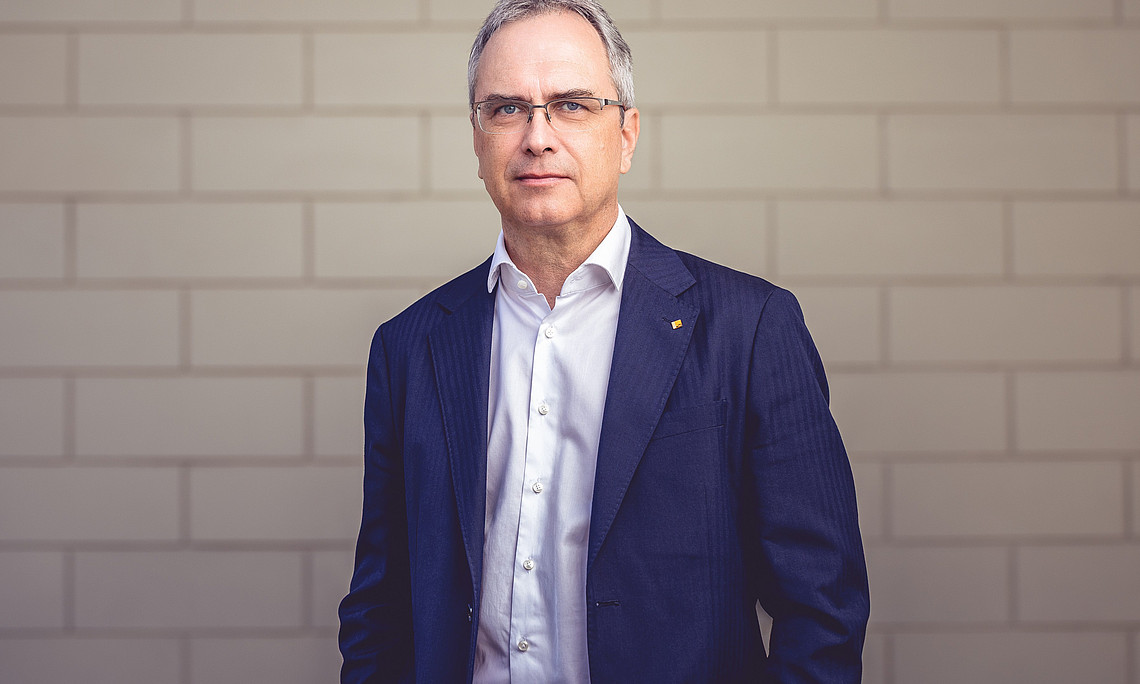
Climate physicist Gottfried Kirchengast and philosopher Lukas Meyer are the spokespersons for “Climate Change Graz”. Their deputies are biologist Kristina Sefc and economist Karl Steininger. Photo: Uni Graz/Pichler ©Uni Graz/Pichler
©Uni Graz/Pichler
Climate physicist Gottfried Kirchengast and philosopher Lukas Meyer are the spokespersons for “Climate Change Graz”. Their deputies are biologist Kristina Sefc and economist Karl Steininger. Photo: Uni Graz/Pichler
created by Gudrun Pichler

Related news

Higher Education Strategy 2040: Austria’s universities on course for the future

Austria has 77 higher education institutions, which is above the EU average – but does this really make sense? The new Higher Education Strategy 2040 focuses on cooperation rather than mergers. As one of the six largest universities in Austria, the University of Graz plays a central role in this.

Climate research in Greenland: Old data provides new insights

The polar explorer and University of Graz professor Alfred Wegener left behind a unique collection of climate data from Greenland. A research team from the University of Graz is now analysing this 100-year-old treasure trove of data and comparing it with current measurements.

Diversity in nature and science: How we talk about plants and each other

Ginkgo, kiwi, hemp: they exist as male and female plants. Anyone who paid attention in biology class will confirm this. But is this categorisation, established by Carl von Linné almost 300 years ago, still valid today? An interdisciplinary team at the University of Graz is questioning these attributions and using this as a starting point to provide food for thought for gender-sensitive interaction between students, scientific and teaching staff.

Around the world in eight stops: the Long Night of Research at the University of Graz

On 24 April from 5 pm, you can take a short trip around the globe at the University of Graz, discovering pecularities of foreign countries or new local features in the entrance hall of the University Library. The itinerary takes you through introduced animal species, political attitudes and the omnipotence of algorithms. There will also be a programme in the historic reading hall, as well as at the UniGraz@Museum and the University Archive.

Begin of page section:
Additional information:

University of Graz
Universitaetsplatz 3
8010 Graz
Austria
  • Contact
  • Web Editors
  • Moodle
  • UNIGRAZonline
  • Imprint
  • Data Protection Declaration
  • Accessibility Declaration
Weatherstation
Uni Graz

End of this page section. Go to overview of page sections

End of this page section. Go to overview of page sections

Begin of page section:

End of this page section. Go to overview of page sections


