Begin of page section:
Page sections:

  • Go to contents (Accesskey 1)
  • Go to position marker (Accesskey 2)
  • Go to main navigation (Accesskey 3)
  • Go to sub navigation (Accesskey 4)
  • Go to additional information (Accesskey 5)
  • Go to page settings (user/language) (Accesskey 8)
  • Go to search (Accesskey 9)

End of this page section. Go to overview of page sections

Begin of page section:
Page settings:

English en
Deutsch de
Search
Login

End of this page section. Go to overview of page sections

Begin of page section:
Search:

Search for details about Uni Graz
Close

End of this page section. Go to overview of page sections


Search

Begin of page section:
Main navigation:

Page navigation:

  • University

    University
    • About the University
    • Organisation
    • Faculties
    • Library
    • Working at University of Graz
    • Campus
    Developing solutions for the world of tomorrow - that is our mission. Our students and our researchers take on the great challenges of society and carry the knowledge out.
  • Research Profile

    Research Profile
    • Our Expertise
    • Research Questions
    • Research Portal
    • Promoting Research
    • Research Transfer
    • Ethics in Research
    • Commission for Scientific Integrity
    Scientific excellence and the courage to break new ground. Research at the University of Graz creates the foundations for making the future worth living.
  • Studies

    Studies
    • Prospective Students
    • Students
    • Registration for Study Programme (Winter semester 2026/27)
  • Community

    Community
    • International
    • Location
    • Research and Business
    • Alumni
    The University of Graz is a hub for international research and brings together scientists and business experts. Moreover, it fosters the exchange and cooperation in study and teaching.
Topics
  • Sustainable University
  • Researchers answer
  • Work for us
Close menu

End of this page section. Go to overview of page sections

Begin of page section:
You are here:

University of Graz News The Nazi elite school Napola: Historian seeks memories and personal documents

End of this page section. Go to overview of page sections

Tuesday, 07 July 2026

The Nazi elite school Napola: Historian seeks memories and personal documents

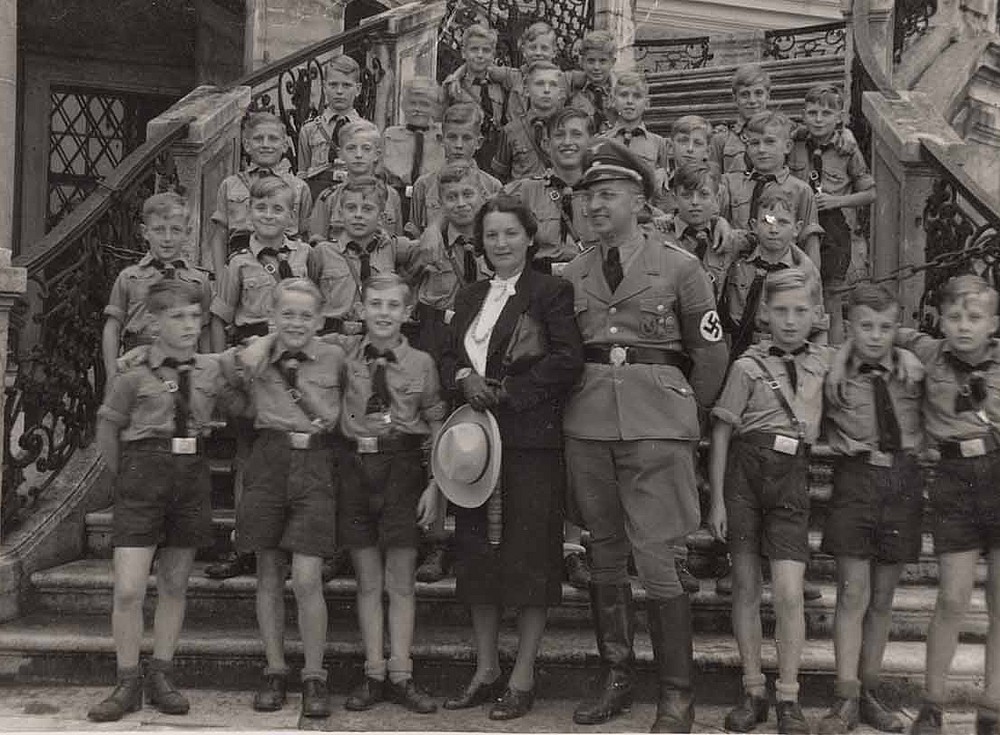
A group of boys in uniform, a woman, and a man in Nazi uniform are standing on a staircase in front of a building; they are all looking at the camera.

A class from the Napola Traiskirchen on a school field trip to Schönbrunn Palace, accompanied by teachers; photographed in 1943–44. Photographer: Martin Fachet Photo Studio, Vienna. Source: BIK/F.K. Collection.

They were to be brought up to become the future elite of National Socialism: boys and girls aged ten and over who, following the ‘Anschluss’ of Austria to the German Reich, attended a so-called Napola (short for Nationalpolitische Lehranstalt; also known as NPEA, Nationalpolitische Erziehungsanstalt). There were nine such institutions in what is now Austria between 1939 and 1945.

Nadjeschda Stoffers from the University of Graz, in collaboration with the Ludwig Boltzmann Institute for Research on the Consequences of War, is investigating how pupils experienced everyday life at the Napola in Traiskirchen. To this end, the historian is looking for people who attended this or any other Napola in the territory of the former ‘Ostmark’, or whose families possess relevant documents. 

Wanted: Memories and records 

Among other things, Stoffers is focusing on the perspectives of former pupils: “How did they experience the entrance exam and daily life at the boarding school? What role did concepts such as camaraderie play for the children and young people? What form did Nazi education and indoctrination take in these total institutions?”, says the historian.  Therefore, she is looking for people who would like to share their memories of their school days. In addition, personal collections such as letters, diaries, photographs, school essays or artefacts are particularly valuable for research into this Nazi elite school.

Strict daily life in Nazi training centres

Napolas were regarded as “selection schools” and were established in the German Reich as early as April 1933. Only those children who met the regime’s racist criteria and passed an entrance examination lasting several days were admitted. Daily school life was strictly regulated: roll call, sport, lessons, pre-military drills, study periods and work assignments determined the daily routine. 

The course of study was designed to last eight years – in the ‘Ostmark’, however, this type of school lasted only six years, from 1939 until the end of the war in 1945. In the German Reich and the occupied territories, there were more than 40 locations; in the ‘Ostmark’ these were in Vienna (Theresianum and Breitensee), Lower Austria (Göttweig and Traiskirchen), Styria (Seckau and Vorau), Carinthia (St Paul in the Lavant Valley/‘Spanheim’) and Upper Austria (Lambach), as well as in St Veit an der Save and Mokritz (Šentvid and Mokrice) in what is now Slovenia. The first Napola for girls in the entire empire opened in Vienna on Boerhaavegasse, but was soon relocated to Lower Austria (Hubertendorf and Türnitz).

Anyone who attended a Napola, or whose family still has letters, diaries, photographs, school exercise books or other mementoes from this period and would like to share them, is asked to contact Nadjeschda Stoffers. Any information can help us to better understand everyday life at these Nazi elite schools.

>> Privacy Policy (German only)

Contact:
Nadjeschda Stoffers, MA
Institute of History at the University of Graz and Ludwig Boltzmann Institute for Research on the Consequences of War 
Liebiggasse 9, 8010 Graz
Telephone: +43 664 533 85 03
Email: nadjeschda.stoffers(at)uni-graz.at

>> Anyone interested in the connection between the past, present, and future can study history at the University of Graz.
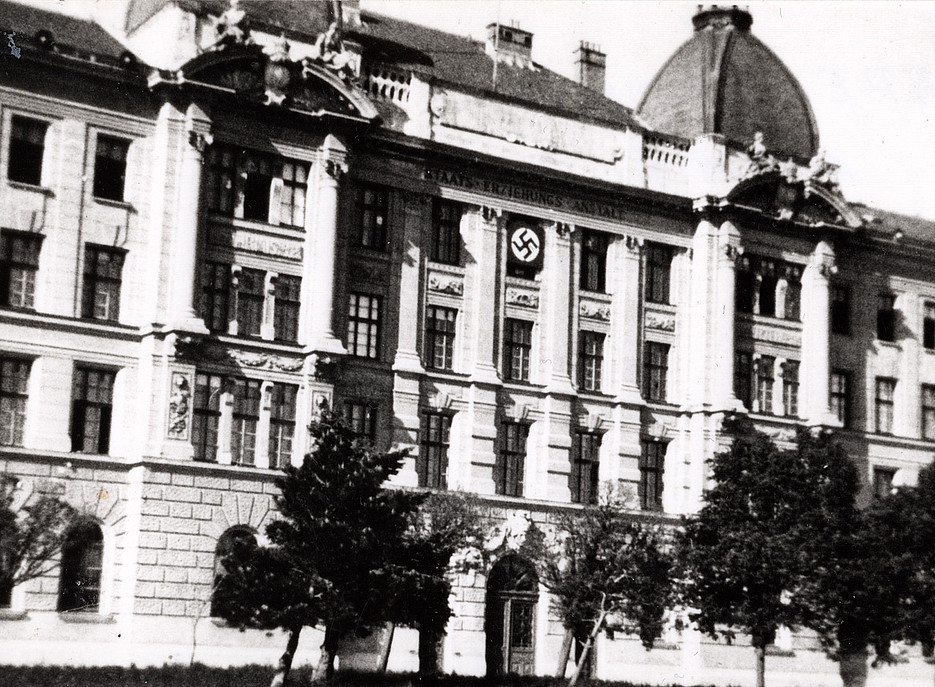

A historic, multi-story building with a domed roof; a swastika symbol in the centre of the facade, with trees in front of it.
Napola Traiskirchen, between 1942 and 1944. Photographer: unknown. Source: BIK/F.K. Collection.
leeres Bild
created by Gerhild Leljak

Related news

Heat-resistant: Eva Preinfalk explains how cities can protect their residents

Certain demographic and some occupational groups are particularly vulnerable to high temperatures. A range of measures is needed to provide relief for everyone, explains climate economist Eva Preinfalk.

Baby health: University of Graz is seeking study participants to investigate early risk factors

Why does the body composition of babies vary so much? Some children gain a significant amount of fat mass within a few weeks, whilst others show hardly any change over the same period. “At the same time, initial observations suggest that fat distribution in all babies may follow a similar pattern, regardless of their total body fat,” explains Marco Höfler from the Institute of Movement Sciences, Sport and Health at the University of Graz. He is coordinating the research project ‘Small Bodies – Big Questions’, for which participants are currently still being sought: pregnant women and babies up to four weeks old.

In hot water: New Report reveals record losses in glaciers, permafrost and snow cover

Climate change is driving up temperatures not only in summer. Winters are also getting warmer – with dramatic consequences for glaciers, permafrost, snow cover and the freezing of lakes. The recently published cryosphere report provides specific figures for Austria. “Our monitoring shows a clear trend with record losses of ice and snow,” says project leader Wolfgang Schöner from the University of Graz.

Theologian at the University of Graz: What the excommunication of the Society of St Pius X

Following the schism involving the Society of St Pius X, there is a need for discussion. Bernd Hillebrand from the University of Graz explains why the Vatican took this step, what role anti-democratic tendencies play, and why the Society’s sacraments are no longer recognised as valid under canon law for Catholics with immediate effect.

Begin of page section:
Additional information:

University of Graz
Universitaetsplatz 3
8010 Graz
Austria
  • Contact
  • Web Editors
  • Moodle
  • UNIGRAZonline
  • Imprint
  • Data Protection Declaration
  • Accessibility Declaration
Weatherstation
Uni Graz

End of this page section. Go to overview of page sections

End of this page section. Go to overview of page sections

Begin of page section:

End of this page section. Go to overview of page sections