Begin of page section:
Page sections:

  • Go to contents (Accesskey 1)
  • Go to position marker (Accesskey 2)
  • Go to main navigation (Accesskey 3)
  • Go to sub navigation (Accesskey 4)
  • Go to additional information (Accesskey 5)
  • Go to page settings (user/language) (Accesskey 8)
  • Go to search (Accesskey 9)

End of this page section. Go to overview of page sections

Begin of page section:
Page settings:

English en
Deutsch de
Search
Login

End of this page section. Go to overview of page sections

Begin of page section:
Search:

Search for details about Uni Graz
Close

End of this page section. Go to overview of page sections


Search

Begin of page section:
Main navigation:

Page navigation:

  • University

    University
    • About the University
    • Organisation
    • Faculties
    • Library
    • Working at University of Graz
    • Campus
    Developing solutions for the world of tomorrow - that is our mission. Our students and our researchers take on the great challenges of society and carry the knowledge out.
  • Research Profile

    Research Profile
    • Our Expertise
    • Research Questions
    • Research Portal
    • Promoting Research
    • Research Transfer
    • Ethics in Research
    • Commission for Scientific Integrity
    Scientific excellence and the courage to break new ground. Research at the University of Graz creates the foundations for making the future worth living.
  • Studies

    Studies
    • Prospective Students
    • Students
    • Registration for Study Programme (Winter semester 2026/27)
  • Community

    Community
    • International
    • Location
    • Research and Business
    • Alumni
    The University of Graz is a hub for international research and brings together scientists and business experts. Moreover, it fosters the exchange and cooperation in study and teaching.
Topics
  • Sustainable University
  • Researchers answer
  • Work for us
Close menu

End of this page section. Go to overview of page sections

Begin of page section:
You are here:

University of Graz News In hot water: New Report reveals record losses in glaciers, permafrost and snow cover

End of this page section. Go to overview of page sections

Friday, 03 July 2026

In hot water: New Report reveals record losses in glaciers, permafrost and snow cover

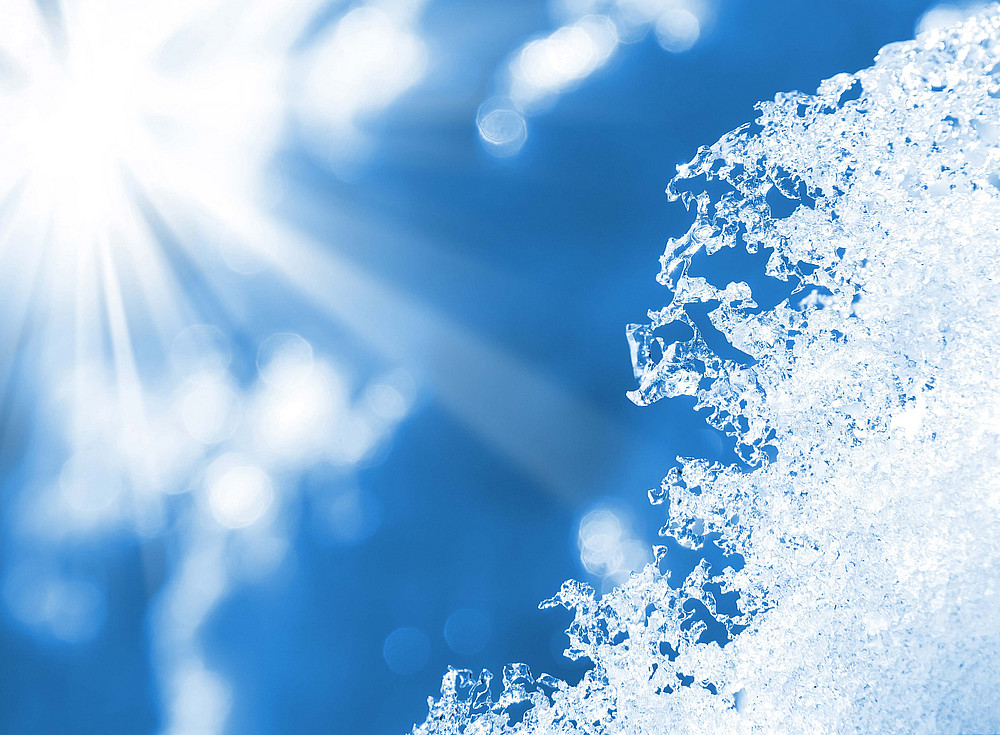
The sun is shining from a blue sky onto melting snow ©Leonid Ikan - stock.adobe.com
©Leonid Ikan - stock.adobe.com

The latest report on the cryosphere in Austria shows that snow and ice are retreating rapidly.

Climate change is driving up temperatures not only in summer. Winters are also getting warmer – with dramatic consequences for glaciers, permafrost, snow cover and the freezing of lakes. The recently published cryosphere report provides specific figures for Austria. “Our monitoring shows a clear trend with record losses of ice and snow,” says project leader Wolfgang Schöner from the University of Graz.


The term ‘cryosphere’ refers to those areas of the Earth’s surface where water occurs as snow or ice. The new report from ‘Cryosphere Monitoring Austria’ summarises the measurement results for the 2022/23 and 2023/24 years. “In 2024, the average temperature in Austria was +8.8 °C, which is +3 °C above the long-term average. This makes 2024 by far the warmest year in Austrian recorded history (as of 2024). At Sonnblick, 66 consecutive frost-free days were recorded – more than twice the previous record,” says Wolfgang Schöner. The impact on the cryosphere was correspondingly severe: the 13 glaciers monitored lost an average of around two metres in thickness per year. 2024 ranks among the top three years with the greatest losses since records began. On the Kitzsteinhorn, the permafrost thawed locally to a depth of 4.4 metres in 2024, which represents the highest value measured to date. At Lake Lunz, the duration of ice cover in the winter of 2023/24 was reduced to just two days. This represents a 97 per cent decrease compared with the long-term average. In Langen am Arlberg, the duration of the winter snow cover in 2023/24 fell by four per cent, and in Lackenhof am Ötscher by 66 per cent. “Although fresh snow continues to fall, it is quickly melted away by the rising temperatures, meaning it now only remains on the ground for longer at higher altitudes,” explains the scientist.

The research and cooperation project “KryoMon.AT – Cryosphere Monitoring Austria”, launched in 2022 and coordinated by the University of Graz, brings together numerous research groups and institutions from Austria as well as one from Germany. The latest report compiles data on snow, glaciers, permafrost and lake ice across Austria, evaluated according to uniform standards and presented in an accessible format.

The new Cryosphere Monitoring Austria website also offers free access to the results. With background information, key messages and clear visualisations, it highlights the changes in Austria’s cryosphere for experts, the media and the interested public. Ongoing updates and further reports are planned.

The project “KryoMon.AT” involves, alongside the University of Graz, the Universities of Innsbruck, Salzburg and Krems, Graz University of Technology, the Austrian Academy of Sciences, the Bavarian Academy of Sciences and Humanities, GeoSphere Austria, Blue Sky Wetteranalysen, GEORESEARCH, the Biological Station Lake Neusiedl Illmitz, Österreichischer Alpenverein, Verein Gletscher und Klima, WasserCluster Lunz and Austrian Hydrography. It is funded by the Federal Ministry of Agriculture and Forestry, Climate and Environmental Protection, Regions and Water Management.

created by Gudrun Pichler

Related news

Theologian at the University of Graz: What the excommunication of the Society of St Pius X

Following the schism involving the Society of St Pius X, there is a need for discussion. Bernd Hillebrand from the University of Graz explains why the Vatican took this step, what role anti-democratic tendencies play, and why the Society’s sacraments are no longer recognised as valid under canon law for Catholics with immediate effect.

“HeinrichBiCool”: University of Graz demonstrates the effects of green facades and roofs

The University of Graz has launched a pioneering project at the University Centre for Theology. Its name, “HeinrichBiCool”, says it all: a comprehensive system of green facades and roof will cool the building at Heinrichstraße 80 during the summer. At the same time, this will create a new habitat for plants and animals, helping to increase biodiversity. The accompanying monitoring programme will provide detailed data on the impact of the measures on indoor climate, energy consumption and biodiversity. The findings will lay a scientifically sound foundation for further projects aimed at making cities sustainable, climate-resilient and liveable. The partners in this project, funded by the Austrian Research Promotion Agency (FFG), are AEE INTEC – Institute for Sustainable Technologies, Technisches Büro Siegfried Stark, the landscape architecture and urban planning firm “studio boden”, and Ökoteam Graz.

When stress melts away in your mouth: nicotine pouches are widespread among Styrian students

Sociologists at the University of Graz, in collaboration with VIVID – the Centre for Addiction Prevention, have carried out a survey involving more than 600 participants. Around a quarter of them use these products. The ability to use them discreetly and flexibly is a key motivation.

Desert sand, microplastics, cancer cells: David Clases awarded ERC grant for analytical method

Nanoparticles trapped in polar ice can reveal a great deal about the climate 100,000 years ago. Chemist David Clases is developing unique methods to analyse them in detail. He will now adapt these methods for use with larger particles in order to glean even more information about Earth’s history. The method can be used for a wide range of other purposes – for example, in medical diagnostics or the investigation of environmental pollution. Clases has been awarded a Proof-of-Concept Grant by the European Research Council (ERC) for this work.

Begin of page section:
Additional information:

University of Graz
Universitaetsplatz 3
8010 Graz
Austria
  • Contact
  • Web Editors
  • Moodle
  • UNIGRAZonline
  • Imprint
  • Data Protection Declaration
  • Accessibility Declaration
Weatherstation
Uni Graz

End of this page section. Go to overview of page sections

End of this page section. Go to overview of page sections

Begin of page section:

End of this page section. Go to overview of page sections