Begin of page section:
Page sections:

  • Go to contents (Accesskey 1)
  • Go to position marker (Accesskey 2)
  • Go to main navigation (Accesskey 3)
  • Go to sub navigation (Accesskey 4)
  • Go to additional information (Accesskey 5)
  • Go to page settings (user/language) (Accesskey 8)
  • Go to search (Accesskey 9)

End of this page section. Go to overview of page sections

Begin of page section:
Page settings:

English en
Deutsch de
Search
Login

End of this page section. Go to overview of page sections

Begin of page section:
Search:

Search for details about Uni Graz
Close

End of this page section. Go to overview of page sections


Search

Begin of page section:
Main navigation:

Page navigation:

  • University

    University
    • About the University
    • Organisation
    • Faculties
    • Library
    • Working at University of Graz
    • Campus
    Developing solutions for the world of tomorrow - that is our mission. Our students and our researchers take on the great challenges of society and carry the knowledge out.
  • Research Profile

    Research Profile
    • Our Expertise
    • Research Questions
    • Research Portal
    • Promoting Research
    • Research Transfer
    • Ethics in Research
    • Commission for Scientific Integrity
    Scientific excellence and the courage to break new ground. Research at the University of Graz creates the foundations for making the future worth living.
  • Studies

    Studies
    • Prospective Students
    • Students
  • Community

    Community
    • International
    • Location
    • Research and Business
    • Alumni
    The University of Graz is a hub for international research and brings together scientists and business experts. Moreover, it fosters the exchange and cooperation in study and teaching.
  • Spotlight
Topics
  • Sustainable University
  • Researchers answer
  • Work for us
Close menu

End of this page section. Go to overview of page sections

Begin of page section:
You are here:

University of Graz News Management im Tierreich

End of this page section. Go to overview of page sections

Thursday, 13 December 2018

Management im Tierreich

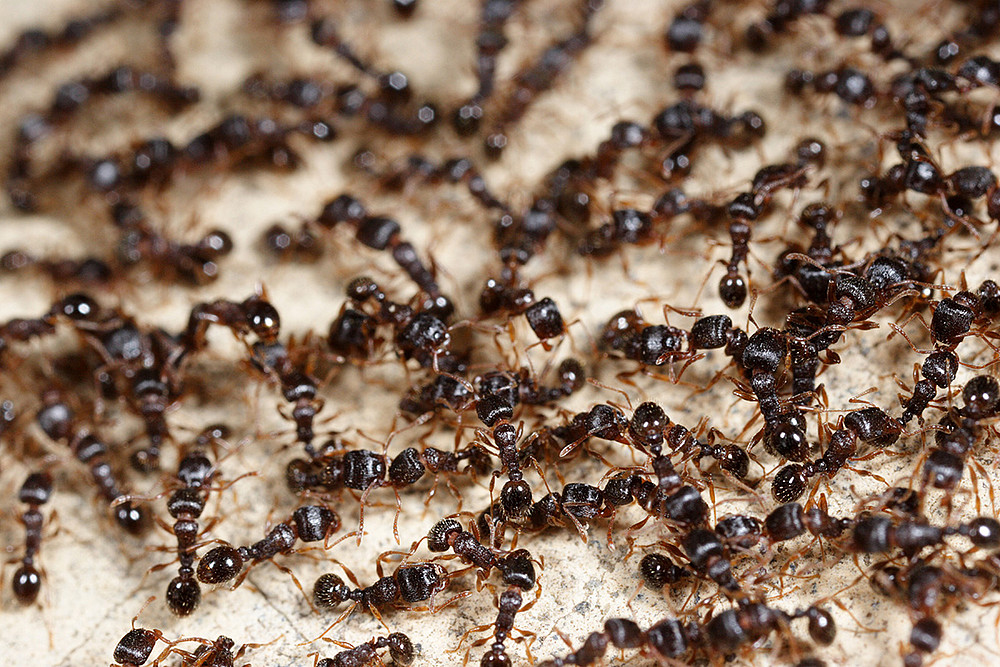
Wie Ameisen, Bienen und Wespen ihr Zusammenleben managen, hat Thomas Schmickl erforscht. Foto: Shutterstock/Hurst Photo

Wie Ameisen, Bienen und Wespen ihr Zusammenleben managen, hat Thomas Schmickl erforscht. Foto: Shutterstock/Hurst Photo

BiologInnen der Universität Graz haben den „sozialen Magen“ als Kommunikationsdrehscheibe identifiziert

Wie funktioniert die perfekte Zusammenarbeit im Bienenschwarm? Wie wissen Ameisen, welche Arbeiten gerade dringend nötig sind? Wer beauftragt Wespen mit der Suche nach dem richtigen Baumaterial? Biologe Thomas Schmickl vom Artificial Life Lab der Universität Graz hat mit seinem Kollegen Istvan Karsai (USA) herausgefunden, wie soziale Insekten ihre Arbeitsteilung regeln.

„All diese Tiere verwenden denselben Trick in verschiedenen Ausprägungen: Sie verfügen über einen so genannten ‚Sozialmagen‘, einen Ort im Nest, an dem Informationen rasch ausgetauscht werden“, schildert Schmickl. Die Ausbeute der Sammlerinnen wird dort abgegeben, alles zum Arbeiten Benötigte entnommen. Der globale „Lagerbestand“ lässt sich daran erkennen, wie einfach eine Arbeiterin Gesammeltes dort loswird oder Material von dort erhält. „Der gemeinsame Magen ist für Ameisen, Bienen und Wespen eine wichtige Drehscheibe, wie wir mit unseren Computermodellen herausgefunden haben. Diese Entdeckung ist ein Beispiel für sogenannte ‚konvergente Evolution‘ im Tierreich: Die Natur hat hier offenbar mehrmals das Rad neu erfunden“, führt der Forscher aus.

Die Kommunikationszentrale funktioniert sehr präzise, ist stets an die aktuellen Bedürfnisse angepasst und benötigt keine große Infrastruktur. „Diese Eigenschaften lassen sich auch in der Technik umsetzen, was beispielsweise ideal für die Schwarmrobotik ist“, ergänzt der Forscher. Im Artificial Life baut Schmickl nach dem Vorbild von Tierschwärmen Roboter, die unter anderem die Wasserqualität in der Lagune von Venedig ermitteln.

Die Erkenntnisse, die in der aktuellen Ausgabe des international renommierten Fachmagazins PNAS publiziert wurden, können auch für weitere technische Anwendungen von Interesse sein, etwa für die Regelung bzw. Verteilung von Verkehrsströmen.

Publikation:
Thomas Schmickl, Istvan Karsai, „Integral feedback control is at the core of task allocation and resilience of insect societies“, PNAS online, Dezember 2018


Mehr zur Forschungsarbeit von Thomas Schmickl

ORF-Beitrag

created by Dagmar Eklaude

Related news

Higher Education Strategy 2040: Austria’s universities on course for the future

Austria has 77 higher education institutions, which is above the EU average – but does this really make sense? The new Higher Education Strategy 2040 focuses on cooperation rather than mergers. As one of the six largest universities in Austria, the University of Graz plays a central role in this.

Climate research in Greenland: Old data provides new insights

The polar explorer and University of Graz professor Alfred Wegener left behind a unique collection of climate data from Greenland. A research team from the University of Graz is now analysing this 100-year-old treasure trove of data and comparing it with current measurements.

Diversity in nature and science: How we talk about plants and each other

Ginkgo, kiwi, hemp: they exist as male and female plants. Anyone who paid attention in biology class will confirm this. But is this categorisation, established by Carl von Linné almost 300 years ago, still valid today? An interdisciplinary team at the University of Graz is questioning these attributions and using this as a starting point to provide food for thought for gender-sensitive interaction between students, scientific and teaching staff.

Around the world in eight stops: the Long Night of Research at the University of Graz

On 24 April from 5 pm, you can take a short trip around the globe at the University of Graz, discovering pecularities of foreign countries or new local features in the entrance hall of the University Library. The itinerary takes you through introduced animal species, political attitudes and the omnipotence of algorithms. There will also be a programme in the historic reading hall, as well as at the UniGraz@Museum and the University Archive.

Begin of page section:
Additional information:

University of Graz
Universitaetsplatz 3
8010 Graz
Austria
  • Contact
  • Web Editors
  • Moodle
  • UNIGRAZonline
  • Imprint
  • Data Protection Declaration
  • Accessibility Declaration
Weatherstation
Uni Graz

End of this page section. Go to overview of page sections

End of this page section. Go to overview of page sections

Begin of page section:

End of this page section. Go to overview of page sections