Begin of page section:
Page sections:

  • Go to contents (Accesskey 1)
  • Go to position marker (Accesskey 2)
  • Go to main navigation (Accesskey 3)
  • Go to sub navigation (Accesskey 4)
  • Go to additional information (Accesskey 5)
  • Go to page settings (user/language) (Accesskey 8)
  • Go to search (Accesskey 9)

End of this page section. Go to overview of page sections

Begin of page section:
Page settings:

English en
Deutsch de
Search
Login

End of this page section. Go to overview of page sections

Begin of page section:
Search:

Search for details about Uni Graz
Close

End of this page section. Go to overview of page sections


Search

Begin of page section:
Main navigation:

Page navigation:

  • University

    University
    • About the University
    • Organisation
    • Faculties
    • Library
    • Working at University of Graz
    • Campus
    Developing solutions for the world of tomorrow - that is our mission. Our students and our researchers take on the great challenges of society and carry the knowledge out.
  • Research Profile

    Research Profile
    • Our Expertise
    • Research Questions
    • Research Portal
    • Promoting Research
    • Research Transfer
    • Ethics in Research
    • Commission for Scientific Integrity
    Scientific excellence and the courage to break new ground. Research at the University of Graz creates the foundations for making the future worth living.
  • Studies

    Studies
    • Prospective Students
    • Students
  • Community

    Community
    • International
    • Location
    • Research and Business
    • Alumni
    The University of Graz is a hub for international research and brings together scientists and business experts. Moreover, it fosters the exchange and cooperation in study and teaching.
  • Spotlight
Topics
  • Sustainable University
  • Researchers answer
  • Work for us
Close menu

End of this page section. Go to overview of page sections

Begin of page section:
You are here:

University of Graz News Wie wirkt's?

End of this page section. Go to overview of page sections

Monday, 19 December 2022

Wie wirkt's?

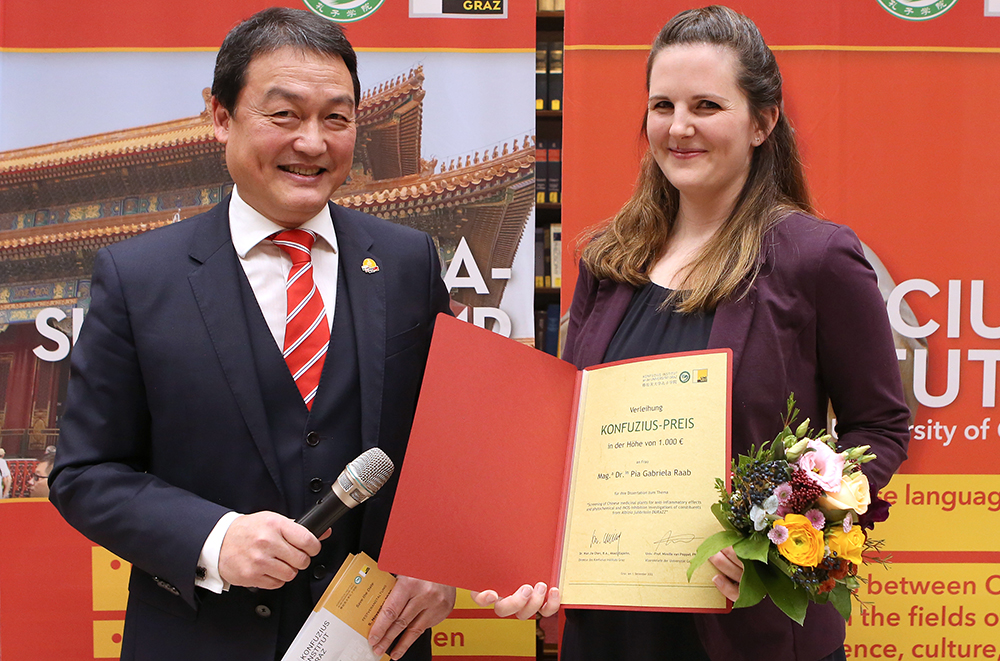
Wan Jie Chen überreichte Pia Raab den Konfuzius-Preis. Foto: Konfuzius-Institut

Wan Jie Chen überreichte Pia Raab den Konfuzius-Preis. Foto: Konfuzius-Institut

Forscherin zu chinesischer Arzneipflanze mit Konfuzius-Preis ausgezeichnet

Sie sind ein echter Hingucker: die pinken Blüten der Seidenakazie. Der Baum erfreut sich in heimischen Parks und Gärten immer größerer Beliebtheit. In seiner ursprünglichen Heimat China wird er als Arzneipflanze genutzt. Wirken diese Inhaltsstoffe auch gegen Entzündungen? Das hat Pia Raab in ihrer Doktorarbeit an der Universität Graz genauer unter die Lupe genommen. Dafür hat die pharmazeutische Wissenschaftlerin kürzlich den Konfuzius-Preis erhalten.

Die Traditionelle Chinesische Medizin verwendet sowohl die Blüten als auch die Rinde des asiatischen Gewächses. „Vorwiegend gegen Schlafstörungen und Müdigkeit“, weiß die Forscherin. „Das Extrakt aus der Rinde wird zur Linderung von Schwellungen und Prellungen äußerlich genutzt.“ Daher hat sie sich mit der entzündungshemmenden Wirkung von Albizia julibrissin, so der botanische Name des Laubbaumes, beschäftigt. „Denn wir sind auf der Suche nach pflanzlichen Alternativen für Schmerzmittel, die weniger Nebenwirkungen haben als herkömmliche.

Raab hat sich dazu zum ersten Mal angesehen, ob jene Flechten, die auf der Seidenakazie wachsen, die aus der Rinde gewonnene Substanz beeinflussen. Ein einzelner Wirkstoff konnte zwar bislang noch nicht gewonnen werden. Die Absolventin hat jedoch mit ihrer Dissertation die Grundlage für weitere Untersuchungen gelegt, die in der Forschungsgruppe von Rudolf Bauer am Institut für Pharmazeutische Wissenschaften fortgesetzt werden – in Kooperation mit chinesischen Wissenschaftler:innen. „Denn die großen Herausforderungen unserer Welt lassen sich nur in Zusammenarbeit lösen“, bekräftigt Raab, die selbst vor Ort in China geforscht hat.
Dieses verbindende Motiv ist ein wesentlicher Aspekt des Konfuzius-Preises – dotiert mit 1000 Euro –, mit dem Pia Raab vor wenigen Tagen geehrt wurde. Überreicht wurde die Auszeichnung von Wan Jie Chen, Leiter des Konfuzius-Instituts.
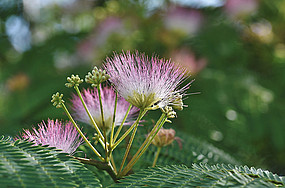
Die Blüte des chinesischen Seidenbaums. Foto: pixabay
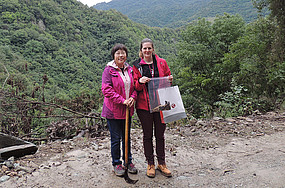
Pia Raab mit Hong Liang, Profesorin von der Peking University. Foto: Raab
created by Andreas Schweiger

Related news

Scientific freedom and neutrality: a question of attitude

How neutral must research be? At the Styrian University Conference at the University of Graz, keynote speaker David Beaver questioned the concept of objectivity. He advocated for bold science that stands by its values in order to remain resilient in times of crisis and actively shape social progress.

University of Graz: Discover the apprentice game and secure jobtraining

The University of Graz not only educates students – it also offers apprenticeships in eight future-oriented professions – even with a school-leaving certificate if desired! From metal technology in the physics workshop to IT systems engineering: discover apprenticeships now and immerse yourself in the world of university apprentices with an interactive game.

Green carpet, wooden staircase, reading room: the specialist history library is back

In just eight months, the university renovated, expanded and modernised the specialist library for history on Heinrichstraße. A total of 200,000 volumes are now available, corresponding to around 3,000 metres of shelving. Head Felicitas Schober explains what has changed and why smaller collections are now also housed there. A local inspection.

Listening to the Middle Ages: exhibition brings poverty then and now to life

What connects Giulio, a blacksmith who worked in Bologna almost 500 years ago, with a single mother from Styria who recently lost her job? Both are afraid that they will soon be unable to pay their rent. How does it feel to have existential worries? An exhibition at the University of Graz provides personal insights into experiences of poverty then and now. Listening stations give a voice to people from the Middle Ages. The exhibition opened on 5 March 2026 in the foyer of the University Library Graz.

Begin of page section:
Additional information:

University of Graz
Universitaetsplatz 3
8010 Graz
Austria
  • Contact
  • Web Editors
  • Moodle
  • UNIGRAZonline
  • Imprint
  • Data Protection Declaration
  • Accessibility Declaration
Weatherstation
Uni Graz

End of this page section. Go to overview of page sections

End of this page section. Go to overview of page sections

Begin of page section:

End of this page section. Go to overview of page sections