Begin of page section:
Page sections:

  • Go to contents (Accesskey 1)
  • Go to position marker (Accesskey 2)
  • Go to main navigation (Accesskey 3)
  • Go to sub navigation (Accesskey 4)
  • Go to additional information (Accesskey 5)
  • Go to page settings (user/language) (Accesskey 8)
  • Go to search (Accesskey 9)

End of this page section. Go to overview of page sections

Begin of page section:
Page settings:

English en
Deutsch de
Search
Login

End of this page section. Go to overview of page sections

Begin of page section:
Search:

Search for details about Uni Graz
Close

End of this page section. Go to overview of page sections


Search

Begin of page section:
Main navigation:

Page navigation:

  • University

    University
    • About the University
    • Organisation
    • Faculties
    • Library
    • Working at University of Graz
    • Campus
    Developing solutions for the world of tomorrow - that is our mission. Our students and our researchers take on the great challenges of society and carry the knowledge out.
  • Research Profile

    Research Profile
    • Our Expertise
    • Research Questions
    • Research Portal
    • Promoting Research
    • Research Transfer
    • Ethics in Research
    • Commission for Scientific Integrity
    Scientific excellence and the courage to break new ground. Research at the University of Graz creates the foundations for making the future worth living.
  • Studies

    Studies
    • Prospective Students
    • Students
  • Community

    Community
    • International
    • Location
    • Research and Business
    • Alumni
    The University of Graz is a hub for international research and brings together scientists and business experts. Moreover, it fosters the exchange and cooperation in study and teaching.
  • Spotlight
Topics
  • Sustainable University
  • Researchers answer
  • Work for us
Close menu

End of this page section. Go to overview of page sections

Begin of page section:
You are here:

University of Graz News Wie wirkt's?

End of this page section. Go to overview of page sections

Monday, 19 December 2022

Wie wirkt's?

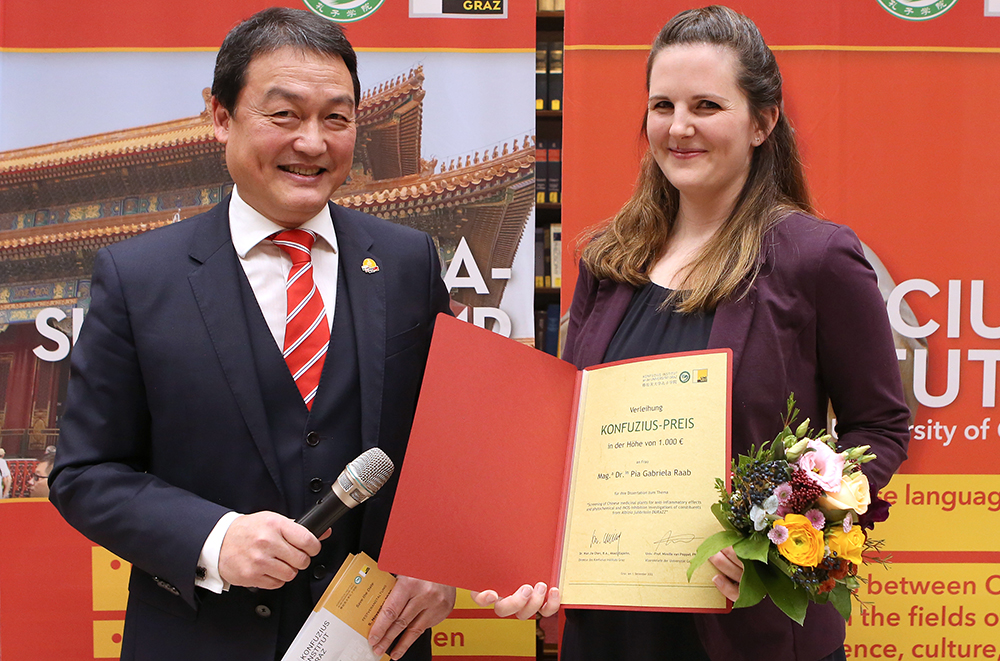
Wan Jie Chen überreichte Pia Raab den Konfuzius-Preis. Foto: Konfuzius-Institut

Wan Jie Chen überreichte Pia Raab den Konfuzius-Preis. Foto: Konfuzius-Institut

Forscherin zu chinesischer Arzneipflanze mit Konfuzius-Preis ausgezeichnet

Sie sind ein echter Hingucker: die pinken Blüten der Seidenakazie. Der Baum erfreut sich in heimischen Parks und Gärten immer größerer Beliebtheit. In seiner ursprünglichen Heimat China wird er als Arzneipflanze genutzt. Wirken diese Inhaltsstoffe auch gegen Entzündungen? Das hat Pia Raab in ihrer Doktorarbeit an der Universität Graz genauer unter die Lupe genommen. Dafür hat die pharmazeutische Wissenschaftlerin kürzlich den Konfuzius-Preis erhalten.

Die Traditionelle Chinesische Medizin verwendet sowohl die Blüten als auch die Rinde des asiatischen Gewächses. „Vorwiegend gegen Schlafstörungen und Müdigkeit“, weiß die Forscherin. „Das Extrakt aus der Rinde wird zur Linderung von Schwellungen und Prellungen äußerlich genutzt.“ Daher hat sie sich mit der entzündungshemmenden Wirkung von Albizia julibrissin, so der botanische Name des Laubbaumes, beschäftigt. „Denn wir sind auf der Suche nach pflanzlichen Alternativen für Schmerzmittel, die weniger Nebenwirkungen haben als herkömmliche.

Raab hat sich dazu zum ersten Mal angesehen, ob jene Flechten, die auf der Seidenakazie wachsen, die aus der Rinde gewonnene Substanz beeinflussen. Ein einzelner Wirkstoff konnte zwar bislang noch nicht gewonnen werden. Die Absolventin hat jedoch mit ihrer Dissertation die Grundlage für weitere Untersuchungen gelegt, die in der Forschungsgruppe von Rudolf Bauer am Institut für Pharmazeutische Wissenschaften fortgesetzt werden – in Kooperation mit chinesischen Wissenschaftler:innen. „Denn die großen Herausforderungen unserer Welt lassen sich nur in Zusammenarbeit lösen“, bekräftigt Raab, die selbst vor Ort in China geforscht hat.
Dieses verbindende Motiv ist ein wesentlicher Aspekt des Konfuzius-Preises – dotiert mit 1000 Euro –, mit dem Pia Raab vor wenigen Tagen geehrt wurde. Überreicht wurde die Auszeichnung von Wan Jie Chen, Leiter des Konfuzius-Instituts.
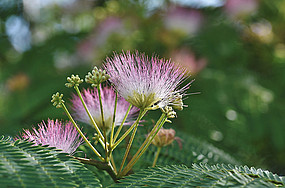
Die Blüte des chinesischen Seidenbaums. Foto: pixabay
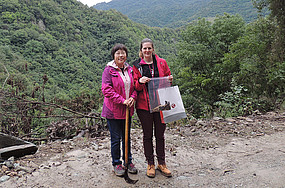
Pia Raab mit Hong Liang, Profesorin von der Peking University. Foto: Raab
created by Andreas Schweiger

Related news

Career Booster: How the Research Careers Campus supports researchers

They are innovative, creative and productive – researchers who have not yet been appointed to a professorship make a massive contribution to a university’s research output. To provide them with even better support on their career path, the University of Graz has established the Research Careers Campus. The official launch took place on 22 April 2026 with a ‘festival’.

Greenery on the rise: over 500 new flowers, perennials and shrubs on campus

Bright blooms and fresh greenery make our hearts beat faster in spring. But it is not just us humans who delight in this colourful growth. For many animals, this splendour provides, above all, food and habitat. There has recently been an increase in this on the University of Graz campus. More than 500 native flowers, perennials and shrubs have been planted on strips of fallow land around Universitätsplatz 2.

Building biological bridges: Chemist discovers an ecological tool for the pharmaceutical industry

Building a relationship on a solid foundation is also important in chemistry. To produce medicines, disinfectants or plant protection products, stable bonds between carbon atoms must be formed. Conventional chemical methods rely on environmentally harmful reagents and solvents to carry out the desired reaction. This process also produces unusable by-products. Chemist Lilla Gal has discovered an enzyme that enables the same process to take place efficiently and sustainably. The results of her research were recently published in the prestigious journal Angewandte Chemie.

Higher Education Strategy 2040: Austria’s universities on course for the future

Austria has 77 higher education institutions, which is above the EU average – but does this really make sense? The new Higher Education Strategy 2040 focuses on cooperation rather than mergers. As one of the six largest universities in Austria, the University of Graz plays a central role in this.

Begin of page section:
Additional information:

University of Graz
Universitaetsplatz 3
8010 Graz
Austria
  • Contact
  • Web Editors
  • Moodle
  • UNIGRAZonline
  • Imprint
  • Data Protection Declaration
  • Accessibility Declaration
Weatherstation
Uni Graz

End of this page section. Go to overview of page sections

End of this page section. Go to overview of page sections

Begin of page section:

End of this page section. Go to overview of page sections