



Begin of page section:
Page sections:

  • Go to contents (Accesskey 1)
  • Go to position marker (Accesskey 2)
  • Go to main navigation (Accesskey 3)
  • Go to sub navigation (Accesskey 4)
  • Go to additional information (Accesskey 5)
  • Go to page settings (user/language) (Accesskey 8)
  • Go to search (Accesskey 9)

End of this page section. Go to overview of page sections

Begin of page section:
Page settings:

English en
Deutsch de
Search
Login

End of this page section. Go to overview of page sections

Begin of page section:
Search:

Search for details about Uni Graz
Close

End of this page section. Go to overview of page sections


Search

Begin of page section:
Main navigation:

Page navigation:

  • University

    University
    • About the University
    • Organisation
    • Faculties
    • Library
    • Working at University of Graz
    • Campus
    Developing solutions for the world of tomorrow - that is our mission. Our students and our researchers take on the great challenges of society and carry the knowledge out.
  • Research Profile

    Research Profile
    • Our Expertise
    • Research Questions
    • Research Portal
    • Promoting Research
    • Research Transfer
    • Ethics in Research
    • Commission for Scientific Integrity
    Scientific excellence and the courage to break new ground. Research at the University of Graz creates the foundations for making the future worth living.
  • Studies

    Studies
    • Prospective Students
    • Students
  • Community

    Community
    • International
    • Location
    • Research and Business
    • Alumni
    The University of Graz is a hub for international research and brings together scientists and business experts. Moreover, it fosters the exchange and cooperation in study and teaching.
  • Spotlight
Topics
  • Sustainable University
  • Researchers answer
  • Work for us
Close menu

End of this page section. Go to overview of page sections

Begin of page section:
You are here:

University of Graz News Listening to the Middle Ages: exhibition brings poverty then and now to life

End of this page section. Go to overview of page sections

Friday, 06 March 2026

Listening to the Middle Ages: exhibition brings poverty then and now to life

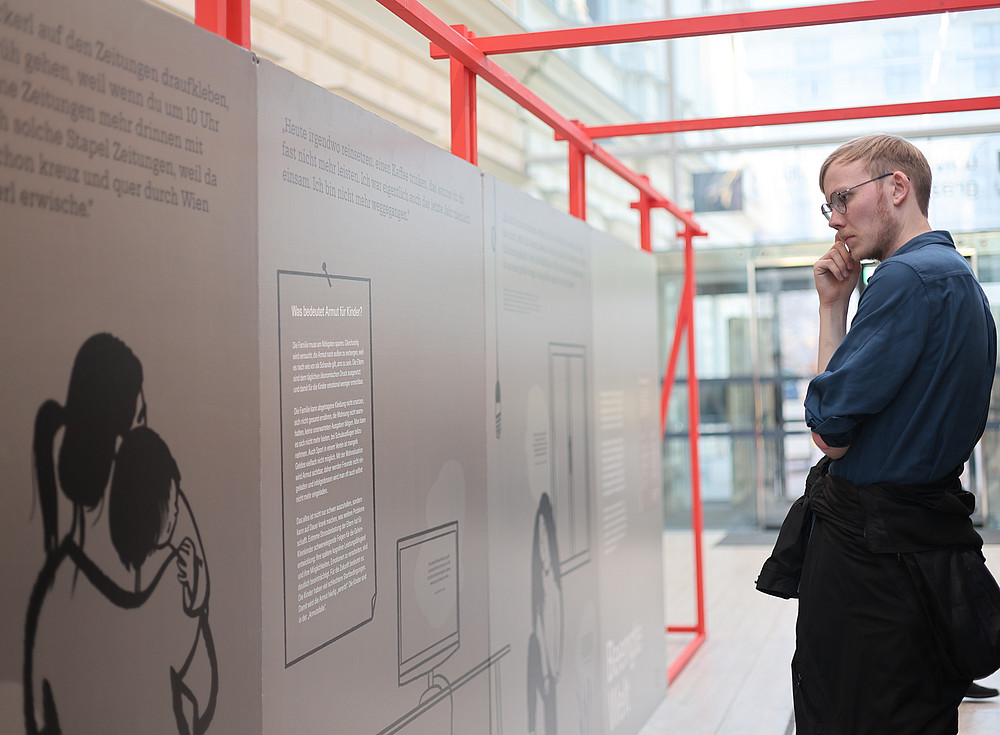
Ein Mann betrachtet rote Aussetellungsflächen

What connects Giulio, a blacksmith who worked in Bologna almost 500 years ago, with a single mother from Styria who recently lost her job? Both are afraid that they will soon be unable to pay their rent. How does it feel to have existential worries? An exhibition at the University of Graz provides personal insights into experiences of poverty then and now. Listening stations give a voice to people from the Middle Ages. The exhibition opened on 5 March 2026 in the foyer of the University Library Graz.


For over a decade, historian Tanja Skambraks has been researching poverty and poverty reduction in the Middle Ages. “Research suggests that 50 to 70 per cent of all people at that time were affected by economic poverty. Wars, epidemics and famines following crop failures repeatedly led to supply shortages,” says the professor at the University of Graz. The scholar is particularly interested in people's personal perspectives. Medieval sources provide a wealth of information that opens up this perspective.

As part of a seminar led by Skambraks, history students have now created audio stations based on various historical texts, giving a voice to those affected in the Middle Ages. At the same time, they convey interesting facts about the everyday life of the poor, how beggars were treated, the experiences of sex workers, social advancement and decline, as well as poverty reduction and voluntary poverty as a Christian ideal.

These listening stations are part of the exhibition “(Leben und) Überleben in Armut in Mittelalter und Gegenwart”, a collaborative project between the University of Graz, Caritas Styria, Akademie Graz, and La Strada. 
The exhibition can be seen until the end of March in the foyer of the University Library Graz. Guided tours are also offered for school classes, and on 24 March, the organisers are hosting a panel discussion on the topic of experiencing poverty and knowledge of poverty with perspectives from the past and present.

Ein gutes Leben für alle: (Leben und) Überleben in Armut in Mittelalter und Gegenwart

Exhibition duration: until 31 March 2026 
Opening hours: Monday to Friday 8 a.m. to 10 p.m., Saturday 9 a.m. to 10 p.m.
Guided tours for school classes: 12 and 17 March 2026; for further information and registration, please contact tanja.skambraks(at)uni-graz.at

Panel discussion: ‘Armutserfahrung und Armutswissen. Perspektiven aus Vergangenheit und Gegenwart’: 24 March 2026, 6.30 p.m., reading room of the University Library of Graz


The Master's programme Historical Science opens doors to interesting fields of work in the communication of historical knowledge.

created by Gudrun Pichler

Related news

Career Booster: How the Research Careers Campus supports researchers

They are innovative, creative and productive – researchers who have not yet been appointed to a professorship make a massive contribution to a university’s research output. To provide them with even better support on their career path, the University of Graz has established the Research Careers Campus. The official launch took place on 22 April 2026 with a ‘festival’.

Greenery on the rise: over 500 new flowers, perennials and shrubs on campus

Bright blooms and fresh greenery make our hearts beat faster in spring. But it is not just us humans who delight in this colourful growth. For many animals, this splendour provides, above all, food and habitat. There has recently been an increase in this on the University of Graz campus. More than 500 native flowers, perennials and shrubs have been planted on strips of fallow land around Universitätsplatz 2.

Building biological bridges: Chemist discovers an ecological tool for the pharmaceutical industry

Building a relationship on a solid foundation is also important in chemistry. To produce medicines, disinfectants or plant protection products, stable bonds between carbon atoms must be formed. Conventional chemical methods rely on environmentally harmful reagents and solvents to carry out the desired reaction. This process also produces unusable by-products. Chemist Lilla Gal has discovered an enzyme that enables the same process to take place efficiently and sustainably. The results of her research were recently published in the prestigious journal Angewandte Chemie.

Higher Education Strategy 2040: Austria’s universities on course for the future

Austria has 77 higher education institutions, which is above the EU average – but does this really make sense? The new Higher Education Strategy 2040 focuses on cooperation rather than mergers. As one of the six largest universities in Austria, the University of Graz plays a central role in this.

Begin of page section:
Additional information:

University of Graz
Universitaetsplatz 3
8010 Graz
Austria
  • Contact
  • Web Editors
  • Moodle
  • UNIGRAZonline
  • Imprint
  • Data Protection Declaration
  • Accessibility Declaration
Weatherstation
Uni Graz

End of this page section. Go to overview of page sections

End of this page section. Go to overview of page sections

Begin of page section:

End of this page section. Go to overview of page sections