



Begin of page section:
Page sections:

  • Go to contents (Accesskey 1)
  • Go to position marker (Accesskey 2)
  • Go to main navigation (Accesskey 3)
  • Go to sub navigation (Accesskey 4)
  • Go to additional information (Accesskey 5)
  • Go to page settings (user/language) (Accesskey 8)
  • Go to search (Accesskey 9)

End of this page section. Go to overview of page sections

Begin of page section:
Page settings:

English en
Deutsch de
Search
Login

End of this page section. Go to overview of page sections

Begin of page section:
Search:

Search for details about Uni Graz
Close

End of this page section. Go to overview of page sections


Search

Begin of page section:
Main navigation:

Page navigation:

  • University

    University
    • About the University
    • Organisation
    • Faculties
    • Library
    • Working at University of Graz
    • Campus
    Developing solutions for the world of tomorrow - that is our mission. Our students and our researchers take on the great challenges of society and carry the knowledge out.
  • Research Profile

    Research Profile
    • Our Expertise
    • Research Questions
    • Research Portal
    • Promoting Research
    • Research Transfer
    • Ethics in Research
    • Commission for Scientific Integrity
    Scientific excellence and the courage to break new ground. Research at the University of Graz creates the foundations for making the future worth living.
  • Studies

    Studies
    • Prospective Students
    • Students
  • Community

    Community
    • International
    • Location
    • Research and Business
    • Alumni
    The University of Graz is a hub for international research and brings together scientists and business experts. Moreover, it fosters the exchange and cooperation in study and teaching.
Topics
  • Sustainable University
  • Researchers answer
  • Work for us
Close menu

End of this page section. Go to overview of page sections

Begin of page section:
You are here:

University of Graz News Scientific freedom and neutrality: a question of attitude

End of this page section. Go to overview of page sections

Thursday, 12 March 2026

Scientific freedom and neutrality: a question of attitude

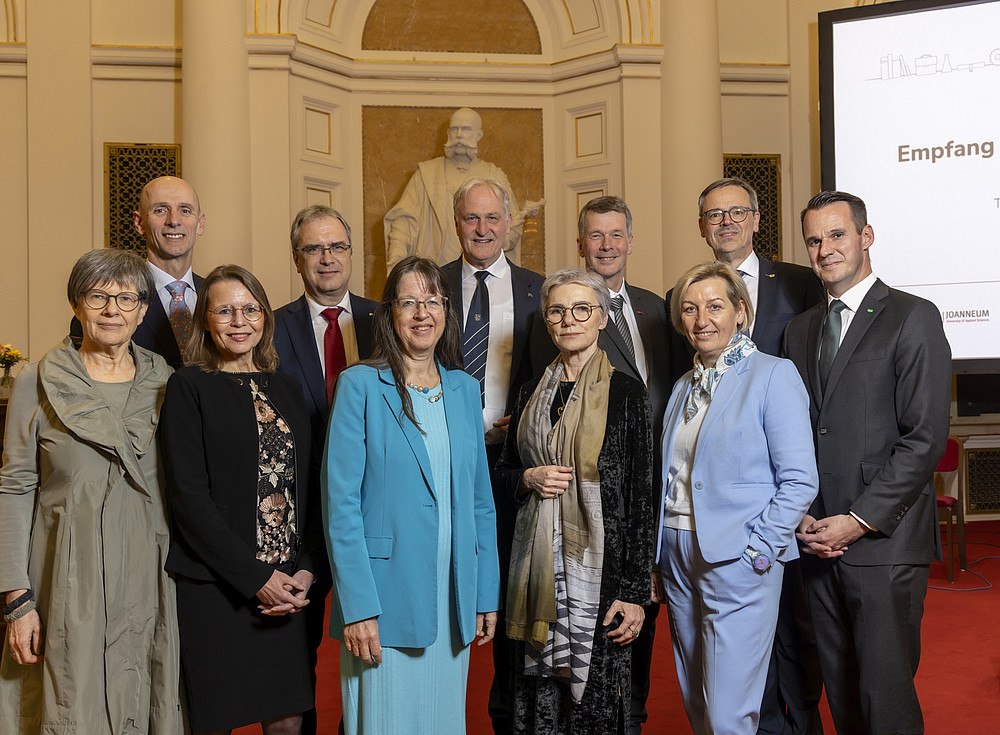
Eine Gruppe elegant gekleideter Personen steht dicht beisammen in einem festlich wirkenden Saal mit hohen, cremefarbenen Wänden und Säulen. Im Hintergrund ist eine große weiße Statue vor einer goldenen Nische zu sehen. Rechts steht ein hoher Bildschirm mit weißer Präsentationsfolie und mehreren Logos im unteren Bereich. Der Boden ist mit rotem Teppich ausgelegt, und die Personen tragen überwiegend Anzüge, Kostüme und festliche Kleider. ©© Helmut Lunghammer

The members of the Styrian University Conference with representatives of the Styrian provincial government. From left: Andrea Seel, Rector of the Augustinum Private University of Education; Willibald Ehrenhöfer, Provincial Councilor for Economy, Labor, Finance, Science, and Research; Beatrix Karl, Rector of the University of Education Styria; Peter Riedler, Rector of the University of Graz; Corinna Engelhardt-Nowitzki, Rector of FH Joanneum; Peter Moser, Rector of Montanuniversität Leoben; Andrea Kurz, Rector of Medical University of Graz; Horst Bischof, Rector of Graz University of Technology; Kristina Edlinger-Ploder, Rector of FH Campus02; Georg Schulz, Rector of University of Music and Performing Arts Graz; Stefan Hermann, Provincial Councilor for Education and Youth, Municipalities, Regional Development. Photo: University of Graz/Lunghammer

How neutral must research be? At the Styrian University Conference at the University of Graz, keynote speaker David Beaver questioned the concept of objectivity. He advocated for bold science that stands by its values in order to remain resilient in times of crisis and actively shape social progress.

How do academic freedom and neutrality go together? David Beaver from the University of Texas, Austin, explored this question at the reception of the Styrian University Conference. Over 150 participants gathered in the auditorium of the University of Graz on March 11, 2026. The university orchestra provided musical accompaniment for the evening.

Rector Peter Riedler, the current chair of the University Conference, emphasized the importance of cooperation between universities in southern Austria before the lecture. “Styria and Carinthia are more closely linked today than ever before. And in these challenging times, it is the universities that strengthen the region's innovative power with their teaching and research, making us more resilient to crises.”

“Our universities make a key contribution to our province being one of the most innovative regions in Europe in many areas,” says Willibald Ehrenhöfer, Styrian Provincial Councilor for Economy, Labor, Finance, Science, and Research. “In order to continue on this path of success, we need an open society and free science, free of boundaries. Because with basic research, we are laying the foundation for the economy of tomorrow, and with applied research, we are securing the prosperity of tomorrow.”

Many collaborations

Andrea Seel, Rector of the Augustinum Private University of Education, highlighted the significance of the collaboration within the Styrian University Conference in figures: “The five universities, two universities of applied sciences, and two universities of education represent more than 60,000 students in around 500 degree programs. 15,000 employees find their professional home here.”

Close cooperation and coordinated further development have enabled projects that benefit everyone. “There are intensive teaching and research collaborations, joint studies, media collaborations, and coordination in the area of crisis and emergency management,” Seel explains. She is particularly proud of projects with a broad impact, such as the Science Garden, the Children's University, and Earth Talks, in which current social issues are openly discussed.

The keynote speaker for the evening, David Beaver from the University of Texas at Austin, addressed a question much discussed among scientists: the conflict between the desire for neutrality and objectivity on the one hand and scientific freedom on the other. "When we talk about neutrality, we often think that there are certain irrefutable facts. But we ourselves are not always completely objective and try to present facts as neutral through language.“ Beaver sees this as a dangerous development. ”Nobel Peace Prize winner Eli Wiesel reminds us that neutrality always helps the oppressor, not the victims. Silence encourages the tormentor, never the tormented." Based on this, Beaver warns that in today's discourse, neutrality and calm are often seen as the antithesis of extremism.

Beaver considers this dangerous: “If the language of those in power is neutral, then the language of those who question the assumptions of those in power must be extremist. Extremist language, the argument goes, is a dangerous tool of indoctrination.”

Clear values

Beaver sees this fallacy as a threat to academic freedom. “I want researchers who see their work as neutral to think about what that really means.” Beaver also has a suggestion for public representatives of universities: "I also don't believe that universities should defend themselves in critical discourse with the argument of scientific neutrality. They should have the courage to stand by a clear value system and proclaim it loudly."

FH Joanneum Rector Corinna Engelhardt-Nowitzki also addressed the topic of language in her closing remarks. “Language is a tool that connects us. It is the basis of every discourse and helps us as representatives of universities in three important areas that connect us: our openness, our social relevance, and the visibility of what distinguishes our institutions.”

During the buffet that followed, the numerous representatives from politics, science, and business had the opportunity to exchange ideas. Not only was there an opportunity to engage in stimulating conversations with the speakers, but the attendees also included numerous representatives from academia and politics, such as Peter Granig, Rector of Carinthia University of Applied Sciences, Ada Pellert, Rector of Alpen-Adria University Klagenfurt, Martin Payer, Managing Director of FH Joanneum, Kristina Edlinger-Ploder, Rector of FH Campus02, Georg Schulz, Rector of the University of Music and Performing Arts Graz, Andrea Kurz, Rector of the Medical University of Graz, Peter Moser, Rector of the Montanuniversität Leoben, Beatrix Karl, Rector of the University of Education Styria Graz City Councilor Robert Krotzer, Leoben Mayor Kurt Wallner, Herbert Beiglböck, Chairman of the University Council of the University of Graz, Styrian Provincial Councilor for Transport, Provincial Building Construction, Rural Road Construction and Technology, Claudia Holzer, and guests from the business community, such as Chamber of Commerce Director Karl-Heinz Dernoschiek, Kleine Zeitung Managing Director Xenia Daum, Martin Schaller, CEO of Raiffeisenlandesbank Steiermark, Georg List, TU University Council and Head of R&D at AVL List, Alfred Heinzl, Chairman of the Supervisory Board of the Heinzl Group, and many more.

Pictures from the event >>Click here

created by Roman Vilgut

Related news

Complying with the norm: Why Do Standards Shape Our Lives, Elisabeth Staudegger?

Standards determine whether a sheet of paper fits in a printer or whether a charging plug can power multiple devices. These standards shape our everyday lives. But who actually sets these standards? Where are the weaknesses, and how could science help to improve them? Elisabeth Staudegger, Head of the ‘Law and IT’ Department at the Institute for Legal Foundations at the University of Graz, host the Academic Standards Day on 16 June. Here she relays how sciences can contribute to the topic of standardisation and reveals her personal favourite standard.

More body awareness than a culture war

In Italy, sex education lessons will in future only be permitted with parental consent, and will be banned entirely in nurseries and primary schools. At the same time, Pride Month highlights why knowledge about the body, relationships, boundaries and diversity is important for young people. A study by the University of Graz shows how important knowledge about the body, contraception, relationship skills and protection against violence is

Will Austria win the World Cup? Mathematician reveals calculation method

Michael Fischer uses the football tournament as a practical example for highschool lessons.

Survival strategies: How plants respond to drought

According to Geosphere Austria, this spring was the driest in Austria since records began around 170 years ago. The low rainfall put particular pressure on the agricultural sector. And climate change is set to make the situation even worse in the coming decades. We asked Johannes Liesche, a professor at the Department of Biology at the University of Graz, how plants react to water shortages and how they survive periods of drought.

Begin of page section:
Additional information:

University of Graz
Universitaetsplatz 3
8010 Graz
Austria
  • Contact
  • Web Editors
  • Moodle
  • UNIGRAZonline
  • Imprint
  • Data Protection Declaration
  • Accessibility Declaration
Weatherstation
Uni Graz

End of this page section. Go to overview of page sections

End of this page section. Go to overview of page sections

Begin of page section:

End of this page section. Go to overview of page sections