




Begin of page section:
Page sections:

  • Go to contents (Accesskey 1)
  • Go to position marker (Accesskey 2)
  • Go to main navigation (Accesskey 3)
  • Go to sub navigation (Accesskey 4)
  • Go to additional information (Accesskey 5)
  • Go to page settings (user/language) (Accesskey 8)
  • Go to search (Accesskey 9)

End of this page section. Go to overview of page sections

Begin of page section:
Page settings:

English en
Deutsch de
Search
Login

End of this page section. Go to overview of page sections

Begin of page section:
Search:

Search for details about Uni Graz
Close

End of this page section. Go to overview of page sections


Search

Begin of page section:
Main navigation:

Page navigation:

  • University

    University
    • About the University
    • Organisation
    • Faculties
    • Library
    • Working at University of Graz
    • Campus
    Developing solutions for the world of tomorrow - that is our mission. Our students and our researchers take on the great challenges of society and carry the knowledge out.
  • Research Profile

    Research Profile
    • Our Expertise
    • Research Questions
    • Research Portal
    • Promoting Research
    • Research Transfer
    • Ethics in Research
    • Commission for Scientific Integrity
    Scientific excellence and the courage to break new ground. Research at the University of Graz creates the foundations for making the future worth living.
  • Studies

    Studies
    • Prospective Students
    • Students
  • Community

    Community
    • International
    • Location
    • Research and Business
    • Alumni
    The University of Graz is a hub for international research and brings together scientists and business experts. Moreover, it fosters the exchange and cooperation in study and teaching.
  • Spotlight
Topics
  • Sustainable University
  • Researchers answer
  • Work for us
Close menu

End of this page section. Go to overview of page sections

Begin of page section:
You are here:

University of Graz News Wendepunkt

End of this page section. Go to overview of page sections

Friday, 19 June 2020

Wendepunkt

Christopher Street Day: Das Uni Graz Logo leuchtet ab heute eine Woche lang in Regenbogenfarben

In der Nacht auf den 28. Juni 1969 begann eine Reihe von gewalttätigen Auseinandersetzungen zwischen homo- und transsexuellen Personen und Polizeibeamten in New York. Der als Stonewall-Aufstand bekannt gewordene Vorfall wird heute als großer Wendepunkt im Kampf für Gleichbehandlung und Anerkennung der LGTB-Bewegung betrachtet.

Der Christopher Street Day (CSD) wird deshalb international am 28. Juni gefeiert. In verschiedenen europäischen Ländern gibt es zusätzlich noch eigene CSD-Paraden an unterschiedlichen Tagen. In Österreich waren sie ursprünglich rund um den 20. Juni geplant gewesen. Aufgrund der Corona-Situation sind diese vielerorts heuer aber nicht möglich beziehungsweise abgesagt worden.

Um dem wichtigen Thema dennoch die benötigte internationale Sichtbarkeit zu geben, hat die Arqus-Allianz, der auch die Universität Graz angehört, angeregt, die Logos der Universitäten sowie das Arqus-Logo selbst für eine Woche in Regenbogenfarben zu hüllen. Arqus setzt sich für Gleichstellung, Anti-Diskriminierung, Chancengleichheit und Diversität im europäischen Hochschulraum ein. In der Action Line 2 namens „Erweiterter Zugang zu Hochschuldbildung, Integration und Diversität“ werden aktuell eine Vielzahl von koordinierten Vorschlägen und gemeinsamen Zielen gebündelt, die in ihrer Gesamtheit in Zukunft zu einem inklusiven Hochschulraum stark beitragen sollen.

Auch die Universität Graz vertritt diese Werte. Daher leuchtet das Logo der Universität ab sofort und bis inklusive 28. Juni 2020 in schillernden Regenbogenfarben.


Turning point

Christopher Street Day: the University of Graz logo will be glowing in rainbow colours for a week from today

In the night of 28 June 1969 a series of violent clashes began in New York between the police and groups of homosexuals and transsexuals. This became known as the Stonewall Riots, and is widely regarded as a great turning point in the LGBT movement’s fight for equality and recognition.

Christopher Street Day (CSD) is now celebrated around the world on 28 June. In some European countries there are also other local Christopher Street Day parades on different dates. In Austria they were originally planned around 20 June. This year however, due to the coronavirus situation, in many places they have not been possible, or have been cancelled.

To ensure that this important topic still has the necessary international visibility, the Arqus Alliance, to which the University of Graz belongs, has encouraged universities to change their logos to rainbow colours for a week, and will be doing the same with the Arqus logo as well. Arqus is committed to equality, anti-discrimination, equal opportunities and diversity in the European Higher Education Area. Its Action Line 2, “Widening Access, Inclusion and Diversity”, now combines a number of coordinated proposals and common goals with the aim of making a significant overall contribution to an inclusive Higher Education Area in the future.

The University of Graz is committed to these values. So from today up to and including 28 June 2020, the university logo will glow in dazzling rainbow colours.
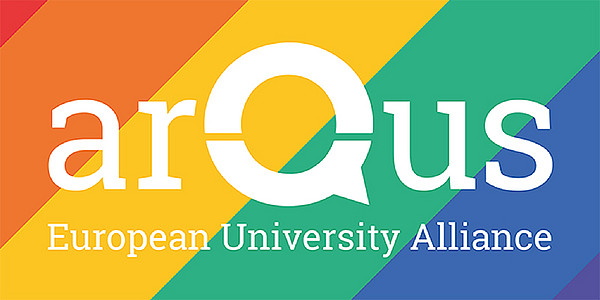

 

Auf Anregung der Arqus Allianz leuchten das Arqus-Logo und das Logo der Universität Graz anlässlich des internationalen Christopher Street Days eine Woche lang in Regenbogenfarben. Foto: Arqus.
created by Gerhild Leljak

Related news

Higher Education Strategy 2040: Austria’s universities on course for the future

Austria has 77 higher education institutions, which is above the EU average – but does this really make sense? The new Higher Education Strategy 2040 focuses on cooperation rather than mergers. As one of the six largest universities in Austria, the University of Graz plays a central role in this.

Climate research in Greenland: Old data provides new insights

The polar explorer and University of Graz professor Alfred Wegener left behind a unique collection of climate data from Greenland. A research team from the University of Graz is now analysing this 100-year-old treasure trove of data and comparing it with current measurements.

Diversity in nature and science: How we talk about plants and each other

Ginkgo, kiwi, hemp: they exist as male and female plants. Anyone who paid attention in biology class will confirm this. But is this categorisation, established by Carl von Linné almost 300 years ago, still valid today? An interdisciplinary team at the University of Graz is questioning these attributions and using this as a starting point to provide food for thought for gender-sensitive interaction between students, scientific and teaching staff.

Around the world in eight stops: the Long Night of Research at the University of Graz

On 24 April from 5 pm, you can take a short trip around the globe at the University of Graz, discovering pecularities of foreign countries or new local features in the entrance hall of the University Library. The itinerary takes you through introduced animal species, political attitudes and the omnipotence of algorithms. There will also be a programme in the historic reading hall, as well as at the UniGraz@Museum and the University Archive.

Begin of page section:
Additional information:

University of Graz
Universitaetsplatz 3
8010 Graz
Austria
  • Contact
  • Web Editors
  • Moodle
  • UNIGRAZonline
  • Imprint
  • Data Protection Declaration
  • Accessibility Declaration
Weatherstation
Uni Graz

End of this page section. Go to overview of page sections

End of this page section. Go to overview of page sections

Begin of page section:

End of this page section. Go to overview of page sections


