Begin of page section:
Page sections:

  • Go to contents (Accesskey 1)
  • Go to position marker (Accesskey 2)
  • Go to main navigation (Accesskey 3)
  • Go to sub navigation (Accesskey 4)
  • Go to additional information (Accesskey 5)
  • Go to page settings (user/language) (Accesskey 8)
  • Go to search (Accesskey 9)

End of this page section. Go to overview of page sections

Begin of page section:
Page settings:

English en
Deutsch de
Search
Login

End of this page section. Go to overview of page sections

Begin of page section:
Search:

Search for details about Uni Graz
Close

End of this page section. Go to overview of page sections


Search

Begin of page section:
Main navigation:

Page navigation:

  • University

    University
    • About the University
    • Organisation
    • Faculties
    • Library
    • Working at University of Graz
    • Campus
    Developing solutions for the world of tomorrow - that is our mission. Our students and our researchers take on the great challenges of society and carry the knowledge out.
  • Research Profile

    Research Profile
    • Our Expertise
    • Research Questions
    • Research Portal
    • Promoting Research
    • Research Transfer
    • Ethics in Research
    • Commission for Scientific Integrity
    Scientific excellence and the courage to break new ground. Research at the University of Graz creates the foundations for making the future worth living.
  • Studies

    Studies
    • Prospective Students
    • Students
    • Registration for Study Programme (Winter semester 2026/27)
  • Community

    Community
    • International
    • Location
    • Research and Business
    • Alumni
    The University of Graz is a hub for international research and brings together scientists and business experts. Moreover, it fosters the exchange and cooperation in study and teaching.
Topics
  • Sustainable University
  • Researchers answer
  • Work for us
Close menu

End of this page section. Go to overview of page sections

Begin of page section:
You are here:

University of Graz News Vergänglich ist das Eis

End of this page section. Go to overview of page sections

Monday, 03 December 2018

Vergänglich ist das Eis

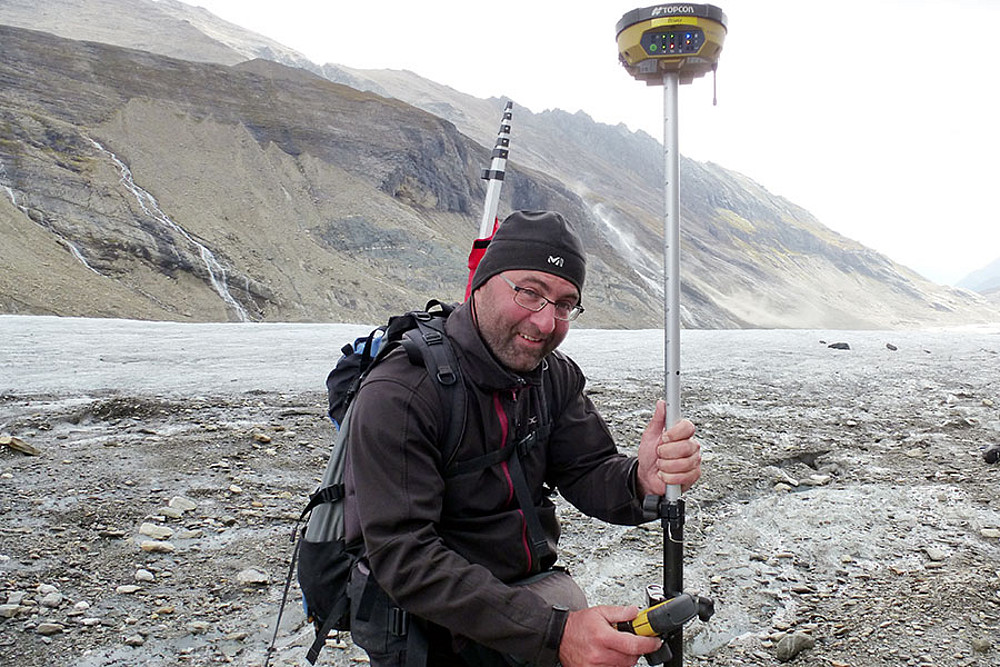
Andreas Kellerer-Pirklbauer bei GPS-Messungen an der Pasterze. Foto: Uni Graz/Lieb

Andreas Kellerer-Pirklbauer bei GPS-Messungen an der Pasterze. Foto: Uni Graz/Lieb

Geographen der Universität Graz dokumentieren den Zerfall des größten österreichischen Gletschers

Forscher des Instituts für Geographie und Raumforschung der Universität Graz messen seit vielen Jahren die Veränderungen des Eises an der Pasterze, dem größten österreichischen Gletscher, um dessen langfristiges Abschmelzen zu dokumentieren. In einer soeben im renommierten Journal „Earth Surface Processes and Landforms“ erschienenen Publikation beschreiben die Geographen den rapiden Zerfall der Gletscherzunge zwischen 1998 und 2012. Messungen zeigen, dass das Eis allein in diesem Zeitraum fast 75 Meter eingesunken ist und immer stärker von Geröll bedeckt wird. „In ein paar Jahrzehnten wird von der Gletscherzunge nur mehr ein schuttbedeckter Eisrest bleiben“, sagt Andreas Kellerer-Pirklbauer, Erstautor der aktuellen Publikation.

Im Mittelpunkt der Beobachtungen standen die Entwicklung der Gletscherspalten, die Abschmelzung sowie der Einfluss des Schmelzwassers auf den Eiszerfall. „Unsere Messungen machen deutlich, dass die Neubildung von Spalten mehr mit dem Zerfall als mit der Bewegung des Gletschers zu tun hat“, berichtet Kellerer-Pirklbauer. „In den 14 Jahren des Untersuchungszeitraums ist die Gletscherzunge um 25 Prozent kleiner geworden und der See davor stark angewachsen. Gleichzeitig hat die Geschwindigkeit des Eiszuflusses von den höheren Bereichen – also auch aus den Karen unterhalb des Großglockners – rasant abgenommen.“ Dass sich die Gletscherspaltendichte zwischen 1998 und 2012 verdoppelt hat, sei ein weiteres Zeichen dafür, dass die Pasterze langsam zerfällt.“

Neben dem an der Oberfläche sichtbaren Eis ist auch das sogenannte „Toteis“, das von Schutt bedeckt noch im Untergrund vorhanden, aber nicht mehr mit dem Gletscher verbunden ist, von großem Interesse. Seit September 2018 leitet Kellerer-Pirklbauer ein vom Glockner-Öko-Fonds gefördertes Forschungsprojekt mit dem Ziel, Toteisvorkommen im Gletschervorfeld zu quantifizieren und deren Entwicklung zu beobachten. „Auch das verborgene Eis nimmt rasant ab. Beschleunigt wird der Prozess durch das Einfließen von Schmelzwasser aus dem gesamten Einzugsgebiet“, erklärt der Geograph. Löst sich Eis aus der Sohle des Sees, taucht es häufig in Form von Eisbergen auf – ein faszinierendes Naturereignis.

Andreas Kellerer-Pirklbauer ist Mitarbeiter in der Arbeitsgruppe Alpine Landschaftsdynamik (ALADYN). Er und sein Kollege Gerhard Lieb leiten auch ehrenamtlich den Gletschermessdienst des Österreichischen Alpenvereins.

Publikation
The evolution of brittle and ductile structures at the surface of a partly debris-covered, rapidly thinning and slowly moving glacier in 1998-2012 (Pasterze Glacier, Austria)
Andreas Kellerer-Pirklbauer, Bernd Kulmer
„Earth Surface Processes and Landforms“, November 2018
https://doi.org/10.1002/esp.4552

Zwischen 1998 und 2012 ist die Gletscherzunge der Pasterze um 25 Prozent kleiner geworden. Foto: Uni Graz/Kellerer-Pirklbauer
Aus der Sohle des Sees vor dem Gletscher tauchen immer wieder Eisberge (Bildmitte) auf. Foto: Uni Graz/Kellerer
Entwicklungen an der Gletscheroberfläche der Pasterze: von Schutt bedecktes Eis (grau), schuttfreie Gletscheroberfläche (blau), Spalten oder Bruchstellen (grün), Überschiebungen (rot), Streifen-Ogiven = bogenförmige Strukturen (schwarz). Grafik: Kellerer-Pirklbauer & Kulmer
created by Gudrun Pichler

Related news

Desert sand, microplastics, cancer cells: David Clases awarded ERC grant for analytical method

Nanoparticles trapped in polar ice can reveal a great deal about the climate 100,000 years ago. Chemist David Clases is developing unique methods to analyse them in detail. He will now adapt these methods for use with larger particles in order to glean even more information about Earth’s history. The method can be used for a wide range of other purposes – for example, in medical diagnostics or the investigation of environmental pollution. Clases has been awarded a Proof-of-Concept Grant by the European Research Council (ERC) for this work.

Staying fit during the holidays: summer sports on the University of Graz campus

The Kleeblattlauf is not the end of the fitness term. Following last year’s successful launch, the University of Graz is once again offering summer sports on campus this year. From 30 June to 16 July 2026, there will be a free exercise programme in the open air. On the shady Südwiese (between the main building and Universitätsplatz 2), anyone interested can get in shape in the afternoons with body workouts, fascia training and yoga.

Getting even hotter: Researchers predict global warming of 1.7 degrees by 2027

While Europe is currently sweltering in the heat, global temperatures are also rising towards concerning record levels. In 2026, Earth’s surface air temperature is expected to reach 1.62 degrees, and in 2027 even 1.71 degrees Celsius above pre-industrial levels. The long-term temperature rise – an average over a 20-year period – is predicted to exceed the 1.5-degree threshold of the Paris Agreement as of 2026 already. For the first time, researchers at the University of Graz have been able to make such a forecast so far in advance. The intensifying El Niño climate event favors forecast skill and thereby facilitates a reliable computation.

Forest fire at Rosenhain: Volunteer fire brigade carried out an evacuation drill at the Jesuit refectory

Thick smoke in the stairwell, flames at the edge of the forest, people missing in the Jesuit refectory at the University of Graz: at Rosenhain, the Graz Volunteer Fire Brigade carried out a drill simulating a scenario that is becoming increasingly realistic given the heat and drought

Begin of page section:
Additional information:

University of Graz
Universitaetsplatz 3
8010 Graz
Austria
  • Contact
  • Web Editors
  • Moodle
  • UNIGRAZonline
  • Imprint
  • Data Protection Declaration
  • Accessibility Declaration
Weatherstation
Uni Graz

End of this page section. Go to overview of page sections

End of this page section. Go to overview of page sections

Begin of page section:

End of this page section. Go to overview of page sections