



Begin of page section:
Page sections:

  • Go to contents (Accesskey 1)
  • Go to position marker (Accesskey 2)
  • Go to main navigation (Accesskey 3)
  • Go to sub navigation (Accesskey 4)
  • Go to additional information (Accesskey 5)
  • Go to page settings (user/language) (Accesskey 8)
  • Go to search (Accesskey 9)

End of this page section. Go to overview of page sections

Begin of page section:
Page settings:

English en
Deutsch de
Search
Login

End of this page section. Go to overview of page sections

Begin of page section:
Search:

Search for details about Uni Graz
Close

End of this page section. Go to overview of page sections


Search

Begin of page section:
Main navigation:

Page navigation:

  • University

    University
    • About the University
    • Organisation
    • Faculties
    • Library
    • Working at University of Graz
    • Campus
    Developing solutions for the world of tomorrow - that is our mission. Our students and our researchers take on the great challenges of society and carry the knowledge out.
  • Research Profile

    Research Profile
    • Our Expertise
    • Research Questions
    • Research Portal
    • Promoting Research
    • Research Transfer
    • Ethics in Research
    • Commission for Scientific Integrity
    Scientific excellence and the courage to break new ground. Research at the University of Graz creates the foundations for making the future worth living.
  • Studies

    Studies
    • Prospective Students
    • Students
  • Community

    Community
    • International
    • Location
    • Research and Business
    • Alumni
    The University of Graz is a hub for international research and brings together scientists and business experts. Moreover, it fosters the exchange and cooperation in study and teaching.
  • Spotlight
Topics
  • Sustainable University
  • Researchers answer
  • Work for us
Close menu

End of this page section. Go to overview of page sections

Begin of page section:
You are here:

University of Graz News Tier-Roboter-Mensch

End of this page section. Go to overview of page sections

Monday, 20 December 2021

Tier-Roboter-Mensch

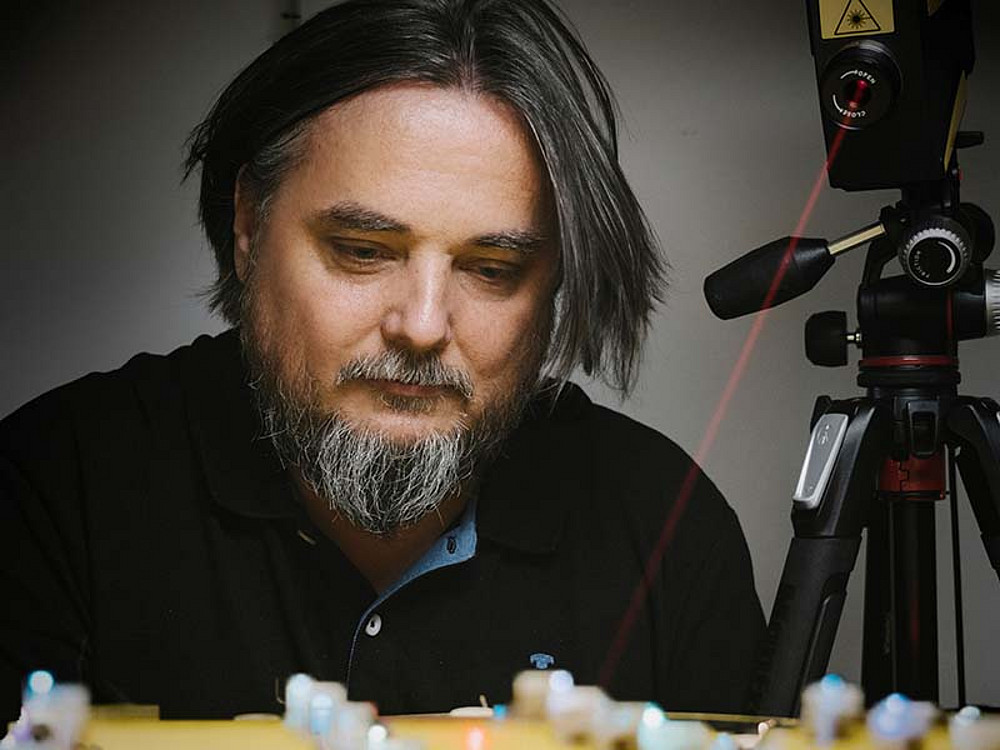
Zoologe Thomas Schmickl wurde von der Königlichen Akademie der Wissenschaften und Schönen Künste von Belgien ausgezeichnet. Foto: Uni Graz/Kernasenko.

Zoologe Thomas Schmickl wurde von der Königlichen Akademie der Wissenschaften und Schönen Künste von Belgien ausgezeichnet. Foto: Uni Graz/Kernasenko.

Zoologe Thomas Schmickl erhält den Prix Agathon de Potter de Biologie Animale der Königlichen Akademie der Wissenschaften und Schönen Künste von Belgien

Unterwasser-Roboterschwärme mit kollektivem Bewusstsein, Gesellschaften aus Pflanzen und Robotern, die gemeinsam neue Lebensräume bauen, oder ein smarter Bienenstock, der die Insekten bei der Arbeit unterstützt und sie vor Gefahren warnt: Thomas Schmickls Forschungen klingen nach Science-Fiction. Sie sind aber in dem von ihm mitgegründeten Artificial Life Lab längst Realität.

Schmickl und sein Team erforschen soziale Insekten, wie eben zum Beispiel Bienen, und andere natürliche Schwarmsysteme. Die ForscherInnen sehen sich nicht nur an, wie tierische Gesellschaften funktionieren, sondern auch, wie man die daraus gewonnenen Erkenntnisse auf künstlich geschaffene Schwarmalgorithmen übertragen kann. Ihr Ziel ist, neue und großflächig verteilte, adaptive Umweltmonitoring-Systeme zu entwickeln und Ökosysteme durch diese ökologisch wirksamen Technologien zu unterstützen.

Für seine langjährigen Forschungen zu diesen Themen hat Thomas Schmickl vergangene Woche den „Prix Agathon de Potter de Biologie“ der Königlichen Akademie der Wissenschaften und Schönen Künste von Belgien erhalten. Die Akademie wurde 1769 im Auftrag von Kaiserin Maria Theresia und Karl Alexander von Lothringen gegründet und zeichnet verdienstvolle WissenschafterInnen in den Natur-, Geistes-, Sozial- und Politikwissenschaften sowie der Künste in ganz Europa aus. Der Preis wurde pandemiebedingt im Rahmen einer Online Zeremonie vergeben.


>> Weitere Infos: https://alife.uni-graz.at/ und https://colibri.uni-graz.at/de/

created by Gerhild Leljak

Related news

Greenery on the rise: over 500 new flowers, perennials and shrubs on campus

Bright blooms and fresh greenery make our hearts beat faster in spring. But it is not just us humans who delight in this colourful growth. For many animals, this splendour provides, above all, food and habitat. There has recently been an increase in this on the University of Graz campus. More than 500 native flowers, perennials and shrubs have been planted on strips of fallow land around Universitätsplatz 2.

Around the world in eight stops: the Long Night of Research at the University of Graz

On 24 April from 5 pm, you can take a short trip around the globe at the University of Graz, discovering pecularities of foreign countries or new local features in the entrance hall of the University Library. The itinerary takes you through introduced animal species, political attitudes and the omnipotence of algorithms. There will also be a programme in the historic reading hall, as well as at the UniGraz@Museum and the University Archive.

Building biological bridges: Chemist discovers an ecological tool for the pharmaceutical industry

Building a relationship on a solid foundation is also important in chemistry. To produce medicines, disinfectants or plant protection products, stable bonds between carbon atoms must be formed. Conventional chemical methods rely on environmentally harmful reagents and solvents to carry out the desired reaction. This process also produces unusable by-products. Chemist Lilla Gal has discovered an enzyme that enables the same process to take place efficiently and sustainably. The results of her research were recently published in the prestigious journal Angewandte Chemie.

Higher Education Strategy 2040: Austria’s universities on course for the future

Austria has 77 higher education institutions, which is above the EU average – but does this really make sense? The new Higher Education Strategy 2040 focuses on cooperation rather than mergers. As one of the six largest universities in Austria, the University of Graz plays a central role in this.

Begin of page section:
Additional information:

University of Graz
Universitaetsplatz 3
8010 Graz
Austria
  • Contact
  • Web Editors
  • Moodle
  • UNIGRAZonline
  • Imprint
  • Data Protection Declaration
  • Accessibility Declaration
Weatherstation
Uni Graz

End of this page section. Go to overview of page sections

End of this page section. Go to overview of page sections

Begin of page section:

End of this page section. Go to overview of page sections


