



Begin of page section:
Page sections:

  • Go to contents (Accesskey 1)
  • Go to position marker (Accesskey 2)
  • Go to main navigation (Accesskey 3)
  • Go to sub navigation (Accesskey 4)
  • Go to additional information (Accesskey 5)
  • Go to page settings (user/language) (Accesskey 8)
  • Go to search (Accesskey 9)

End of this page section. Go to overview of page sections

Begin of page section:
Page settings:

English en
Deutsch de
Search
Login

End of this page section. Go to overview of page sections

Begin of page section:
Search:

Search for details about Uni Graz
Close

End of this page section. Go to overview of page sections


Search

Begin of page section:
Main navigation:

Page navigation:

  • University

    University
    • About the University
    • Organisation
    • Faculties
    • Library
    • Working at University of Graz
    • Campus
    Developing solutions for the world of tomorrow - that is our mission. Our students and our researchers take on the great challenges of society and carry the knowledge out.
  • Research Profile

    Research Profile
    • Our Expertise
    • Research Questions
    • Research Portal
    • Promoting Research
    • Research Transfer
    • Ethics in Research
    • Commission for Scientific Integrity
    Scientific excellence and the courage to break new ground. Research at the University of Graz creates the foundations for making the future worth living.
  • Studies

    Studies
    • Prospective Students
    • Students
  • Community

    Community
    • International
    • Location
    • Research and Business
    • Alumni
    The University of Graz is a hub for international research and brings together scientists and business experts. Moreover, it fosters the exchange and cooperation in study and teaching.
Topics
  • Sustainable University
  • Researchers answer
  • Work for us
Close menu

End of this page section. Go to overview of page sections

Begin of page section:
You are here:

University of Graz News Survival strategies: How plants respond to drought

End of this page section. Go to overview of page sections

Tuesday, 09 June 2026

Survival strategies: How plants respond to drought

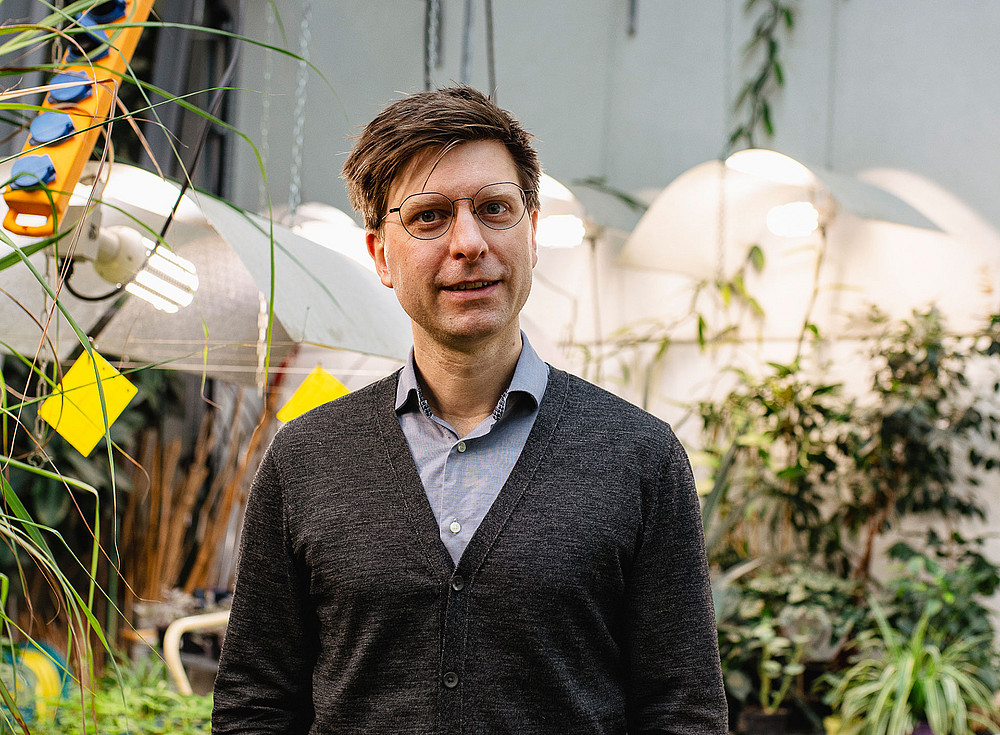
Johannes Liesche in front of plants ©Uni Graz/Tzivanopoulos

Johannes Liesche is investigating which genetic factors regulate sugar transport in plants, particularly in relation to changing environmental conditions and stress responses. Photo: University of Graz/Tzivanopoulos

According to Geosphere Austria, this spring was the driest in Austria since records began around 170 years ago. The low rainfall put particular pressure on the agricultural sector. And climate change is set to make the situation even worse in the coming decades. We asked Johannes Liesche, a professor at the Department of Biology at the University of Graz, how plants react to water shortages and how they survive periods of drought.


Plants have several strategies for protecting themselves from dehydration. “First of all, they close the stomata on their leaves to reduce transpiration,” says Johannes Liesche, head of the Plant Cell and Stress Biology Research Group at the University of Graz. This means that significantly less water escapes, but also that hardly any CO2 is taken up for photosynthesis. “As a result, the plant produces less sugar and its productivity declines. The remaining energy is increasingly channelled into root growth to penetrate deeper, moister layers,” explains the researcher.

During prolonged drought, the entire life cycle adapts. The growth phase is shortened. “Depending on when the drought occurs, many plants flower earlier or for a shorter period and form seeds more quickly to give the next generation a chance,” says Liesche. Fruits remain smaller or fail to form at all.

Some plants cope better with drought than others. “Vines root up to six metres deep and can thus still reach water, even if it hasn’t rained for a long time,” the researcher gives as an example, adding: “Others reduce transpiration through small, thick, leathery leaves. In some, the stomata are situated deeper and are thus sheltered from the wind, which further reduces evaporation.

Furthermore, plants adapt to changing environmental conditions through molecular mechanisms. These alter the composition of cell membranes and cytoplasm to maintain structural integrity. New findings in this area are of high interest, particularly with regard to the breeding of drought-resistant varieties for agriculture.

In a project, Liesche and his research group investigated how molecular signalling pathways can be fine-tuned so that a plant reacts more quickly or strongly to drought. For the scientist, genetic engineering is anything but a bogeyman: “With new genomic technologies (NGT), the plant’s own genes are modified. This also happens in traditional breeding. The advantage of NGT is that the desired characteristics of a plant can be achieved more quickly. But the result is essentially the same.” The researcher is convinced: “If we want our familiar food in future, there is no way around plant breeding with NGT.”

The research team behind the KLIWAS – Water in a Changing Climate study, which is funded by the Ministry of Agriculture, also highlights the need to place greater emphasis on drought-resistant varieties in agriculture in future.

If you want to learn more about the fascinating world of plants, you can study Biology at the University of Graz.

created by Gudrun Pichler

Related news

World literature from Austria: Anne-Kathrin Reulecke on Ingeborg Bachmann

On 25 June, Ingeborg Bachmann would have turned 100. To this day, she remains one of the most important German-language authors. Anne-Kathrin Reulecke, Professor of Modern German Literature at the Institute of German Studies, has conducted extensive research into the writer, who died in 1973. The academic explains why Bachmann continues to be influential and what makes her work so special. In addition to her literary analysis, Anne-Kathrin Reulecke shares some reading recommendations.

What matters in the end: moral theologian takes stock of assisted suicide

Since 1 January 2022, assisted suicide has been legal in Austria under certain conditions. This was made possible by a ruling of the Constitutional Court, which overturned the blanket ban on assisting in suicide. Four years on, it is clear that: “Although the legal framework is in place, many pressing questions remain unanswered when it comes to its practical implementation,” says Johann Platzer, a moral theologian at the University of Graz.

Noise is the signal: new simulation method enables secure communication

Researchers from Graz, Vienna and Munich have developed a new simulation method that makes it possible to calculate quantum light using classical software – a step towards secure quantum communication.

Massacre and Memory: University of Graz addresses the wounds of history

A conference on 12 and 13 June 2026 at the Jesuit Refectory will focus on trauma in Eastern and South-Eastern Europe.

Begin of page section:
Additional information:

University of Graz
Universitaetsplatz 3
8010 Graz
Austria
  • Contact
  • Web Editors
  • Moodle
  • UNIGRAZonline
  • Imprint
  • Data Protection Declaration
  • Accessibility Declaration
Weatherstation
Uni Graz

End of this page section. Go to overview of page sections

End of this page section. Go to overview of page sections

Begin of page section:

End of this page section. Go to overview of page sections