Begin of page section:
Page sections:

  • Go to contents (Accesskey 1)
  • Go to position marker (Accesskey 2)
  • Go to main navigation (Accesskey 3)
  • Go to sub navigation (Accesskey 4)
  • Go to additional information (Accesskey 5)
  • Go to page settings (user/language) (Accesskey 8)
  • Go to search (Accesskey 9)

End of this page section. Go to overview of page sections

Begin of page section:
Page settings:

English en
Deutsch de
Search
Login

End of this page section. Go to overview of page sections

Begin of page section:
Search:

Search for details about Uni Graz
Close

End of this page section. Go to overview of page sections


Search

Begin of page section:
Main navigation:

Page navigation:

  • University

    University
    • About the University
    • Organisation
    • Faculties
    • Library
    • Working at University of Graz
    • Campus
    Developing solutions for the world of tomorrow - that is our mission. Our students and our researchers take on the great challenges of society and carry the knowledge out.
  • Research Profile

    Research Profile
    • Our Expertise
    • Research Questions
    • Research Portal
    • Promoting Research
    • Research Transfer
    • Ethics in Research
    • Commission for Scientific Integrity
    Scientific excellence and the courage to break new ground. Research at the University of Graz creates the foundations for making the future worth living.
  • Studies

    Studies
    • Prospective Students
    • Students
  • Community

    Community
    • International
    • Location
    • Research and Business
    • Alumni
    The University of Graz is a hub for international research and brings together scientists and business experts. Moreover, it fosters the exchange and cooperation in study and teaching.
  • Spotlight
Topics
  • Sustainable University
  • Researchers answer
  • Work for us
Close menu

End of this page section. Go to overview of page sections

Begin of page section:
You are here:

University of Graz News Students start the new international Master's program "European Studies

End of this page section. Go to overview of page sections

Tuesday, 10 October 2023

Students start the new international Master's program "European Studies

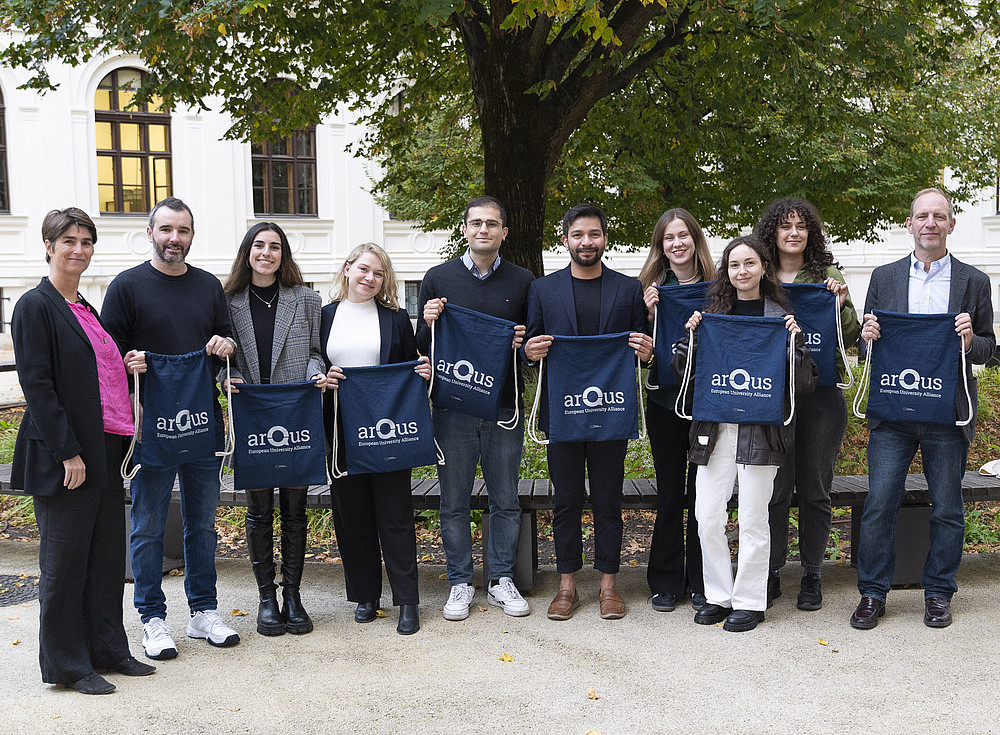
A group of people holding a bag with the inscription Arqus.

The photo shows the students with Vice Rector Mireille Van Poppel (left) and Florian Bieber (right), director of the Center for Southeast European Studies. Credit: Uni Graz/Angele

Sie profitieren von der Expertise und dem Netzwerk der vier teilnehmenden Universitäten und werden bestens auf die globalen Herausforderungen vorbereitet, mit denen die europäische Gesellschaft konfrontiert ist.

Vizerektorin für Internationalisierung Mireille Van Poppel begrüßte am neunten Oktober die zehn Erstbeleger des Joint Masters Programm: „Um Europa zu verstehen, muss man über die Grenzen des eigenen Landes hinausblicken. Das neue Studium „European Studies“ macht genau das möglich. Das Arqus-Netzwerk vereinfacht dabei den Zugang zu den anderen Universitäten. Wir freuen uns, als Universität Teil dieser Gemeinschaft zu sein und unsere Kompetenz einzubringen.“

Das neue, englischsprachige Masterstudium widmet sich Problemstellungen, wie zum Beispiel die Rolle Europas in der aktuellen Weltpolitik oder den Auswirkungen globaler Entwicklungen auf den Kontinent. Das Besondere: Studierende der Uni Graz können das Studium an Universitäten in vier Ländern absolvieren. Neben Österreich (Graz) sind das Spanien (Granada), Litauen (Vilnius) und Deutschland (Leipzig). Abgeschlossen wird der Studiengang mit dem Titel "Master of Arts", den alle vier Universitäten gemeinsam verleihen.

Die Uni Graz bietet dabei Expertise in den Bereichen Südosteuropa, Frieden, Migration und Klimawandel sowie dem Umgang mit Vielfalt in unseren Gesellschaften. 

Entstanden ist der Joint Master unter dem Dach von Arqus, einer Allianz aus neun europäischen Universitäten. Als besonderes „Zuckerl“ können die Teilnehmenden zusätzlich zu den regulären Auslandsaufenthalten ein Austauschsemester und/oder ein Praktikum an einer jener fünf Universitäten absolvieren, die nicht Teil des Joint-Master-Konsortiums sind: Lyon 1 (Frankreich), Maynooth (Irland), Minho (Portugal), Padua (Italien) und Wroclaw (Polen). Für die physische Mobilität können die Studierenden um ein Erasmus+ Stipendium ansuchen, das die erhöhten Lebenskosten deckt.

Weitere Infos online auf: https://arqus-alliance.eu/master-european-studies/
Related news

Around the world in eight stops: the Long Night of Research at the University of Graz

On 24 April from 5 pm, you can take a short trip around the globe at the University of Graz, discovering pecularities of foreign countries or new local features in the entrance hall of the University Library. The itinerary takes you through introduced animal species, political attitudes and the omnipotence of algorithms. There will also be a programme in the historic reading hall, as well as at the UniGraz@Museum and the University Archive.

Studying at the University of Graz: How to enrol

Ready for a new chapter in your life with the start of your studies at the University of Graz in the winter semester 2026/27? Here you will find information on deadlines, admission procedures, registration, and everything else you need to successfully start your studies in the fall.

Interpreting data: Why studies sometimes get it wrong

Hilmar Brohmer and Ziva Korda from the Institute of Psychology, together with 500 international colleagues, have re-evaluated a hundred scientific publications and have often come to different conclusions.

Crystal-clear: AI method revolutionises solar observation

The Sun makes life on Earth possible. However, its magnetic fields can also cause massive disruption. This makes it all the more important to gain a better understanding of the processes taking place on our nearest star. A research team from the University of Graz and the High Altitude Observatory in Boulder (USA) has succeeded in doing just that. The astrophysicists have developed an AI-supported method that makes even the smallest structures on the Sun visible. The scientists are convinced that this will bring about a lasting change in solar observation and that the new method can be used for the planned European Solar Telescope.

Begin of page section:
Additional information:

University of Graz
Universitaetsplatz 3
8010 Graz
Austria
  • Contact
  • Web Editors
  • Moodle
  • UNIGRAZonline
  • Imprint
  • Data Protection Declaration
  • Accessibility Declaration
Weatherstation
Uni Graz

End of this page section. Go to overview of page sections

End of this page section. Go to overview of page sections

Begin of page section:

End of this page section. Go to overview of page sections