



The Federal Government intends to make just under 16 billion euros available to Austrian universities as a block grant for the years 2028–2030, describing this as ‘constant’ funding. At a press conference (view here), Brigitte Hütter, President of the Austrian University Conference (uniko), refutes this claim: “This is not a constant budget, but a massive cut to the budget for 2028 to 2030.” The government is, she claims, manipulating the figures to make them look better. There is no provision to offset inflation, and the announced 16 billion euros would include expenditure that was previously covered by special funds, such as doctors’ salaries and the new IT:U in Linz.
Hütter anticipates serious consequences for teaching, research and administration. Fixed costs such as rent cannot be reduced accordingly; moreover, the current inflation rate of 3.6 per cent exceeds the original assumptions. “Under these circumstances, we can no longer deliver the same level of service.” Hütter warns of a possible cut of around 6,800 posts, restrictions on the range of courses on offer, and the closure of degree programmes. Cost-intensive areas such as STEM subjects and research projects requiring extensive infrastructure and additional funding would also be particularly affected.
A shift away from research policy
Peter Riedler, Rector of the University of Graz, disputes the federal government’s assumption that the financial situation of universities will improve once the government’s austerity target has been met. “If the government does not achieve savings in other areas of the budget, the situation facing universities will not ease even after 2031.” He sees the budget proposal as a departure from a goal-oriented science and research policy that has been very successful to date, as demonstrated by the numerous ERC grants and clusters of excellence.
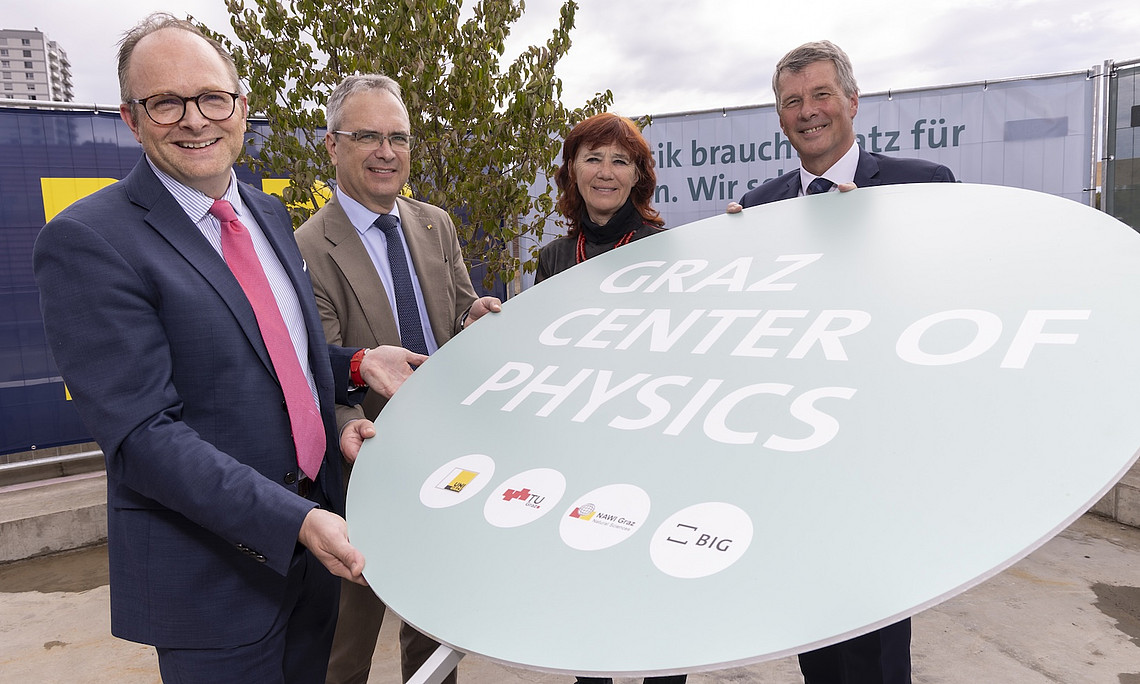
Riedler also expects staff cuts at the University of Graz. Natural wastage is unlikely to be sufficient, as it does not necessarily occur in those areas where staff reductions are required. “Once the Graz Centre of Physics is completed, there will probably be no money left for the necessary equipment for the research infrastructure run jointly with Graz University of Technology.”
Investments have borne fruit
Sebastian Schütze, Rector of the University of Vienna, emphasises that the universities are, in principle, prepared to contribute to cost-cutting measures. However, he argues that the scale of the cuts is disproportionate. Especially as the investments made to date have clearly yielded positive results. Significantly more third-party funding and EU grants have been secured, the student-tutor ratio has improved, and the universities have risen considerably in the rankings. “This is precisely what previous governments had demanded of us, and we have met those targets. Yet, in response to these successes, drastic cuts are now being threatened.”
He does, however, see room for improvement. This, however, lies primarily in the hands of politicians. A comprehensive higher education strategy must take into account the entire system of 77 higher education institutions and define more clearly the different roles of universities, universities of applied sciences and private universities.
A blow to industry and the economy
Jens Schneider, Rector of TU Wien and representative of TU Austria, sees the impending cuts as a serious blow to industry and the economy. In future, technical universities may be less able to contribute to industrial strategy, start-ups and innovation, as well as to future-oriented fields such as artificial intelligence and cybersecurity. “Technical universities, in particular, rely on modern laboratories and expensive, cost-intensive equipment.”
Schneider says, it is very unfair to portray staff as inefficient. University staff are highly motivated and regularly go far beyond what is contractually agreed. “I come from the private sector, and I have never experienced such a high level of efficiency there as I have at the universities.” This makes it all the more painful for him that, due to the short-term nature of the budget, universities are forced to take action, particularly with regard to fixed-term contracts, which will mainly affect younger staff.
Uniko Chair Brigitte Hütter sees the budget proposal as a massive loss of trust in the Minister for Science and criticises the fact that the assessments of specialist civil servants appear to have little influence on political decisions. Uniko intends to continue publicising the consequences of the cuts and, together with student representatives, university senates, trade unions and lecturers, will be protesting at the large-scale demonstration in Vienna this coming Thursday.