Begin of page section:
Page sections:

  • Go to contents (Accesskey 1)
  • Go to position marker (Accesskey 2)
  • Go to main navigation (Accesskey 3)
  • Go to sub navigation (Accesskey 4)
  • Go to additional information (Accesskey 5)
  • Go to page settings (user/language) (Accesskey 8)
  • Go to search (Accesskey 9)

End of this page section. Go to overview of page sections

Begin of page section:
Page settings:

English en
Deutsch de
Search
Login

End of this page section. Go to overview of page sections

Begin of page section:
Search:

Search for details about Uni Graz
Close

End of this page section. Go to overview of page sections


Search

Begin of page section:
Main navigation:

Page navigation:

  • University

    University
    • About the University
    • Organisation
    • Faculties
    • Library
    • Working at University of Graz
    • Campus
    Developing solutions for the world of tomorrow - that is our mission. Our students and our researchers take on the great challenges of society and carry the knowledge out.
  • Research Profile

    Research Profile
    • Our Expertise
    • Research Questions
    • Research Portal
    • Promoting Research
    • Research Transfer
    • Ethics in Research
    • Commission for Scientific Integrity
    Scientific excellence and the courage to break new ground. Research at the University of Graz creates the foundations for making the future worth living.
  • Studies

    Studies
    • Prospective Students
    • Students
  • Community

    Community
    • International
    • Location
    • Research and Business
    • Alumni
    The University of Graz is a hub for international research and brings together scientists and business experts. Moreover, it fosters the exchange and cooperation in study and teaching.
  • Spotlight
Topics
  • Sustainable University
  • Researchers answer
  • Work for us
Close menu

End of this page section. Go to overview of page sections

Begin of page section:
You are here:

University of Graz News Step by step: What motivates Mireille van Poppel as a scientist and vice-rector

End of this page section. Go to overview of page sections

Monday, 02 March 2026

Step by step: What motivates Mireille van Poppel as a scientist and vice-rector

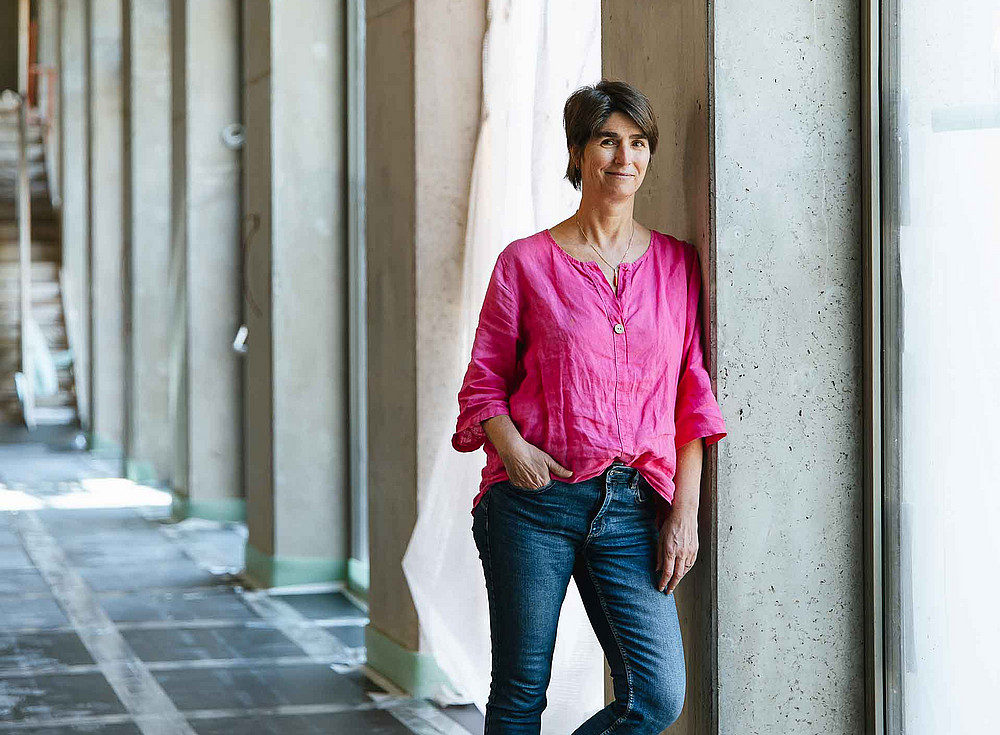
Mireille van Poppel

Mireille van Poppel is a medical biologist and professor at the Department for Human Movement Sciences, Sport and Health. Photo: Uni Graz/Kanizaj

Improving people's health and eliminating inequalities: Mireille van Poppel pursues these goals both as a public health researcher and as vice-rector for Internationalisation and Equality. In both roles, she pays particular attention to individual needs.

It starts in primary school. “On average, boys are more active than girls,” says Mireille van Poppel. And women tend to remain less active, especially during pregnancy and periods when they have a lot of care responsibilities, explains the medical biologist. Men tend to prefer performance- or competition-oriented sports activities, but they are often difficult to motivate to engage in everyday exercise. “A few years ago, a campaign to walk 10,000 steps a day was launched in Queensland, Australia,” recalls van Poppel. However, it was mainly women who took part in the campaign. ‘Of course, these are generalisations. On an individual level, the motivation to be physically active can be very different,’ adds the researcher. This is also the challenge for public health: on the one hand, addressing the entire population, and on the other hand, individualising programmes according to needs and situations.

Balancing differences

As Vice-Rector for Internationalisation and Equality, tailor-made solutions are also a key concern for Mireille van Poppel: "Women do not form a homogeneous group. They are at different stages of life, have different working environments and different needs." These factors also include aspects of diversity. "In recent years, many teams have succeeded in balancing gender differences and breaking down exclusionary mechanisms," says van Poppel, pointing to successes.

In general, women at the University of Graz are on the fast track: with 62 per cent female students, two-thirds female graduates and 57 per cent female employees, they make up the majority in many areas. While three of six faculties are headed by female deans – Katharina Pyschny (Catholic Theology), Gabriele Schmölzer (law) and Andrea Steiner (environmental, regional and educational sciences) – there is still room for improvement at the departments, where just under a third of the heads are women. Women have caught up significantly in the last 25 years in terms of professorships: in 2000, they accounted for six per cent, but this figure has now risen to over 36 per cent.

created by Andreas Schweiger

Related news

Climate research in Greenland: Old data provides new insights

The polar explorer and University of Graz professor Alfred Wegener left behind a unique collection of climate data from Greenland. A research team from the University of Graz is now analysing this 100-year-old treasure trove of data and comparing it with current measurements.

Diversity in nature and science: How we talk about plants and each other

Ginkgo, kiwi, hemp: they exist as male and female plants. Anyone who paid attention in biology class will confirm this. But is this categorisation, established by Carl von Linné almost 300 years ago, still valid today? An interdisciplinary team at the University of Graz is questioning these attributions and using this as a starting point to provide food for thought for gender-sensitive interaction between students, scientific and teaching staff.

Around the world in eight stops: the Long Night of Research at the University of Graz

On 24 April from 5 pm, you can take a short trip around the globe at the University of Graz, discovering pecularities of foreign countries or new local features in the entrance hall of the University Library. The itinerary takes you through introduced animal species, political attitudes and the omnipotence of algorithms. There will also be a programme in the historic reading hall, as well as at the UniGraz@Museum and the University Archive.

Studying at the University of Graz: How to enrol

Ready for a new chapter in your life with the start of your studies at the University of Graz in the winter semester 2026/27? Here you will find information on deadlines, admission procedures, registration, and everything else you need to successfully start your studies in the fall.

Begin of page section:
Additional information:

University of Graz
Universitaetsplatz 3
8010 Graz
Austria
  • Contact
  • Web Editors
  • Moodle
  • UNIGRAZonline
  • Imprint
  • Data Protection Declaration
  • Accessibility Declaration
Weatherstation
Uni Graz

End of this page section. Go to overview of page sections

End of this page section. Go to overview of page sections

Begin of page section:

End of this page section. Go to overview of page sections