



Begin of page section:
Page sections:

  • Go to contents (Accesskey 1)
  • Go to position marker (Accesskey 2)
  • Go to main navigation (Accesskey 3)
  • Go to sub navigation (Accesskey 4)
  • Go to additional information (Accesskey 5)
  • Go to page settings (user/language) (Accesskey 8)
  • Go to search (Accesskey 9)

End of this page section. Go to overview of page sections

Begin of page section:
Page settings:

English en
Deutsch de
Search
Login

End of this page section. Go to overview of page sections

Begin of page section:
Search:

Search for details about Uni Graz
Close

End of this page section. Go to overview of page sections


Search

Begin of page section:
Main navigation:

Page navigation:

  • University

    University
    • About the University
    • Organisation
    • Faculties
    • Library
    • Working at University of Graz
    • Campus
    Developing solutions for the world of tomorrow - that is our mission. Our students and our researchers take on the great challenges of society and carry the knowledge out.
  • Research Profile

    Research Profile
    • Our Expertise
    • Research Questions
    • Research Portal
    • Promoting Research
    • Research Transfer
    • Ethics in Research
    • Commission for Scientific Integrity
    Scientific excellence and the courage to break new ground. Research at the University of Graz creates the foundations for making the future worth living.
  • Studies

    Studies
    • Prospective Students
    • Students
  • Community

    Community
    • International
    • Location
    • Research and Business
    • Alumni
    The University of Graz is a hub for international research and brings together scientists and business experts. Moreover, it fosters the exchange and cooperation in study and teaching.
Topics
  • Sustainable University
  • Researchers answer
  • Work for us
Close menu

End of this page section. Go to overview of page sections

Begin of page section:
You are here:

University of Graz News Study and research more beautifully: How the Campus 2025 is evolving

End of this page section. Go to overview of page sections

Tuesday, 10 December 2024

Study and research more beautifully: How the Campus 2025 is evolving

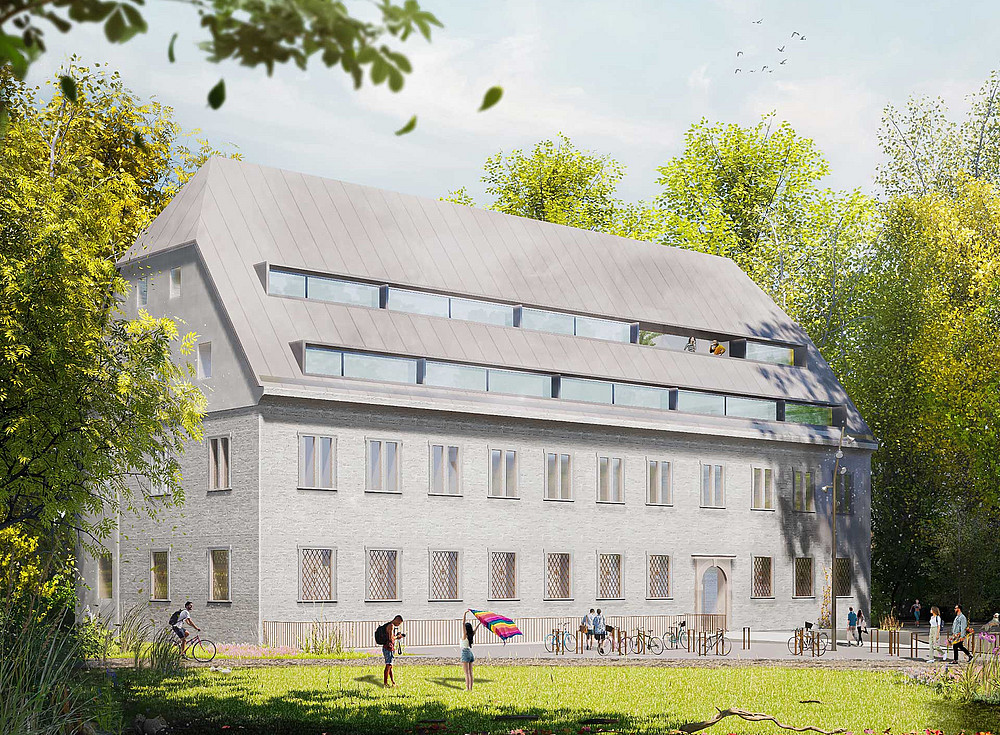
Rendering of the Jesuit refectory

This is what the refurbished Jesuit refectory will look like. The Institute of Human Movement Sciences, Sport and Health will be researching and teaching there in autumn 2025. Photo: lebidris-Daniel Neubauer

It is a research centre, place of study, workplace and living space all in one. The green, inner-city campus of the University of Graz fulfils numerous requirements. And it is constantly evolving. Currently with striking new buildings and renovations: the Graz Centre of Physics, the House of Educational Sciences and the refurbished Jesuit Refectory. "Sustainability aspects are incorporated into all planning and implementation phases in order to achieve the goal of climate neutrality," emphasises Rector Peter Riedler.

They have characterised the campus for exactly 150 years: the institute buildings for Chemistry at Universitätsplatz 1 and for Physics at Universitätsplatz 5 are celebrating their birthdays in 2025. In the 1870s, the Physics Building was considered to be one of the most advanced of its time: Observation louvres made it possible to direct sunlight for optical experiments. Experiment tables could be mechanically decoupled from the building by insulated columns in the floor. Iron-free laboratories for galvanometric measurements and specially insulated rooms for thermal investigations were set up.

The story continues right next door. Just a few metres away from the historic building, the Graz Center of Physics is one of the most modern research centres in Austria. Following the spectacular demolition of the former pre-clinic, the architecturally impressive complex will begin to rise in the spring.

Construction workers are also at work directly opposite: the former medical institute building for hygiene and forensic medicine is being converted into the House of Educational Sciences. Completion is planned for 2027.

However, the opening is already planned for this year. The Institute of Human Movement Sciences, Sport and Health will take up work in the former, completely renovated Jesuit refectory on Rosenhain from the 2025/26 winter semester. With 50 workstations, a lecture theatre and seminar rooms for almost 300 people as well as event rooms with modern equipment on a total of five floors, the Jesuit Refectory will expand the infrastructure of the University of Graz.

created by Andreas Schweiger

Related news

Survival strategies: How plants respond to drought

According to Geosphere Austria, this spring was the driest in Austria since records began around 170 years ago. The low rainfall put particular pressure on the agricultural sector. And climate change is set to make the situation even worse in the coming decades. We asked Johannes Liesche, a professor at the Department of Biology at the University of Graz, how plants react to water shortages and how they survive periods of drought.

World literature from Austria: Anne-Kathrin Reulecke on Ingeborg Bachmann

On 25 June, Ingeborg Bachmann would have turned 100. To this day, she remains one of the most important German-language authors. Anne-Kathrin Reulecke, Professor of Modern German Literature at the Institute of German Studies, has conducted extensive research into the writer, who died in 1973. The academic explains why Bachmann continues to be influential and what makes her work so special. In addition to her literary analysis, Anne-Kathrin Reulecke shares some reading recommendations.

What matters in the end: moral theologian takes stock of assisted suicide

Since 1 January 2022, assisted suicide has been legal in Austria under certain conditions. This was made possible by a ruling of the Constitutional Court, which overturned the blanket ban on assisting in suicide. Four years on, it is clear that: “Although the legal framework is in place, many pressing questions remain unanswered when it comes to its practical implementation,” says Johann Platzer, a moral theologian at the University of Graz.

Noise is the signal: new simulation method enables secure communication

Researchers from Graz, Vienna and Munich have developed a new simulation method that makes it possible to calculate quantum light using classical software – a step towards secure quantum communication.

Begin of page section:
Additional information:

University of Graz
Universitaetsplatz 3
8010 Graz
Austria
  • Contact
  • Web Editors
  • Moodle
  • UNIGRAZonline
  • Imprint
  • Data Protection Declaration
  • Accessibility Declaration
Weatherstation
Uni Graz

End of this page section. Go to overview of page sections

End of this page section. Go to overview of page sections

Begin of page section:

End of this page section. Go to overview of page sections