



Begin of page section:
Page sections:

  • Go to contents (Accesskey 1)
  • Go to position marker (Accesskey 2)
  • Go to main navigation (Accesskey 3)
  • Go to sub navigation (Accesskey 4)
  • Go to additional information (Accesskey 5)
  • Go to page settings (user/language) (Accesskey 8)
  • Go to search (Accesskey 9)

End of this page section. Go to overview of page sections

Begin of page section:
Page settings:

English en
Deutsch de
Search
Login

End of this page section. Go to overview of page sections

Begin of page section:
Search:

Search for details about Uni Graz
Close

End of this page section. Go to overview of page sections


Search

Begin of page section:
Main navigation:

Page navigation:

  • University

    University
    • About the University
    • Organisation
    • Faculties
    • Library
    • Working at University of Graz
    • Campus
    Developing solutions for the world of tomorrow - that is our mission. Our students and our researchers take on the great challenges of society and carry the knowledge out.
  • Research Profile

    Research Profile
    • Our Expertise
    • Research Questions
    • Research Portal
    • Promoting Research
    • Research Transfer
    • Ethics in Research
    • Commission for Scientific Integrity
    Scientific excellence and the courage to break new ground. Research at the University of Graz creates the foundations for making the future worth living.
  • Studies

    Studies
    • Prospective Students
    • Students
    • Registration for Study Programme (Winter semester 2026/27)
    • Welcome Weeks for First Year Students
  • Community

    Community
    • International
    • Location
    • Research and Business
    • Alumni
    The University of Graz is a hub for international research and brings together scientists and business experts. Moreover, it fosters the exchange and cooperation in study and teaching.
Topics
  • Sustainable University
  • Researchers answer
  • Work for us
Close menu

End of this page section. Go to overview of page sections

Begin of page section:
You are here:

University of Graz News “Roter Stern über Graz”: Barbara Stelzl-Marx's book about the Soviet occupation in 1945

End of this page section. Go to overview of page sections

Friday, 04 April 2025

“Roter Stern über Graz”: Barbara Stelzl-Marx's book about the Soviet occupation in 1945

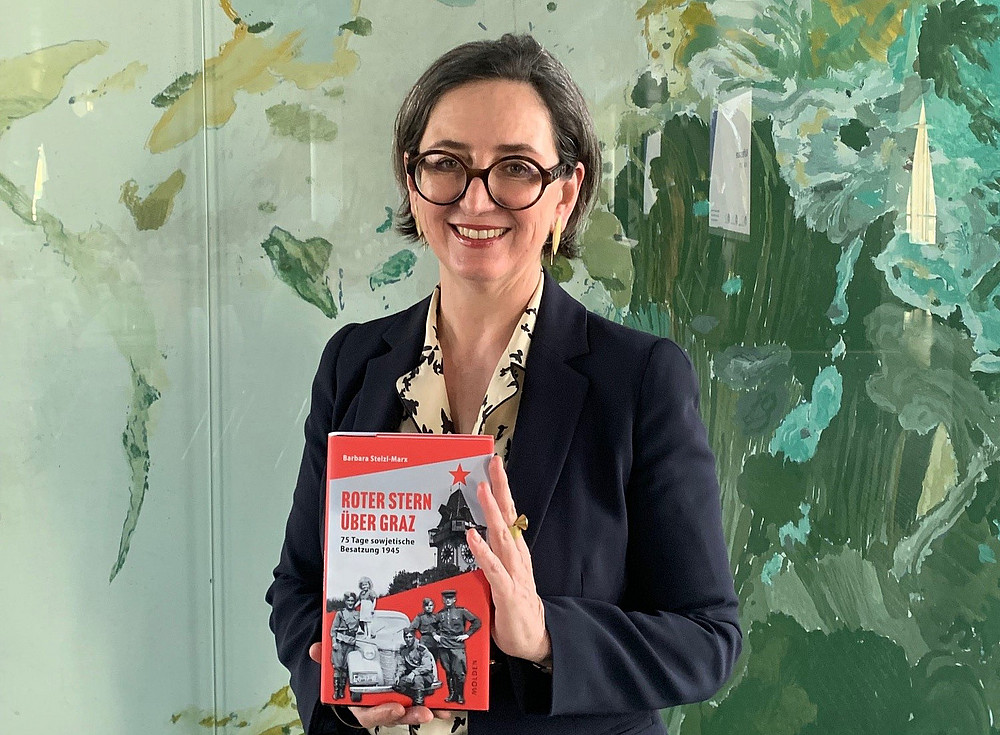
Barbara Stelzl-Marx with the book "Roter Stern über Graz" in her hand ©BIK
©BIK

In her book "Roter Stern über Graz", Barbara Stelzl-Marx describes how the people of Graz experienced the 75 days of Soviet occupation in 1945. Photo: BIK

When the Styrian capital was occupied by the Red Army on 9 May 1945, fear and uncertainty mingled with relief at the end of the war for the majority of the population. The British had actually been expected. They took over eleven weeks later. Although the time under Soviet occupation was short-lived, it left deep traces in the collective memory and in personal life stories. Based on archive documents and interviews with contemporary witnesses, historian Barbara Stelzl-Marx describes the everyday life of the people in the first weeks after the war in her new book "Roter Stern über Graz" in a well-founded and detailed manner.


During the night of 8 to 9 May 1945, units of the 57th Army of the 3rd Ukrainian Front liberated Graz. The Styrian capital was handed over to the Red Army without resistance. Graz was subsequently under Soviet occupation for 75 days before the British took over the administration of Styria as part of the zone exchange on 23/24 July. "It was a social and emotional state of emergency that people in the former ‘Stadt der Volkserhebung’ found themselves in at the time," says Barbara Stelzl-Marx, contemporary historian at the University of Graz and head of the Ludwig Boltzmann Institute for Research on Consequences of War. In her new book "Roter Stern über Graz", she impressively describes how people experienced every day as a challenge.

For the first time, she drew on in-depth analyses of archive documents, newspaper articles and diary entries as well as interviews with 80 contemporary witnesses. "For the research project, we used the media to find people who experienced the end of the war and the eleven weeks that followed in Graz as children or young people and wanted to tell us about it. Many more came forward than we had expected," reports Stelzl-Marx. The result is a captivating narrative non-fiction book with elements of oral history.

Book presentation:
Barbara Stelzl-Marx: Roter Stern über Graz. 75 Tage sowjetische Besatzung 1945, Molden Verlag 2025
Thursday, 10 April 2025, 7:30 pm 
Moser bookshop, Am Eisernen Tor 1, 8010 Graz
Please register at veranstaltungen(at)styriabooks.at. 

A cooperation event between Styria Books, the University of Graz and the Ludwig Boltzmann Institute for Research on Consequences of War

https://www.styriabooks.at/shop/gesellschaft-geschichte/roter-stern-ueber-graz


⇒ If you are interested in how the past affects our present and future, you can study History at the University of Graz.

created by Gudrun Pichler

Related news

Commissioned by NATO: University of Graz tests high-tech textiles

As part of an international project, antimicrobial and fire-resistant fabrics with UV protection are being developed in Zagreb. Pharmacists from the University of Graz are ensuring that these fabrics are skin-friendly.

The Arctic up close: ORF special feature on the University of Graz’s research station in S

Students from the University of Graz are spending two weeks conducting research at the Univerisity of Graz research station at the Sermilik Fjord in Greenland, which has been operational for three years. They are measuring glacial runoff, tracking ice melt in real time and installing weather stations. ORF is following the expedition and will be reporting on the special feature ‘Arctic Adventure’ across its various channels from 20 July.

Medicine for ants: Caffeine prolongs the life of infected insects

Black coffee stimulates us and acts against bacteria. So, can caffeine also be good for insects? Yes, confirm biologists of the University of Graz. When ants suffer from a fungal disease, they consume more caffeine and remain active for longer.

How formulas are making medicine more personalised

When Federica Caforio talks about the heart, it doesn’t sound like an operating theatre, but rather like equations, parameters and simulations. Yet this is precisely where the medical promise of her research lies: one day, clinical data will be used to create a digital twin of the heart – a virtual model that will enable a better understanding of diseases and allow for more personalised treatment plans. She will be presenting her research at the ‘ECMTB 2026’ mathematics conference.

Begin of page section:
Additional information:

University of Graz
Universitaetsplatz 3
8010 Graz
Austria
  • Contact
  • Web Editors
  • Moodle
  • UNIGRAZonline
  • Imprint
  • Data Protection Declaration
  • Accessibility Declaration
Weatherstation
Uni Graz

End of this page section. Go to overview of page sections

End of this page section. Go to overview of page sections

Begin of page section:

End of this page section. Go to overview of page sections