



Begin of page section:
Page sections:

  • Go to contents (Accesskey 1)
  • Go to position marker (Accesskey 2)
  • Go to main navigation (Accesskey 3)
  • Go to sub navigation (Accesskey 4)
  • Go to additional information (Accesskey 5)
  • Go to page settings (user/language) (Accesskey 8)
  • Go to search (Accesskey 9)

End of this page section. Go to overview of page sections

Begin of page section:
Page settings:

English en
Deutsch de
Search
Login

End of this page section. Go to overview of page sections

Begin of page section:
Search:

Search for details about Uni Graz
Close

End of this page section. Go to overview of page sections


Search

Begin of page section:
Main navigation:

Page navigation:

  • University

    University
    • About the University
    • Organisation
    • Faculties
    • Library
    • Working at University of Graz
    • Campus
    Developing solutions for the world of tomorrow - that is our mission. Our students and our researchers take on the great challenges of society and carry the knowledge out.
  • Research Profile

    Research Profile
    • Our Expertise
    • Research Questions
    • Research Portal
    • Promoting Research
    • Research Transfer
    • Ethics in Research
    • Commission for Scientific Integrity
    Scientific excellence and the courage to break new ground. Research at the University of Graz creates the foundations for making the future worth living.
  • Studies

    Studies
    • Prospective Students
    • Students
    • Welcome Weeks for First Year Students
  • Community

    Community
    • International
    • Location
    • Research and Business
    • Alumni
    The University of Graz is a hub for international research and brings together scientists and business experts. Moreover, it fosters the exchange and cooperation in study and teaching.
Topics
  • Sustainable University
  • Researchers answer
  • Work for us
Close menu

End of this page section. Go to overview of page sections

Begin of page section:
You are here:

University of Graz News ERC Starting Grants: three million euros for two researchers at the University of Graz

End of this page section. Go to overview of page sections

Thursday, 03 September 2026

ERC Starting Grants: three million euros for two researchers at the University of Graz

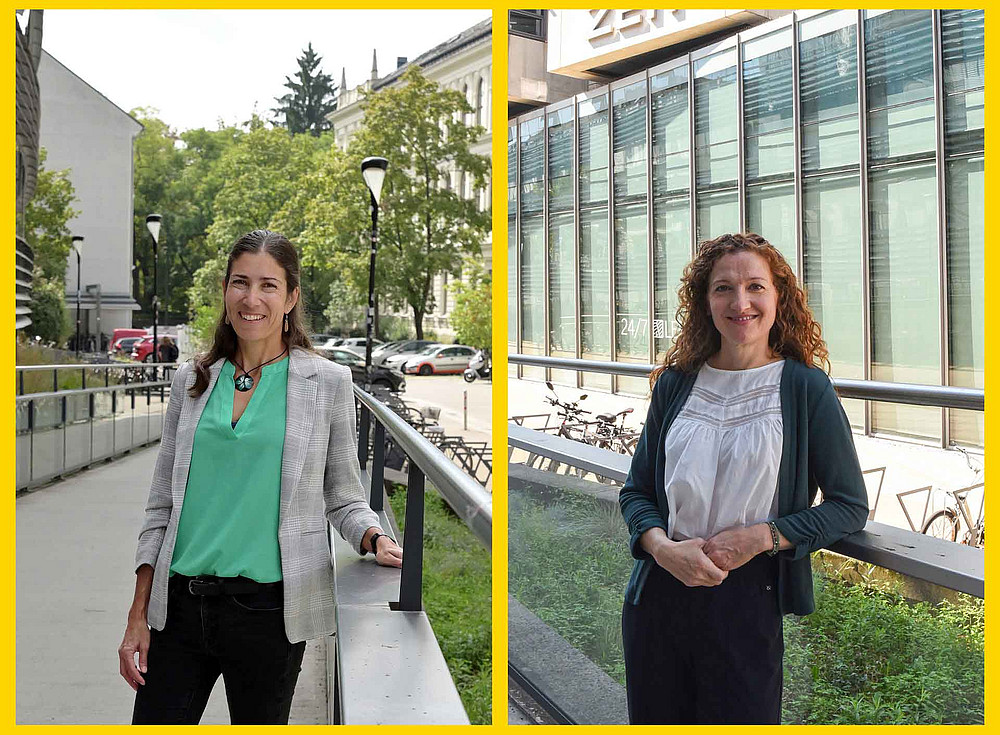
Two women are standing by a glass balustrade; buildings can be seen in the background ©University of Graz/Pichler&Schweiger
©University of Graz/Pichler&Schweiger

Heide Bruckner and Silvana Weiss (from left to right) have each received 1.5 million euros from the European Research Council (ERC) for their projects.

Two researchers from the University of Graz have secured prestigious and generously funded grants from the EU. Starting Grants from the European Research Council (ERC), each worth 1.5 million euros, have been awarded to the human geographer Heide Bruckner and the social scientist Silvana Weiss.

In her project, Heide Bruckner aims to give a voice to the people of the Fiji and Solomon Islands in the Pacific. She is focusing on the relationship between the people and the mangrove forests of their homeland as a key element in the protection of these valuable ecosystems.
Silvana Weiss is investigating how the factor of time influences opportunities and fairness in the world of work. Her research centres on the question of how organisational demands, in conjunction with individuals’ available time, create, reinforce or reduce inequalities.

Rector Peter Riedler congratulates the two researchers and is delighted with this great success: “The University of Graz supports promising talents in realising their full potential. Securing international funding is of great importance to the University and to Graz as a centre of science.”

Indigenous narratives against colonial narratives

Fiji and the Solomon Islands are home to the largest mangrove forests in the Pacific. These ecosystems fulfil vital functions in climate protection. On the one hand, they capture carbon from the atmosphere; on the other, they protect coastlines from erosion and flooding as sea levels rise. Yet their protection cannot be taken for granted. In Fiji, mangrove forests are to make way for sandy beaches for tourists. In the Solomon Islands, they must give way to transport routes for timber exports by Malaysian and Chinese companies. Even during British colonial rule, mangrove forests were cleared to build harbours along the coast.
“Drawing on archival research, we will take a critical look at this legacy and highlight how it continues to have an impact on the economy and society to this day,” explains Heide Bruckner. She wants the islanders to tell their own stories – about their traditions, experiences and emotions – which have bound their communities to the mangroves for centuries. These stories are intended to empower people to shape their own futures. “After all, our relationship with a landscape influences the way we treat it. We must perceive nature with all our senses in order to deepen our relationship with it and our care for it,” emphasises Heide Bruckner.
⇒ Find out more

Researcher investigates the influence of time in the world of work

Submission deadlines, project deadlines, work rota, but also personal circumstances – time plays a central role in working life. Social scientist Silvana Weiss is investigating how this factor influences opportunities and fairness in the workplace.
“It starts right from the application process,” the researcher points out. When is the vacancy advertised? How long is the application period? When are candidates invited for an interview? “If a person has care responsibilities or falls ill, this can exclude them, even though formally the same conditions apply to all applicants,” explains the scientist at the Department of Human Resource Management at the University of Graz. Time-related mechanisms shape the entire day-to-day working routine. The greater emphasis on work-life balance, as well as the increasing use of AI, are further changing perspectives on the issue.
Weiss highlights the importance of the time factor by posing a number of questions: “How long are people working? At what pace? At what time are meetings scheduled? The crucial question is: who can meet these demands, and who is disadvantaged or, conversely, favoured as a result?”
The social scientist aims to find answers to these questions with the help of case studies across various professional fields, including the IT and software sectors, as well as the health and care sectors. In addition, she is tracking career progression through repeated interviews and analysing European labour market data.
⇒ Find out more
created by Gudrun Pichler & Andreas Schweiger

Related news

Austria’s emissions rose in 2025: University of Graz researchers analyse the causes

The Environment Agency Austria has today published the figures for the country’s greenhouse gas emissions in 2025. While emissions fell sharply year on year from 2022 to 2024, they rose again by just under 0.7 per cent in 2025. Researchers at the University of Graz have analysed how much of this increase was due to structural changes in the economy and how much was attributable to external factors over which there is little control. “In 2025, the colder winter compared with 2024 increased emissions by 0.81 per cent, while the weak economy reduced them by 0.38 per cent. If we factor out these influences, we find an underlying increase of 0.26 per cent compared with the previous year,” reports economist Karl Steininger. “This clearly means that Austria is not on track to meet its climate targets, which require a substantial reduction in emissions by 2030.”

Electrifying: Researchers film the first moments on the way from light to electricity

Physicists at the University of Graz (Austria), in collaboration with colleagues from Marburg University and Forschungszentrum Jülich (Germany), have achieved a scientific breakthrough. For the first time, the generation of electrical energy from light has been filmed and described theoretically. This work is of far-reaching significance, not least for optimising sustainable energy production from photovoltaics. This is because it provides fundamental building blocks for understanding the physical processes that take place, for example, in organic solar cells. The paper was published in the journal Physical Review X, one of the world’s most prestigious physics journals.

University of Graz: Working together to make Styria a sustainable centre of learning

Round table calls for sustainable funding for the 2028–2030 performance agreement period between the five Styrian universities and the federal government.

How can we teach using YouTube and AI? The University of Graz is strengthening media education in schools

A journey through the blood vessels using VR headsets brings biology lessons to life. An interactive quiz brings physics to life. The YouTube video explains the First World War. Whilst mobile phones are increasingly being banned from the classroom, social media platforms, apps and AI are playing an ever-greater role in knowledge transfer at school. But how can teaching with media be made even more effective? What are the challenges in media-based teaching? At the University of Graz, researchers are discussing these issues at a conference being held in Austria for the first time.

Begin of page section:
Additional information:

University of Graz
Universitaetsplatz 3
8010 Graz
Austria
  • Contact
  • Web Editors
  • Moodle
  • UNIGRAZonline
  • Imprint
  • Data Protection Declaration
  • Accessibility Declaration
Weatherstation
Uni Graz

End of this page section. Go to overview of page sections

End of this page section. Go to overview of page sections

Begin of page section:

End of this page section. Go to overview of page sections

