Begin of page section:
Page sections:

  • Go to contents (Accesskey 1)
  • Go to position marker (Accesskey 2)
  • Go to main navigation (Accesskey 3)
  • Go to sub navigation (Accesskey 4)
  • Go to additional information (Accesskey 5)
  • Go to page settings (user/language) (Accesskey 8)
  • Go to search (Accesskey 9)

End of this page section. Go to overview of page sections

Begin of page section:
Page settings:

English en
Deutsch de
Search
Login

End of this page section. Go to overview of page sections

Begin of page section:
Search:

Search for details about Uni Graz
Close

End of this page section. Go to overview of page sections


Search

Begin of page section:
Main navigation:

Page navigation:

  • University

    University
    • About the University
    • Organisation
    • Faculties
    • Library
    • Working at University of Graz
    • Campus
    Developing solutions for the world of tomorrow - that is our mission. Our students and our researchers take on the great challenges of society and carry the knowledge out.
  • Research Profile

    Research Profile
    • Our Expertise
    • Research Questions
    • Research Portal
    • Promoting Research
    • Research Transfer
    • Ethics in Research
    • Commission for Scientific Integrity
    Scientific excellence and the courage to break new ground. Research at the University of Graz creates the foundations for making the future worth living.
  • Studies

    Studies
    • Prospective Students
    • Students
  • Community

    Community
    • International
    • Location
    • Research and Business
    • Alumni
    The University of Graz is a hub for international research and brings together scientists and business experts. Moreover, it fosters the exchange and cooperation in study and teaching.
Topics
  • Sustainable University
  • Researchers answer
  • Work for us
Close menu

End of this page section. Go to overview of page sections

Begin of page section:
You are here:

University of Graz News Noise is the signal: new simulation method enables secure communication

End of this page section. Go to overview of page sections

Wednesday, 03 June 2026

Noise is the signal: new simulation method enables secure communication

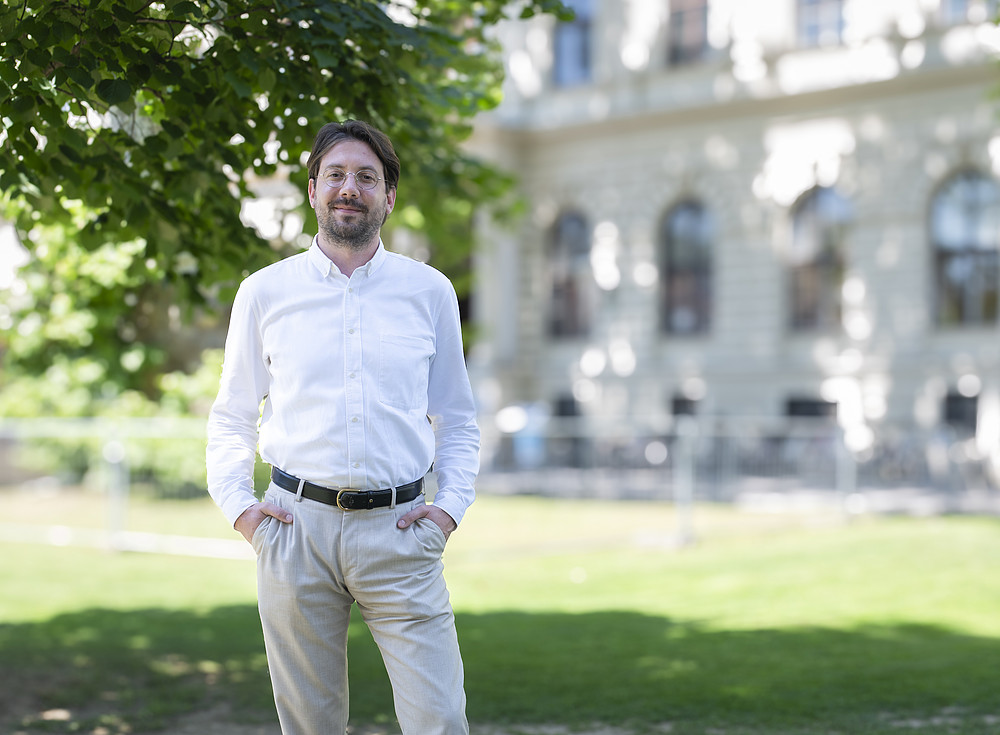
Ein Mann mit weißem Hemd steht auf einer Wiese ©Uni Graz/Angele

Der Physiker Felix Hitzelhammer forscht auf dem Gebiet der Quantenkommunikation. Foto: Uni Graz/Angele

Researchers from Graz, Vienna and Munich have developed a new simulation method that makes it possible to calculate quantum light using classical software – a step towards secure quantum communication.

Tapp-proof communication is regarded as one of the great promises of quantum physics. In this process, information is transmitted using individual particles of light – known as photons – and is encoded and decoded using a special key that is generated with every measurement. The key feature of quantum cryptography is that if an external attempt is made to intercept the signal, the key changes. Until now, it has only been possible to a limited extent to transfer certain properties of quantum light – which is required for quantum cryptography – into the classical world. 

A team of researchers from the University of Graz, the University of Vienna and the Technical University of Munich has now developed a method enabling classical, commercial light simulations to capture key properties of quantum light. The new approach is intended to facilitate the development of components for eavesdropping-proof quantum communication, quantum computers and quantum sensors. The results have been published in the prestigious journal Nature Communications. 

“Simulation programmes, as we know them from classical physics, can calculate very precisely how light travels through nanostructured materials. However, what they do not adequately capture are the actual quantum properties of light – such as its changes and interactions,” explains Felix Hitzelhammer, a PhD student at the Institute of Physics at the University of Graz and lead author of the article. He collaborated on the project with his colleague and co-supervisor Gaby Slavcheva. The key question the researchers therefore ask is: “How can the effects from the quantum world be transferred to classical electrodynamics to make them measurable?”

Noise: not a disruptive factor, but a tool

After numerous calculations and experiments, the scientists have found a way to extend classical light simulations so that they also correctly describe important properties of quantum light. The trick: deliberately generated noise. “In this case, noise is not a disruptive signal, but the carrier of crucial information,” explains physicist Ulrich Hohenester, supervisor of Hitzelhammer’s PhD thesis. In the process, specific noise components are ‘imprinted’ onto the simulated light sources during transmission. These are selected in such a way that they contain the quantum properties of the light. The light can then be ‘observed’ and further analysed using established classical simulation programmes. The sought-after information about the quantum light is contained within the noise itself. 

The method was tested on a well-known test case in quantum optics: the so-called “Mollow triplet”. This characteristic light spectrum arises when a quantum system is strongly excited by laser light. It shows particularly clearly whether a model correctly describes the fluctuations of a quantum system. The result: the simulations matched measurements on a semiconductor quantum dot made of indium gallium arsenide perfectly. Such a quantum dot is an artificial light source for individual photons.

This is still a proof of concept. Nevertheless, the work points to a promising avenue: quantum light does not need to be calculated entirely using extremely complex quantum models. Under certain conditions, its properties can also be transferred to classical light simulations – provided the correct noise is incorporated.

Publication

Hitzelhammer, F., Stowasser, J., Hanschke, L. et al. Bridging quantum noise and classical electrodynamics with stochastic methods. Nat Commun (2026). https://doi.org/10.1038/s41467-026-73066-4 
created by Konstantin Tzivanopoulos

Related news

What matters in the end: moral theologian takes stock of assisted suicide

Since 1 January 2022, assisted suicide has been legal in Austria under certain conditions. This was made possible by a ruling of the Constitutional Court, which overturned the blanket ban on assisting in suicide. Four years on, it is clear that: “Although the legal framework is in place, many pressing questions remain unanswered when it comes to its practical implementation,” says Johann Platzer, a moral theologian at the University of Graz.

Massacre and Memory: University of Graz addresses the wounds of history

A conference on 12 and 13 June 2026 at the Jesuit Refectory will focus on trauma in Eastern and South-Eastern Europe.

Uni Vibes: An open-air stage for science and street art

At the third Uni Vibes event hosted by the University of Graz, visitors enjoyed science, music and performances on campus. Guided tours focusing on democracy, educational sciences and the Graz Centre of Physics demonstrated how research shapes community life, urban development and culture.

Protest against budget cuts: universities send a united message in Graz

On 28 May, thousands of students, researchers and staff from all Styrian universities demonstrated in Graz against the announced budget cuts. University management and student representatives warned of severe consequences for research, teaching and the region’s standing as a centre of academic excellence.

Begin of page section:
Additional information:

University of Graz
Universitaetsplatz 3
8010 Graz
Austria
  • Contact
  • Web Editors
  • Moodle
  • UNIGRAZonline
  • Imprint
  • Data Protection Declaration
  • Accessibility Declaration
Weatherstation
Uni Graz

End of this page section. Go to overview of page sections

End of this page section. Go to overview of page sections

Begin of page section:

End of this page section. Go to overview of page sections