Begin of page section:
Page sections:

  • Go to contents (Accesskey 1)
  • Go to position marker (Accesskey 2)
  • Go to main navigation (Accesskey 3)
  • Go to sub navigation (Accesskey 4)
  • Go to additional information (Accesskey 5)
  • Go to page settings (user/language) (Accesskey 8)
  • Go to search (Accesskey 9)

End of this page section. Go to overview of page sections

Begin of page section:
Page settings:

English en
Deutsch de
Search
Login

End of this page section. Go to overview of page sections

Begin of page section:
Search:

Search for details about Uni Graz
Close

End of this page section. Go to overview of page sections


Search

Begin of page section:
Main navigation:

Page navigation:

  • University

    University
    • About the University
    • Organisation
    • Faculties
    • Library
    • Working at University of Graz
    • Campus
    Developing solutions for the world of tomorrow - that is our mission. Our students and our researchers take on the great challenges of society and carry the knowledge out.
  • Research Profile

    Research Profile
    • Our Expertise
    • Research Questions
    • Research Portal
    • Promoting Research
    • Research Transfer
    • Ethics in Research
    • Commission for Scientific Integrity
    Scientific excellence and the courage to break new ground. Research at the University of Graz creates the foundations for making the future worth living.
  • Studies

    Studies
    • Prospective Students
    • Students
    • Registration for Study Programme (Winter semester 2026/27)
    • Welcome Weeks for First Year Students
  • Community

    Community
    • International
    • Location
    • Research and Business
    • Alumni
    The University of Graz is a hub for international research and brings together scientists and business experts. Moreover, it fosters the exchange and cooperation in study and teaching.
Topics
  • Sustainable University
  • Researchers answer
  • Work for us
Close menu

End of this page section. Go to overview of page sections

Begin of page section:
You are here:

University of Graz News Preserving cultural heritage: Graz researchers make Roman inscriptions legible again

End of this page section. Go to overview of page sections

Monday, 10 August 2026

Preserving cultural heritage: Graz researchers make Roman inscriptions legible again

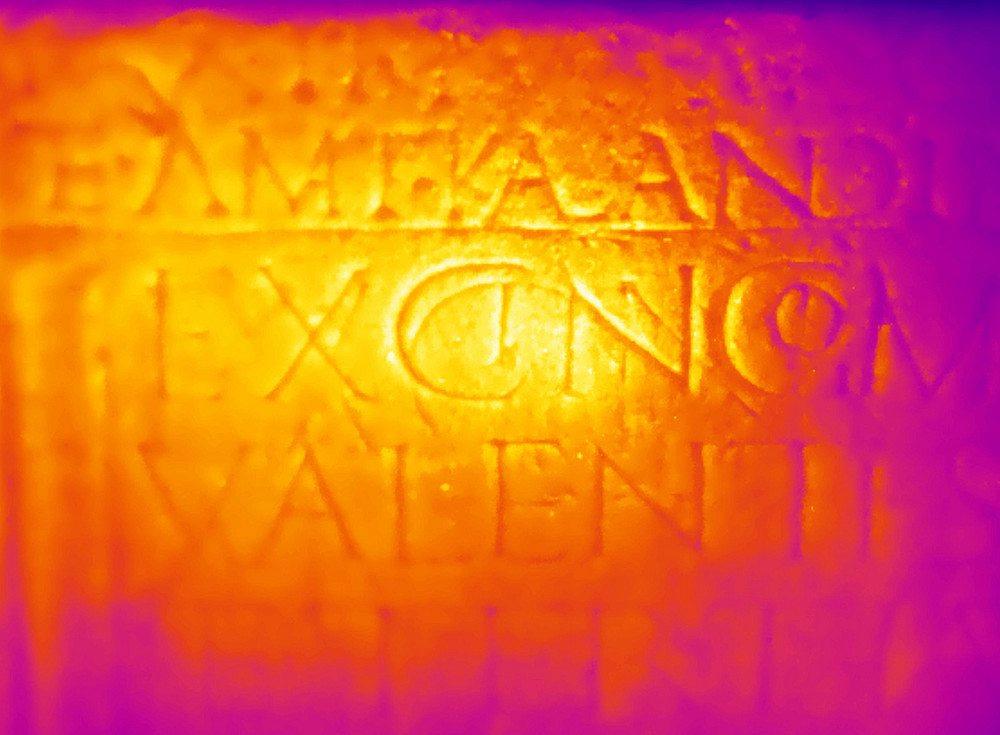
Thermographic image of a Roman inscription with legible letters: AMKAANDI, EXCNOM, VALENTIS ©Uni Graz/Diez
©Uni Graz/Diez

After the researchers have heated a stone, thermal imaging captures details during the cooling process that are no longer visible to the naked eye.

Researchers from the University of Graz and Graz University of Technology are working to save inscriptions carved in stone in Styria during Roman times from disappearing. They have developed a simple and cost-effective method to make inscriptions on tombs and votive altars – which have been weathered or damaged – legible again. They are currently testing the method on Roman stones at several sites across Styria. The aim is to provide other historians with a tool to preserve cultural heritage when expensive research equipment is not available.


Around 200 Roman stones are stored in the depot of the Universalmuseum Joanneum in Graz, the personal histories of which in many cases remain a mystery. This is because their inscriptions have become illegible – and not just due to weathering. “Some of them were used as building materials in later periods – for example, fitted as door thresholds – and were partially destroyed as a result,” says Gregor Diez, a postdoctoral researcher at the Department of Classics at the University of Graz. The researcher and the team led by project partner Jakob Woisetschläger from Graz University of Technology, an expert in optical measurement technology, are now working to shed light on the matter. And they’re doing so with simple tools: a UV lamp from a DIY store, a wildlife camera and a smartphone to take photos.
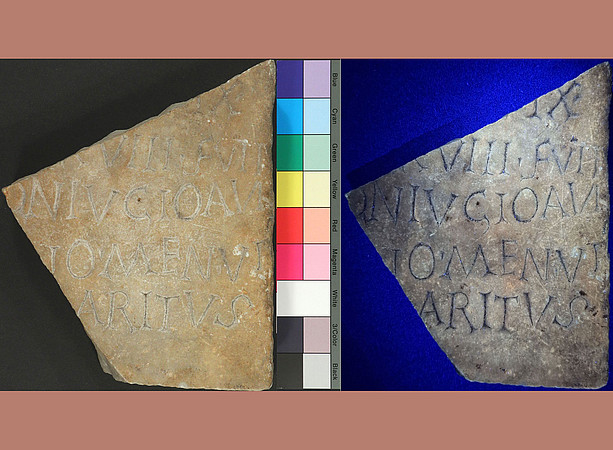
“When the inscription is illuminated with UV light at a wavelength of 365 nanometres, previously invisible details become apparent. These may include, amongst other things, traces of paint or dirt in the recesses of the chiselled letters,” explains Diez. Infrared light also reveals what lies hidden. To this end, the scientists use a wildlife camera. “If the stone is no thicker than three to four centimetres, an infrared backlit photograph – that is, an image taken from behind – often provides further insightful information,” says the researcher.
Many inscriptions can be reconstructed in this way. If the surface has been worn away too deeply or is destroyed, a thermal imaging camera may still be of help in some circumstances: “We have heated stones to 60 degrees Celsius. Images taken as they cool reveal irregularities that sometimes allow us to draw conclusions about letters that are no longer legible,” explains Diez. 
Roman stones are not only found in museums today. Many have been built into the walls of churches, and sometimes other buildings. That is why the team is also out and about in the Hartberg area and the Murau district, deciphering inscriptions on site.

The project, led by Gregor Diez, was funded by the Province of Styria as part of the UFO – Unconventional Research programme. To ensure that other historians can make the best possible use of this cost-effective method for restoring the legibility of ancient inscriptions, the researchers have compiled a detailed guide. The scientific publication on this topic has just been released.

Publication
„Through a Laser Beam Darkly – Attempting a Reassessment Using Optical Diagnostics in Epigraphy”
Gregor Diez, Matthias Diez, Jakob Woisetschläger
Heritage Science 2026, https://doi.org/10.1038/s40494-026-02828-6


If you are fascinated by the society and culture of people in antiquity, you can study Ancient History and Classical Antiquities at the University of Graz.

A young man wearing glasses, a checked jacket, a white shirt and a tie is standing against a plain background, looking at the camera. ©P. Kalcher
©P. Kalcher
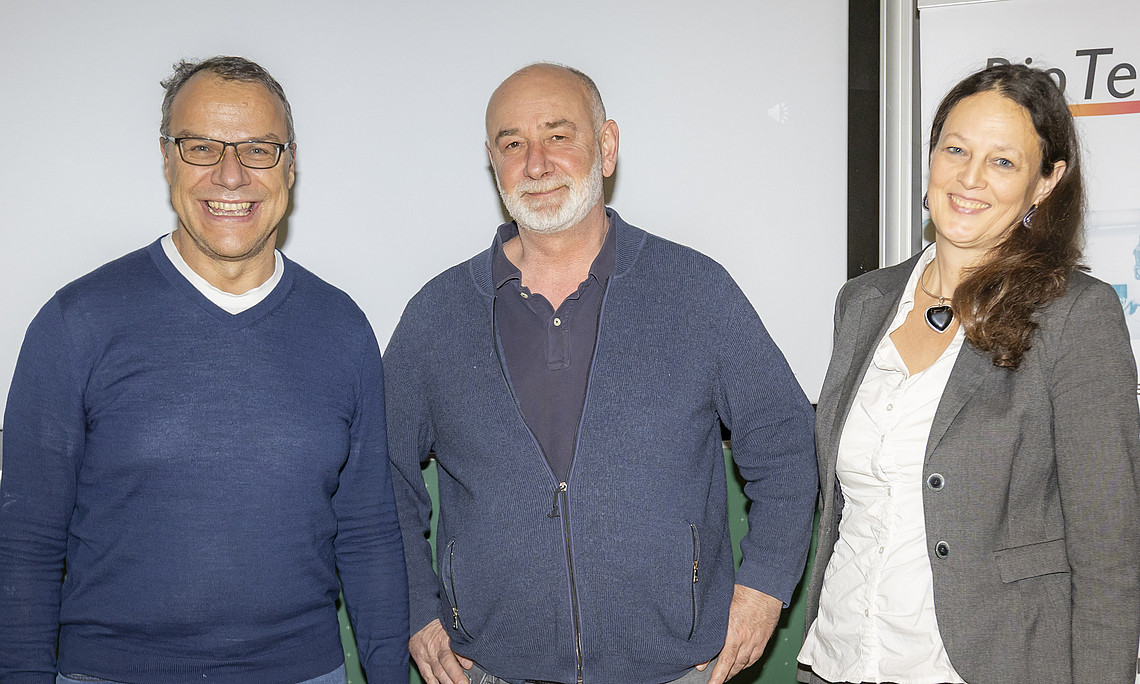
Project leader Gregor Diez is a postdoctoral researcher at the Department of Classics at the University of Graz.
Fragment of a Roman inscription; left: normal view; right: under fluorescence ©Uni Graz/Diez
©Uni Graz/Diez
The researchers use fluorescence, triggered by UV light with a wavelength of 365 nanometres, to make inscriptions more clearly visible.
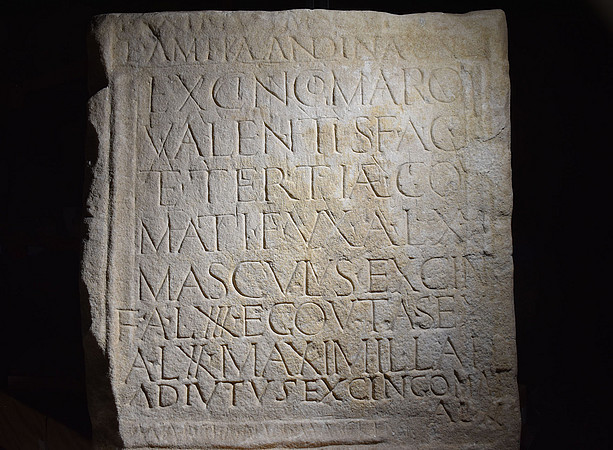
Roman gravestone with a Latin inscription ©Uni Graz / Skrinjar, Ederer
©Uni Graz / Skrinjar, Ederer
The first line of the inscription on Excingomarus’s gravestone is now difficult to read. The thermal imaging camera – see picture above – can be helpful in deciphering it.
created by Gudrun Pichler

Related news

When the sun goes dark: Enlightening for science and the people of Graz

When the moon partially passes in front of the sun in Graz on 12 August 2026, the event will once again captivate many people. This includes Manuela Temmer, an astrophysicist at the University of Graz. The scientist confirms that this celestial phenomenon offers significant value for research: “During a solar eclipse, the corona can be observed more clearly than with any instrument.”

Courtly Love and Aubergines: What Medieval Literature Has in Common with Emojis

Plants and fruits were already used as symbols of love in the Middle Ages. German studies scholar Isabella Managò, together with her colleagues Brigitte Spreitzer-Fleck and Julia Zimmermann, explains how this came about and why this figurative language remains familiar to us to this day.

New technology from the University of Graz reveals the hidden properties of tumour cells

It sounds like science fiction, but it could advance cancer research in the future: a team at the University of Graz, led by physicist Jan Enenkel, is developing a new laboratory device using laser technology that can be used to examine individual tumour cells. The idea is reminiscent of the medical tricorder from the Star Trek film series – albeit as a high-precision measurement platform. A spin-off fellowship from the Austrian Research Promotion Agency (FFG) is supporting the development of the technology at the University of Graz with around 500,000 euros.

Four introduced species of leafhoppers newly discovered in the Botanical Garden Graz

They have travelled to Europe as stowaways via international trade and are now rapidly taking over large parts of the continent: more and more insects from other parts of the world are becoming established here. Biologist Gernot Kunz recently discovered four species for the first time at the University of Graz Botanical Garden: the American grapevine leafhopper (Scaphoideus titanus), the wounded leafhopper from North America (Erasmoneura vulnerata) and the Japanese grape leafhopper (Arboridia kakogawana) – all three specialising in vines – as well as the Indian leafhopper Pediopsoides sharmai, which is associated with walnut trees.

Begin of page section:
Additional information:

University of Graz
Universitaetsplatz 3
8010 Graz
Austria
  • Contact
  • Web Editors
  • Moodle
  • UNIGRAZonline
  • Imprint
  • Data Protection Declaration
  • Accessibility Declaration
Weatherstation
Uni Graz

End of this page section. Go to overview of page sections

End of this page section. Go to overview of page sections

Begin of page section:

End of this page section. Go to overview of page sections