History is not only found in school textbooks, museums and memorial sites. It is also recounted, passed on and remembered within families. But do all these stories find their way into our collective memory?
Since 2022, discussions have been taking place as part of what is known as the ‘Historians’ Dispute 2.0’ about whether an Austrian and German culture of remembrance centred on the Holocaust still reflects the realities of a society shaped by migration. This also raises the question of whether greater consideration should be given to other, in particular colonial, violent crimes of the 20th century. Is the Holocaust still a central component of the historical consciousness of everyone living in Austria and Germany? Or are other experiences of violence, including colonial ones, coming to the fore? And whose stories are being told in historical museums and history lessons, despite the commitment to diversity?
Diverse Memories in the Classroom
These questions are the focus of the Sparkling Science project ‘The Memory of the Classroom. Multidirectional Remembrance in Graz Schools (MEiK)’. Together with pupils from six schools in Graz, Georg Marschnig and Melanie Göttfried from the Department of History Didactics, as well as Gerald Lamprecht, Maria Pasaricek and Esraa Shehata from the Centre for Jewish Studies at the University of Graz, are investigating the diverse narratives present in the young people’s family memories and the extent to which these are addressed in history lessons at school.
Pupils become researchers
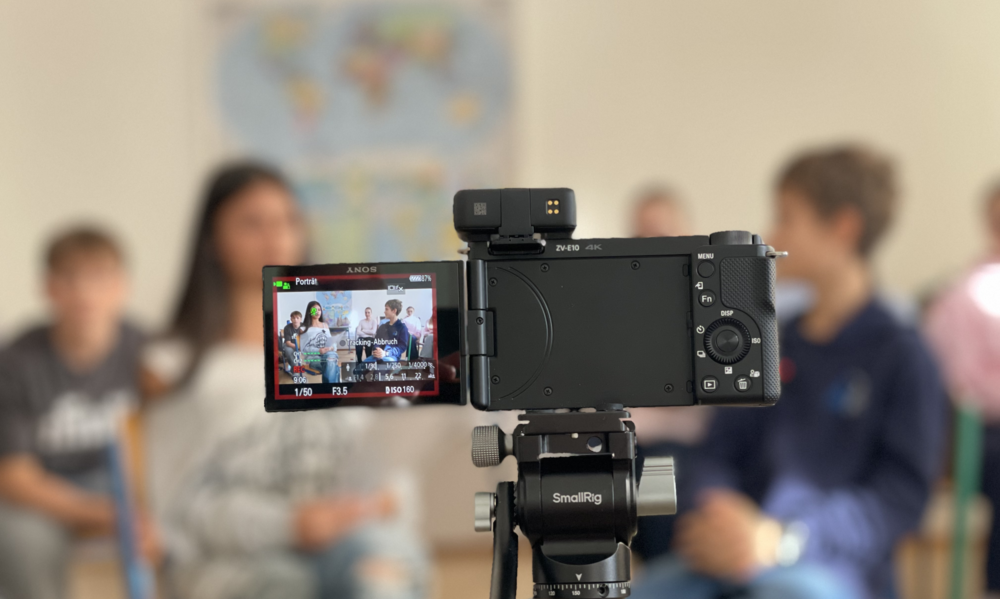
Pupils from MS Straßgang, MS St. Leonhard, MS/BG/BRG Klusemann, the Akademisches Gymnasium, BG/BRG Oeversee and Sacré Coeur became researchers themselves. They each chose a family member and used professional equipment to record life story interviews. This resulted in a total of 45 interviews in ten languages, reflecting the diversity of Graz’s classrooms. These conversations form the basis of the exhibition ‘Our History(ies)’, which will be on display from 16 to 27 September 2026 at the Museum of History on Sackstraße in Graz.
“The project enables,” emphasises history educator Georg Marschnig, “young people to develop their own agency through their involvement in the research process. Using the stories they have collected, we can work together to develop a picture of Graz’s population that is not black and white, but rather colourful and multi-layered. Their stories stand side by side on an equal footing, without being overvalued or undervalued. That is where I see the great strength of our project.”
The exhibition provides an insight into the findings of the interview project through the thematic areas ‘Defining Moments’, ‘Faith and Values’, ‘Graz’, ‘Childhood’ and ‘Family’. On display are selected video clips as well as mementoes presented by the family members interviewed during the conversations. The pupils themselves also have their say, reflecting on their experiences in the project.
“The classrooms and family living rooms became workshops where a diverse range of stories were recorded,” says Gerald Lamprecht, Director of the Centre for Jewish Studies, describing a key aspect of the project. A colour-coding system identifies the participating schools, pupils and family members and guides visitors through the exhibition. The Sparkling Science project is funded by the Federal Ministry of Education.
Further information on the exhibition can be found on the website of the Museum of History in Graz