



Begin of page section:
Page sections:

  • Go to contents (Accesskey 1)
  • Go to position marker (Accesskey 2)
  • Go to main navigation (Accesskey 3)
  • Go to sub navigation (Accesskey 4)
  • Go to additional information (Accesskey 5)
  • Go to page settings (user/language) (Accesskey 8)
  • Go to search (Accesskey 9)

End of this page section. Go to overview of page sections

Begin of page section:
Page settings:

English en
Deutsch de
Search
Login

End of this page section. Go to overview of page sections

Begin of page section:
Search:

Search for details about Uni Graz
Close

End of this page section. Go to overview of page sections


Search

Begin of page section:
Main navigation:

Page navigation:

  • University

    University
    • About the University
    • Organisation
    • Faculties
    • Library
    • Working at University of Graz
    • Campus
    Developing solutions for the world of tomorrow - that is our mission. Our students and our researchers take on the great challenges of society and carry the knowledge out.
  • Research Profile

    Research Profile
    • Our Expertise
    • Research Questions
    • Research Portal
    • Promoting Research
    • Research Transfer
    • Ethics in Research
    • Commission for Scientific Integrity
    Scientific excellence and the courage to break new ground. Research at the University of Graz creates the foundations for making the future worth living.
  • Studies

    Studies
    • Prospective Students
    • Students
  • Community

    Community
    • International
    • Location
    • Research and Business
    • Alumni
    The University of Graz is a hub for international research and brings together scientists and business experts. Moreover, it fosters the exchange and cooperation in study and teaching.
  • Spotlight
Topics
  • Sustainable University
  • Researchers answer
  • Work for us
Close menu

End of this page section. Go to overview of page sections

Begin of page section:
You are here:

University of Graz News Polier-Arbeit

End of this page section. Go to overview of page sections

Monday, 24 June 2019

Polier-Arbeit

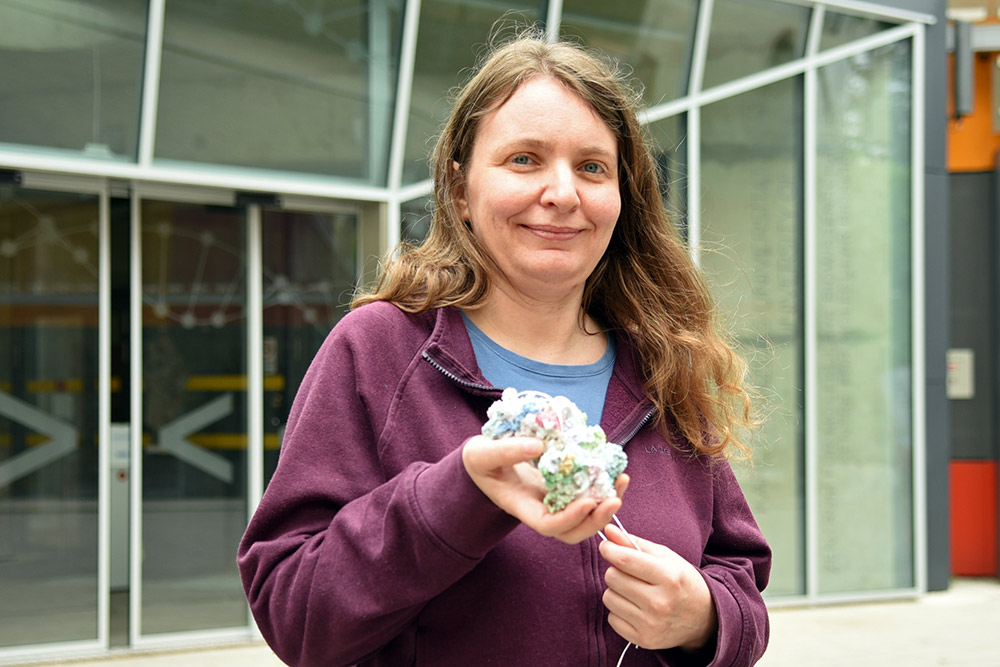
Brigitte Pertschy präsentiert ein Ribosomen-Modell: Wie der Bau der Protein-Fabriken koordiniert wird, hat die Biowissenschafterin entschlüsselt. Foto: Uni Graz/Eklaude ©Uni Graz/Eklaude

Brigitte Pertschy präsentiert ein Ribosomen-Modell: Wie der Bau der Protein-Fabriken koordiniert wird, hat die Biowissenschafterin entschlüsselt. Foto: Uni Graz/Eklaude

Biowissenschafterin Brigitte Pertschy identifiziert „Bau-Koordinator“ für Protein-Fabriken

In jeder einzelnen Zelle unseres Körpers gibt es eigene Moleküle, die ständig die Bausteine des Organismus produzieren. Diese sogenannten Ribosomen werden auch selbst mit enormer Geschwindigkeit permanent reproduziert. Wie dieser Vorgang im Detail abläuft, ist das Spezialgebiet von Brigitte Pertschy. „Es handelt sich um einen sehr zentralen, lebenswichtigen Prozess, der aber noch wenig untersucht ist. Durch unsere Grundlagenforschung können wir unter anderem die Basis schaffen, um die Ursachen von Krankheiten besser zu verstehen“, erklärt die Biowissenschafterin. In ihrer neuesten Publikation im soeben erschienenen Fachmagazin Nature Communications beschreibt sie, wie die „Arbeiter“, die diese Protein-Fabriken zusammenbauen, miteinander kommunizieren.

Die Ribosomen bestehen aus einem langen RNA-Faden, der zigfach gedreht und gefaltet ist. Daran sind ebenso komplex ausgeprägte Proteine angeordnet. Diese Struktur ist bis ins kleinste Detail vorgegeben. „Mehrere hundert Assemblierungsfaktoren schneiden und falten die Teile des Ribosoms zurecht, wie Arbeiter auf einem Baugerüst“, beschreibt Pertschy. „Stoppt man den Prozess an einer Stelle, wird kurz darauf nirgends mehr weitergebaut“, hat sie beobachtet. Wie aber wissen die Helferlein auf der einen Seite, was auf der anderen passiert? Dieser Frage ist die Studienleiterin mit Co-Autor Valentin Mitterer und einem Forschungsteam aus Frankreich, Deutschland und der Schweiz nachgegangen und hat das Rätsel um die Kommunikation über eine verhältnismäßig große Distanz gelöst: „Wir haben ein Protein entdeckt, das durch einen Teil des Ribosoms hindurchreicht und den Austausch zwischen beiden Seiten ermöglicht“, erklärt sie. Die ersten „Handgriffe“ im Zuge des „Neubaus“ passieren unabhängig voneinander, vor bestimmten Schlüsselschritten gibt es aber einen Checkpunkt, um den Prozess zu koordinieren.

Erst kürzlich hat Pertschy, mit Ingrid Rössler als Erstautorin, einen Artikel im Magazin Nucleic Acids Research veröffentlicht mit neuen Erkenntnissen zu Schutzfaktoren, die den Transport von „Baumaterial“ für die Ribosomenbiogenese in die Zellkerne sicherstellen.

Publikation:
Valentin Mitterer, Ramtin Shayan, Sébastien Ferreira-Cerca, Guillaume Murat, Tanja Enne, Danka Rinaldi, Sarah Weigl, Hajrija Omanic, Pierre-Emmanuel Gleizes, Dieter Kressler, Celia Plisson-Chastang und Brigitte Pertschy, „Conformational proofreading of distant 40S ribosomal subunit maturation events by a long-range communication mechanism, Nature Communications, DOI: 10.1038/s41467-019-10678-z


created by Dagmar Eklaude

Related news

Higher Education Strategy 2040: Austria’s universities on course for the future

Austria has 77 higher education institutions, which is above the EU average – but does this really make sense? The new Higher Education Strategy 2040 focuses on cooperation rather than mergers. As one of the six largest universities in Austria, the University of Graz plays a central role in this.

Climate research in Greenland: Old data provides new insights

The polar explorer and University of Graz professor Alfred Wegener left behind a unique collection of climate data from Greenland. A research team from the University of Graz is now analysing this 100-year-old treasure trove of data and comparing it with current measurements.

Diversity in nature and science: How we talk about plants and each other

Ginkgo, kiwi, hemp: they exist as male and female plants. Anyone who paid attention in biology class will confirm this. But is this categorisation, established by Carl von Linné almost 300 years ago, still valid today? An interdisciplinary team at the University of Graz is questioning these attributions and using this as a starting point to provide food for thought for gender-sensitive interaction between students, scientific and teaching staff.

Around the world in eight stops: the Long Night of Research at the University of Graz

On 24 April from 5 pm, you can take a short trip around the globe at the University of Graz, discovering pecularities of foreign countries or new local features in the entrance hall of the University Library. The itinerary takes you through introduced animal species, political attitudes and the omnipotence of algorithms. There will also be a programme in the historic reading hall, as well as at the UniGraz@Museum and the University Archive.

Begin of page section:
Additional information:

University of Graz
Universitaetsplatz 3
8010 Graz
Austria
  • Contact
  • Web Editors
  • Moodle
  • UNIGRAZonline
  • Imprint
  • Data Protection Declaration
  • Accessibility Declaration
Weatherstation
Uni Graz

End of this page section. Go to overview of page sections

End of this page section. Go to overview of page sections

Begin of page section:

End of this page section. Go to overview of page sections


