




Begin of page section:
Page sections:

  • Go to contents (Accesskey 1)
  • Go to position marker (Accesskey 2)
  • Go to main navigation (Accesskey 3)
  • Go to sub navigation (Accesskey 4)
  • Go to additional information (Accesskey 5)
  • Go to page settings (user/language) (Accesskey 8)
  • Go to search (Accesskey 9)

End of this page section. Go to overview of page sections

Begin of page section:
Page settings:

English en
Deutsch de
Search
Login

End of this page section. Go to overview of page sections

Begin of page section:
Search:

Search for details about Uni Graz
Close

End of this page section. Go to overview of page sections


Search

Begin of page section:
Main navigation:

Page navigation:

  • University

    University
    • About the University
    • Organisation
    • Faculties
    • Library
    • Working at University of Graz
    • Campus
    Developing solutions for the world of tomorrow - that is our mission. Our students and our researchers take on the great challenges of society and carry the knowledge out.
  • Research Profile

    Research Profile
    • Our Expertise
    • Research Questions
    • Research Portal
    • Promoting Research
    • Research Transfer
    • Ethics in Research
    • Commission for Scientific Integrity
    Scientific excellence and the courage to break new ground. Research at the University of Graz creates the foundations for making the future worth living.
  • Studies

    Studies
    • Prospective Students
    • Students
  • Community

    Community
    • International
    • Location
    • Research and Business
    • Alumni
    The University of Graz is a hub for international research and brings together scientists and business experts. Moreover, it fosters the exchange and cooperation in study and teaching.
  • Spotlight
Topics
  • Sustainable University
  • Researchers answer
  • Work for us
Close menu

End of this page section. Go to overview of page sections

Begin of page section:
You are here:

University of Graz News Neuer Bericht

End of this page section. Go to overview of page sections

Monday, 28 November 2022

Neuer Bericht

Radfahrer auf Radweg zwischen fahrenden Autos. Foto: pixabay

Damit klimafreundliches Leben attraktiv, dauerhaft möglich und auch selbstverständlich wird, braucht es weitreichende strukturelle Veränderungen in allen Lebensbereichen, hält der neue APCC-Bericht fest. Foto: pixabay

Umfassend klimafreundlich zu leben, ist in Österreich schwierig

Klimafreundliches Leben braucht geeignete Strukturen, und die sind in Österreich derzeit nur unzureichend vorhanden. Diese Bilanz zieht der neue, 700 Seiten starke Special Report des Austrian Panel of Climate Change (APCC). Am 28. November 2022 wurde er von den Mitherausgebern Karl Steininger (Universität Graz) und Andreas Novy (Wirtschaftsuniversität Wien) präsentiert und an Klimaschutzministerin Leonore Gewessler und Arbeitsminister Martin Kocher übergeben.

Für die Autor:innen ist klar: Menschen nur zu klimabewusstem Handeln aufzufordern, ist weder ausreichend noch zielführend. Denn fehlen die entsprechenden Rahmenbedingungen, ist es für Bürger:innen schwer, im Alltag nachhaltig zu agieren. Damit klimafreundliches Leben attraktiv, dauerhaft möglich und auch selbstverständlich wird, braucht es weitreichende strukturelle Veränderungen in allen Lebensbereichen, von Wohnen und Mobilität über die Ernährung bis hin zu Freizeitgestaltung und Arbeit. Und dazu seien alle gesellschaftlichen Kräfte gefordert.

„Ohne kritische wissenschaftliche Analyse, ohne Unternehmen, die sich für klimafreundliches Leben einsetzen, und ohne an Allgemeinwohl und klimafreundlichem Leben orientierte Interessenvertretungen und Politik sind die notwendigen Transformationen kaum umsetzbar“, sagt Karl Steininger vom Wegener Center der Uni Graz. „Entscheidend wird sein, in den kommenden Jahren Strukturen sehr schnell umzugestalten, damit die Klimaziele noch erreicht werden können, dabei aber stets den sozialen Zusammenhalt und die Klimagerechtigkeit im Auge zu behalten“, ergänzt Alfred Posch vom Institut für Systemwissenschaften, Innovations- und Nachhaltigkeitsforschung. Mit Steininger und Posch sind zwei der insgesamt sieben Mit-Herausgeber:innen des APCC Special Report Experten der Universität Graz.

Der vom Klima- und Energiefonds in Auftrag gegebene Bericht mit dem Titel „Strukturen für ein klimafreundliches Leben“ – dotiert aus Mitteln des Klimaschutzministeriums – wurde von mehr als 80 renommierten Wissenschaftler:innen aus unterschiedlichen Disziplinen erstellt, von mehr als 180 Expert:innen begutachtet und von einem Dialog mit Stakeholdern aus Gesellschaft und Politik begleitet.

>> Aussendung des Bundesministeriums für Klimaschutz

>> zum Bericht
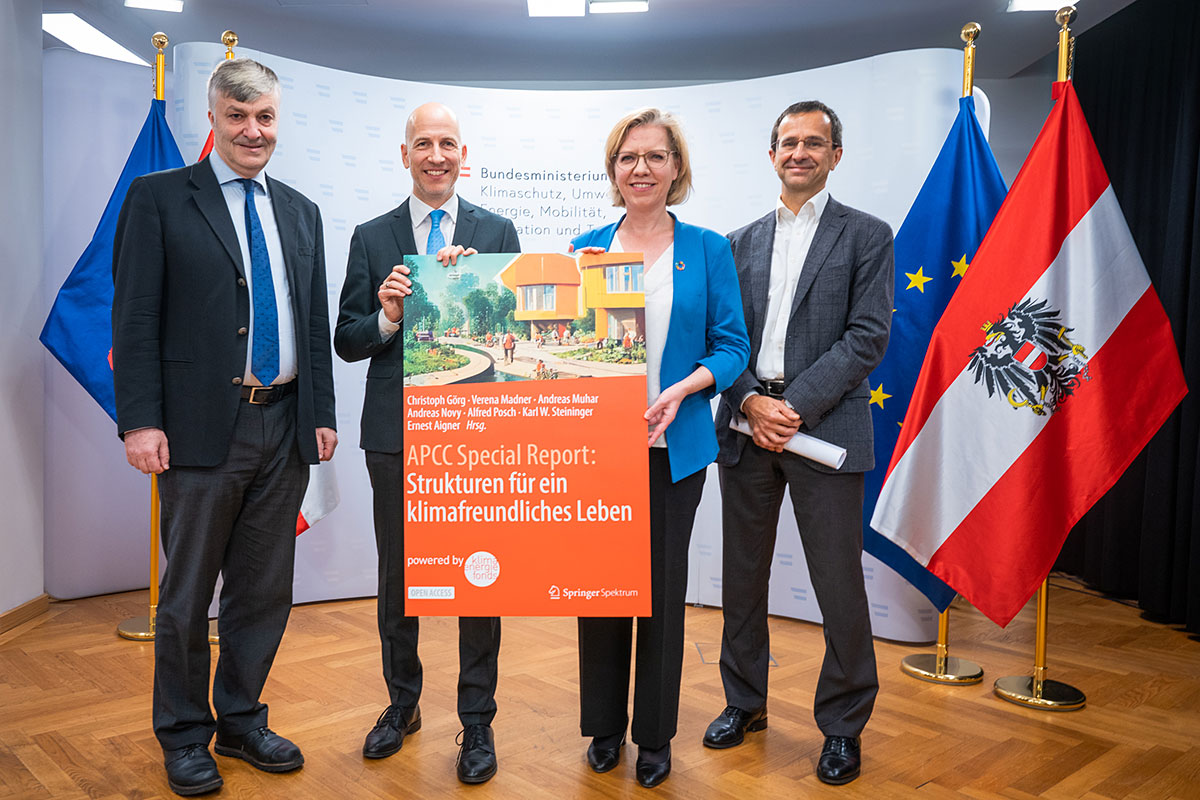
Präsentation des APCC-Berichts: Karl Steininger, Martin Kocher, Leonore Gewessler, Andreas Novy (v.l.). Foto: Cajetan Perwein/BMK
created by Gudrun Pichler

Related news

Building biological bridges: Chemist discovers an ecological tool for the pharmaceutical industry

Building a relationship on a solid foundation is also important in chemistry. To produce medicines, disinfectants or plant protection products, stable bonds between carbon atoms must be formed. Conventional chemical methods rely on environmentally harmful reagents and solvents to carry out the desired reaction. This process also produces unusable by-products. Chemist Lilla Gal has discovered an enzyme that enables the same process to take place efficiently and sustainably. The results of her research were recently published in the prestigious journal Angewandte Chemie.

Higher Education Strategy 2040: Austria’s universities on course for the future

Austria has 77 higher education institutions, which is above the EU average – but does this really make sense? The new Higher Education Strategy 2040 focuses on cooperation rather than mergers. As one of the six largest universities in Austria, the University of Graz plays a central role in this.

Climate research in Greenland: Old data provides new insights

The polar explorer and University of Graz professor Alfred Wegener left behind a unique collection of climate data from Greenland. A research team from the University of Graz is now analysing this 100-year-old treasure trove of data and comparing it with current measurements.

Diversity in nature and science: How we talk about plants and each other

Ginkgo, kiwi, hemp: they exist as male and female plants. Anyone who paid attention in biology class will confirm this. But is this categorisation, established by Carl von Linné almost 300 years ago, still valid today? An interdisciplinary team at the University of Graz is questioning these attributions and using this as a starting point to provide food for thought for gender-sensitive interaction between students, scientific and teaching staff.

Begin of page section:
Additional information:

University of Graz
Universitaetsplatz 3
8010 Graz
Austria
  • Contact
  • Web Editors
  • Moodle
  • UNIGRAZonline
  • Imprint
  • Data Protection Declaration
  • Accessibility Declaration
Weatherstation
Uni Graz

End of this page section. Go to overview of page sections

End of this page section. Go to overview of page sections

Begin of page section:

End of this page section. Go to overview of page sections