Begin of page section:
Page sections:

  • Go to contents (Accesskey 1)
  • Go to position marker (Accesskey 2)
  • Go to main navigation (Accesskey 3)
  • Go to sub navigation (Accesskey 4)
  • Go to additional information (Accesskey 5)
  • Go to page settings (user/language) (Accesskey 8)
  • Go to search (Accesskey 9)

End of this page section. Go to overview of page sections

Begin of page section:
Page settings:

English en
Deutsch de
Search
Login

End of this page section. Go to overview of page sections

Begin of page section:
Search:

Search for details about Uni Graz
Close

End of this page section. Go to overview of page sections


Search

Begin of page section:
Main navigation:

Page navigation:

  • University

    University
    • About the University
    • Organisation
    • Faculties
    • Library
    • Working at University of Graz
    • Campus
    Developing solutions for the world of tomorrow - that is our mission. Our students and our researchers take on the great challenges of society and carry the knowledge out.
  • Research Profile

    Research Profile
    • Our Expertise
    • Research Questions
    • Research Portal
    • Promoting Research
    • Research Transfer
    • Ethics in Research
    Scientific excellence and the courage to break new ground. Research at the University of Graz creates the foundations for making the future worth living.
  • Studies

    Studies
    • Prospective Students
    • Students
  • Community

    Community
    • International
    • Location
    • Research and Business
    • Alumni
    The University of Graz is a hub for international research and brings together scientists and business experts. Moreover, it fosters the exchange and cooperation in study and teaching.
  • Spotlight
Topics
  • Our digital Advent calendar
  • Sustainable University
  • Researchers answer
  • Work for us
Close menu

End of this page section. Go to overview of page sections

Begin of page section:
You are here:

University of Graz News Sustainable steel production: Graz researchers shed light on CO2 footprint and social impacts

End of this page section. Go to overview of page sections

Tuesday, 17 October 2023

Sustainable steel production: Graz researchers shed light on CO2 footprint and social impacts

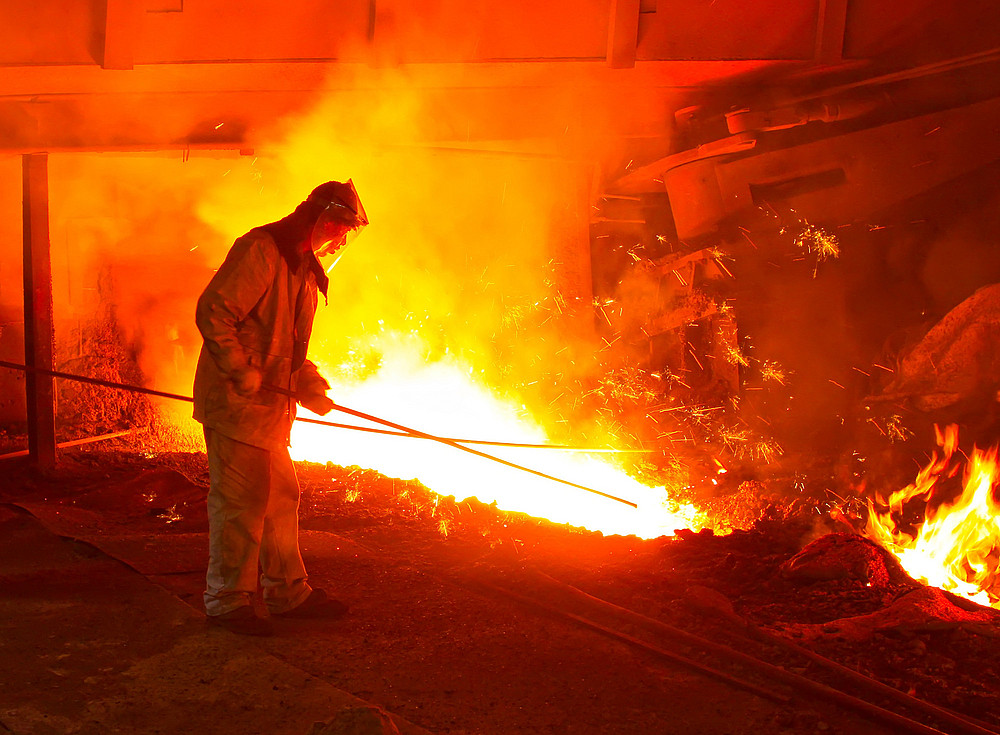
Worker in protective clothing in front of red-hot blast furnace

Sociologist Markus Hadler and colleagues from Joanneum Research are investigating how steel production can be made more environmentally friendly on the one hand and socially sustainable on the other. Photo: Adobe Stock/junrong

The production of steel causes about seven percent of global CO2 emissions. Intensive efforts are therefore being made to drastically reduce them. Researchers at the University of Graz and Joanneum Research have investigated for the first time whether these changes are also socially acceptable. The conclusion: the social impact depends strongly on the location and the supplier companies. The results of the study have been published in the Journal of Sustainable Metallurgy.

Together with Michael Brenner-Fließer and Ingrid Kaltenegger from the Institute for Climate, Energy Systems and Society at Joanneum Research, sociologist Markus Hadler from the University of Graz took a close look at the steel industry in Belgium, China and the USA. "If, for example, waste wood is used instead of coal to heat the blast furnaces, this undoubtedly leads to CO2 savings, but not necessarily to positive effects on society," reports Hadler. Indeed, China currently sources raw materials from Australia, where they are produced to high standards. The conversion would replace them with local products that pay far less attention to social sustainability. Belgium, on the other hand, imports coal that is mined under poor conditions. So doing without would also bring social benefits.

Belgium als Model
In an EU-funded model plant in Ghent (https://www.torero.eu/), some wood waste is used to heat the blast furnaces, for example from demolished roof trusses and offcuts from sawmills. The Graz research team has analysed the consequences for humans and nature. "These results can also be applied to our country," Hadler and Brenner-Fließer are convinced. Waste wood instead of coal would therefore also improve both environmental and social conditions in Austria. "However, the negative effects on the countries that currently export the raw material would also have to be mitigated," the researchers caution. They could, for example, switch from the extraction of fossil fuels to the production of alternative energies in order to create new fields of work.

Publication:
Markus Hadler, Michael Brenner-Fließer and Ingrid Kaltenegger: "The Social Impact of the Steel Industry in Belgium, China, and the United States: A Social Lifecycle Assessment (s-LCA)-Based Assessment of the Replacement of Fossil Coal with Waste Wood“, Journal of Sustainable Metallurgy

created by Dagmar Eklaude

Related news

Chemical Christmas show at the University of Graz: An explosive evening at the Schauspielh

At the beginning of December, the University of Graz transformed the theater into a laboratory: as part of “Chemical Life,” teacher training students staged a chemical Christmas show for Styrian school classes—complete with ethanol rockets, nitrogen snow, and glowing effects. An evening designed to inspire interest in studying chemistry.

Train by train: Koralm railway accelerates exchange between the Universities

Lectures at the University of Klagenfurt in the morning, seminars at the University of Graz in the afternoon: Austria's longest tunnel and a journey time of around 45 minutes make it easy. The Koralm railway increases the speed of networking between the two university locations. The collaboration builds on existing cooperation - for example in the areas of teacher training, Slavic studies and as employers, the universities are well coordinated.

On the trail of the Big Bang: University of Graz receives 1.5 million euros for doctoral programmes

The Austrian Science Fund FWF has selected the Doctoral Programme in Theoretical Particle Physics at the University of Graz for funding from the Doc.funds. Six young scientists will be funded for 3.5 years. They will gain fundamentally new insights into the origins of the world.

From trans women and knee prostheses: sports science prizes awarded

Walking better with a prosthesis, successfully getting rid of excess weight, training more effectively, more fairness for trans people in sport: these were the topics addressed by the students at the University of Graz who were awarded the sports science prizes for their Master's theses on 3 December 2025.

Begin of page section:
Additional information:

University of Graz
Universitaetsplatz 3
8010 Graz
Austria
  • Contact
  • Web Editors
  • Moodle
  • UNIGRAZonline
  • Imprint
  • Data Protection Declaration
  • Accessibility Declaration
Weatherstation
Uni Graz

End of this page section. Go to overview of page sections

End of this page section. Go to overview of page sections

Begin of page section:

End of this page section. Go to overview of page sections