



Begin of page section:
Page sections:

  • Go to contents (Accesskey 1)
  • Go to position marker (Accesskey 2)
  • Go to main navigation (Accesskey 3)
  • Go to sub navigation (Accesskey 4)
  • Go to additional information (Accesskey 5)
  • Go to page settings (user/language) (Accesskey 8)
  • Go to search (Accesskey 9)

End of this page section. Go to overview of page sections

Begin of page section:
Page settings:

English en
Deutsch de
Search
Login

End of this page section. Go to overview of page sections

Begin of page section:
Search:

Search for details about Uni Graz
Close

End of this page section. Go to overview of page sections


Search

Begin of page section:
Main navigation:

Page navigation:

  • University

    University
    • About the University
    • Organisation
    • Faculties
    • Library
    • Working at University of Graz
    • Campus
    Developing solutions for the world of tomorrow - that is our mission. Our students and our researchers take on the great challenges of society and carry the knowledge out.
  • Research Profile

    Research Profile
    • Our Expertise
    • Research Questions
    • Research Portal
    • Promoting Research
    • Research Transfer
    • Ethics in Research
    • Commission for Scientific Integrity
    Scientific excellence and the courage to break new ground. Research at the University of Graz creates the foundations for making the future worth living.
  • Studies

    Studies
    • Prospective Students
    • Students
    • Welcome Weeks for First Year Students
  • Community

    Community
    • International
    • Location
    • Research and Business
    • Alumni
    The University of Graz is a hub for international research and brings together scientists and business experts. Moreover, it fosters the exchange and cooperation in study and teaching.
Topics
  • Sustainable University
  • Researchers answer
  • Work for us
Close menu

End of this page section. Go to overview of page sections

Begin of page section:
You are here:

University of Graz News Landliebe

End of this page section. Go to overview of page sections

Wednesday, 02 March 2016

Landliebe

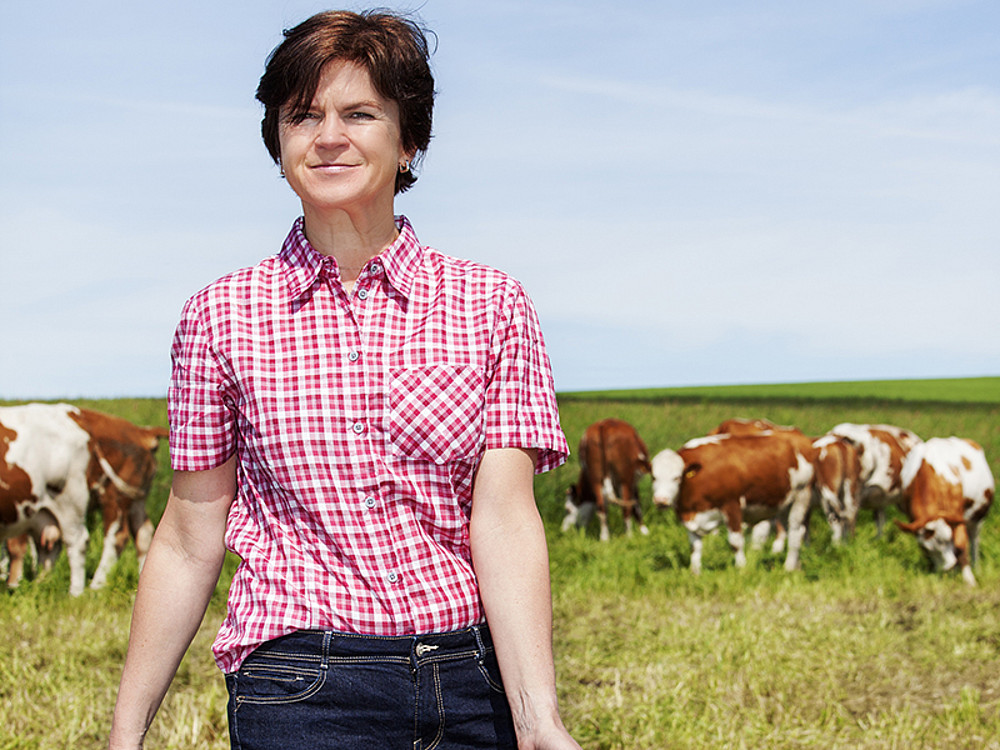
Die ländliche Idylle trügt: Für die schwere Arbeit am Hof begeistern sich immer weniger Frauen. Diese sind aber im Schnitt zufriedener als andere Berufstätige. Foto: Fotolia.com/Edler von Rabenstein ©Edler von Rabenstein
©Edler von Rabenstein

Die ländliche Idylle trügt: Für die schwere Arbeit am Hof begeistern sich immer weniger Frauen. Diese sind aber im Schnitt zufriedener als andere Berufstätige. Foto: Fotolia.com/Edler von Rabenstein

SoziologInnen der Uni Graz untersuchen erstmals bäuerliche Lebenswelten in Österreich

„Bauer sucht Frau“ und ähnliche TV-Formate locken die Massen vor den Bildschirm. Die ländliche Idylle und das Häuschen im Grünen werden von vielen herbeigesehnt. Wie es sich als Bäuerin und Bauer in Österreich tatsächlich lebt, welchen wirtschaftlichen und sozialen Herausforderungen sich der Berufsstand stellen muss, war universitär bis dato allerdings kaum erforscht. „Das ist erstaunlich, denn bei uns arbeiten nach wie vor rund fünf Prozent der erwerbstätigen Bevölkerung in der Landwirtschaft – haupt- oder nebenberuflich“, weiß Ao.Univ.-Prof. Dr. Franz Höllinger vom Institut für Soziologie der Uni Graz. Er leitet das Projekt „Bäuerliche Lebenswelten“, das sich erstmals mit den starken Veränderungen dieses Berufsstandes auseinandersetzt.
„Nur ein Großbetrieb kann heute noch rein von seinen Produkten leben“, hat der Wissenschafter festgestellt. Kleinbauern sehen sich gezwungen, neue Bereiche zu erschließen, etwa Ab-Hof-Verbrauch, Bio-Produkte, Urlaub am Bauernhof oder den eigenen Buschenschank. „Durch die wirtschaftlichen Veränderungen mussten sie ständig kreativ reagieren und – teilweise mehrmals – ihr Betriebskonzept und ihre Vermarktung umstellen“, so Höllinger. Gerechtere Preise und KonsumentInnen, die wieder größeren Wert auf regionale Produkte legen, sind daher einhellige Wünsche aller Befragten.

Starke Familienbande
Ein Schwerpunkt des Forschungsprojekts beleuchtet das Zusammenleben und die Arbeitsteilung am Hof. „Die Dreigenerationen-Familie ist nach wie vor üblich und wird von den meisten Befragten positiv bewertet“, fasst der Experte zusammen. Allerdings geht der Trend immer stärker zu getrennten Wohnbereichen oder überhaupt separaten Häusern. Auch wird von den Kindern nicht mehr zwangsläufig erwartet, dass eines den Hof übernimmt. Die traditionelle Arbeitsaufteilung – der Mann geht einem Beruf nach und kümmert sich daneben um die Feld- und Forstarbeit, während die Frau die Verarbeitung der Milch, Haushalt und Garten übernimmmt – ist auch anno 2016 weit verbreitet. „Aus ganz pragmatischen Gründen ist das eine sinnvolle Lösung, mit der die Beteiligten zufrieden sind“, weiß Höllinger. Marketing und Buchhaltung sind – anders als früher – egalitär aufgeteilt, finanzielle Entscheidungen werden in der Regel ebenfalls gemeinsam getroffen.
Allerdings: „‚Bauer sucht Frau‘ ist kein erfundenes Sendeformat – es gibt nicht mehr viele, die bereit sind, sich auf das Abenteuer Landleben einzulassen, insbesondere wenn sie aus einem anderen Umfeld kommen“, hat der Soziologie erfahren.

Details zum Projekt in der aktuellen Ausgabe der UNIZEIT

created by Dagmar Eklaude

Related news

Jurassic Sounds: Biologist reconstructs insect songs from 165 million years ago

It was apparently not just the roars of the dinosaurs that made up the soundscape of the animal world during the Jurassic period. Crickets and grasshoppers communicated through a variety of songs and high-pitched sounds, as Thorin Jonsson from the Institute of Biology at the University of Graz discovered together with colleagues from the universities of Lincoln, Bristol (UK), Beijing (China) and Tempe (USA). The findings on what are so far the oldest traces of sound on Earth have just been published in the journal PNAS.

EU funding boosts international exchange between universities

The University of Graz is further expanding its international study opportunities through the European university alliance Arqus and is taking the lead in two key projects. In future, students will benefit from even more joint degree programmes and from simplified recognition of academic achievements through the Joint European Degree Label.

Rescue and risks: Researchers have surveyed public perceptions of AI

The use of artificial intelligence has had to be made transparent since 2 August 2026. The EU’s AI Act, which has been in force since then, also sets out how risky an application is and which security measures apply as a result. However, the assessment of risks by the legislation differs in some cases significantly from the perceptions of the Austrian public. This is the finding of a representative study carried out by data scientist Stefan Thalmann from the University of Graz and his team.

The Healing Sea: Researchers discover new approaches to treating chronic inflammation in sponges

Chronic inflammation plays a key role in many diseases, ranging from metabolic disorders and cardiovascular diseases to tissue damage following injuries or infections. “Normally, the body is able to resolve inflammation on its own. If this process becomes unbalanced, immune cells remain permanently active and continue to drive negative changes in the tissue,” explains Andreas Koeberle, a pharmacist at the University of Graz.

Begin of page section:
Additional information:

University of Graz
Universitaetsplatz 3
8010 Graz
Austria
  • Contact
  • Web Editors
  • Moodle
  • UNIGRAZonline
  • Imprint
  • Data Protection Declaration
  • Accessibility Declaration
Weatherstation
Uni Graz

End of this page section. Go to overview of page sections

End of this page section. Go to overview of page sections

Begin of page section:

End of this page section. Go to overview of page sections