Begin of page section:
Page sections:

  • Go to contents (Accesskey 1)
  • Go to position marker (Accesskey 2)
  • Go to main navigation (Accesskey 3)
  • Go to sub navigation (Accesskey 4)
  • Go to additional information (Accesskey 5)
  • Go to page settings (user/language) (Accesskey 8)
  • Go to search (Accesskey 9)

End of this page section. Go to overview of page sections

Begin of page section:
Page settings:

English en
Deutsch de
Search
Login

End of this page section. Go to overview of page sections

Begin of page section:
Search:

Search for details about Uni Graz
Close

End of this page section. Go to overview of page sections


Search

Begin of page section:
Main navigation:

Page navigation:

  • University

    University
    • About the University
    • Organisation
    • Faculties
    • Library
    • Working at University of Graz
    • Campus
    Developing solutions for the world of tomorrow - that is our mission. Our students and our researchers take on the great challenges of society and carry the knowledge out.
  • Research Profile

    Research Profile
    • Our Expertise
    • Research Questions
    • Research Portal
    • Promoting Research
    • Research Transfer
    • Ethics in Research
    • Commission for Scientific Integrity
    Scientific excellence and the courage to break new ground. Research at the University of Graz creates the foundations for making the future worth living.
  • Studies

    Studies
    • Prospective Students
    • Students
  • Community

    Community
    • International
    • Location
    • Research and Business
    • Alumni
    The University of Graz is a hub for international research and brings together scientists and business experts. Moreover, it fosters the exchange and cooperation in study and teaching.
  • Spotlight
Topics
  • Sustainable University
  • Researchers answer
  • Work for us
Close menu

End of this page section. Go to overview of page sections

Begin of page section:
You are here:

University of Graz News Kümmernde Kinder

End of this page section. Go to overview of page sections

Monday, 22 November 2021

Kümmernde Kinder

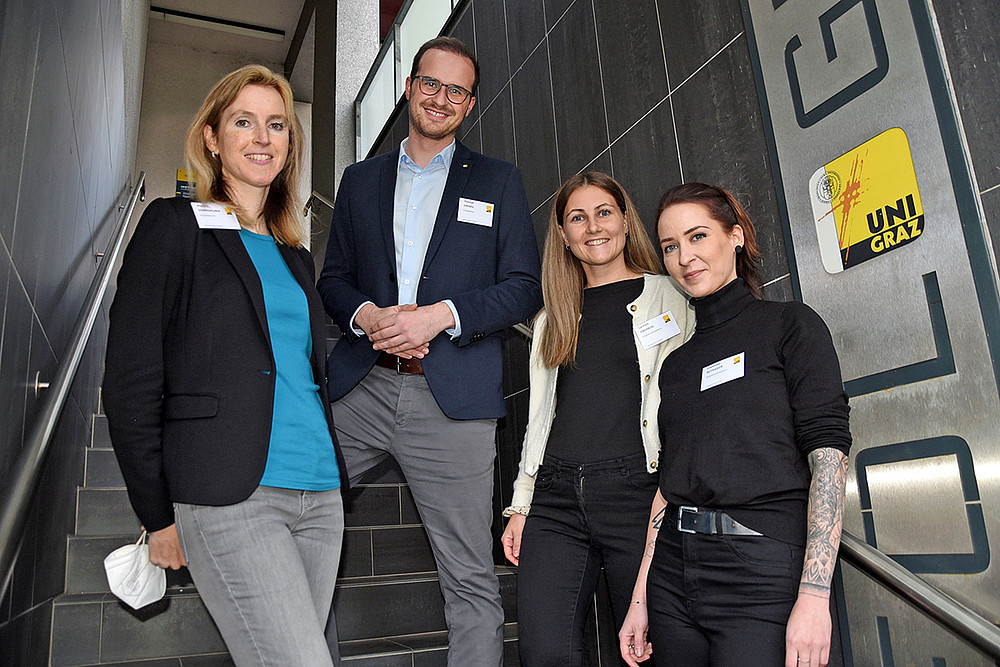
Martina Schmidhuber, Thomas Gremsl, Carmen Oberreßl und Franziska Reitegger erheben Bedürfnisse pflegender Minderjähriger, um bessere Unterstützung zu ermöglichen. Foto: Uni Graz/Pichler

Martina Schmidhuber, Thomas Gremsl, Carmen Oberreßl und Franziska Reitegger erheben Bedürfnisse pflegender Minderjähriger, um bessere Unterstützung zu ermöglichen. Foto: Uni Graz/Pichler

"Young carers", Minderjährige, die ihre Angehörigen pflegen, werden meist übersehen. EthikerInnen der Universität Graz zeigen auf, was sie brauchen.

Rund 43.000 Kinder pflegen in Österreich einen Elternteil. Sie werden allerdings selten wahrgenommen, geschweige denn, unterstützt, und müssen ihr Leben lang mit den Folgen umgehen. Ihre Bedürfnisse hat das Projektteam um die Medizinethikerin Martina Schmidhuber erhoben und wichtige Forderungen an Politik, Pädagogik und Therapie zusammengefasst.

"Das größte Problem ist, überhaupt Young Carers zu erreichen, weil sie sich entweder ihrer Ausnahemsituation nicht bewusst sind oder aus Scham nicht darüber sprechen wollen", berichtet Schmidhuber. Hilfe in vielerlei Hinsicht hätten sie aber bitter nötig, wie ihr Team in Interviews mit aktuellen und ehemaligen Betroffenen herausgefunden hat. "Sie haben oft keine Hobbys, keine Freunde, und viele entwickeln psychische Probleme", fasst die Wissenschafterin zusammen. Abgesehen davon bräuchten sie auch fachliche Unterstützung in der Pflege. Relevante Informationen suchen sie sich lückenhaft aus dem Internet zusammen.

"Eine Online-Plattform mit gesicherten gesundheitlichen Informationen, die Möglichkeit des Austauschs mit anderen Young Carers und professionellen HelferInnen sowie eine kostenlose psychische Betreuung und Beratung wären drei ganz wichtige Maßnahmen, die möglichst schnell zur Verfügung gestellt werden sollten", richtet sich Schmidhuber an die Politik.

Das Projekt "Young Carers in Graz - Digitale Transformation als Fluch oder Segen?" wird von Martina Schmidhuber und dem Sozialethiker Thomas Gremsl geleitet und von der Stadt Graz gefördert. Am Freitag präsentierte das Team erste Ergebnisse der Öffentlichkeit.

created by Dagmar Eklaude

Related news

Higher Education Strategy 2040: Austria’s universities on course for the future

Austria has 77 higher education institutions, which is above the EU average – but does this really make sense? The new Higher Education Strategy 2040 focuses on cooperation rather than mergers. As one of the six largest universities in Austria, the University of Graz plays a central role in this.

Climate research in Greenland: Old data provides new insights

The polar explorer and University of Graz professor Alfred Wegener left behind a unique collection of climate data from Greenland. A research team from the University of Graz is now analysing this 100-year-old treasure trove of data and comparing it with current measurements.

Diversity in nature and science: How we talk about plants and each other

Ginkgo, kiwi, hemp: they exist as male and female plants. Anyone who paid attention in biology class will confirm this. But is this categorisation, established by Carl von Linné almost 300 years ago, still valid today? An interdisciplinary team at the University of Graz is questioning these attributions and using this as a starting point to provide food for thought for gender-sensitive interaction between students, scientific and teaching staff.

Unsichtbare Kinder

Uni Graz erhebt Bedürfnisse pflegender Minderjähriger

Begin of page section:
Additional information:

University of Graz
Universitaetsplatz 3
8010 Graz
Austria
  • Contact
  • Web Editors
  • Moodle
  • UNIGRAZonline
  • Imprint
  • Data Protection Declaration
  • Accessibility Declaration
Weatherstation
Uni Graz

End of this page section. Go to overview of page sections

End of this page section. Go to overview of page sections

Begin of page section:

End of this page section. Go to overview of page sections