



Begin of page section:
Page sections:

  • Go to contents (Accesskey 1)
  • Go to position marker (Accesskey 2)
  • Go to main navigation (Accesskey 3)
  • Go to sub navigation (Accesskey 4)
  • Go to additional information (Accesskey 5)
  • Go to page settings (user/language) (Accesskey 8)
  • Go to search (Accesskey 9)

End of this page section. Go to overview of page sections

Begin of page section:
Page settings:

English en
Deutsch de
Search
Login

End of this page section. Go to overview of page sections

Begin of page section:
Search:

Search for details about Uni Graz
Close

End of this page section. Go to overview of page sections


Search

Begin of page section:
Main navigation:

Page navigation:

  • University

    University
    • About the University
    • Organisation
    • Faculties
    • Library
    • Working at University of Graz
    • Campus
    Developing solutions for the world of tomorrow - that is our mission. Our students and our researchers take on the great challenges of society and carry the knowledge out.
  • Research Profile

    Research Profile
    • Our Expertise
    • Research Questions
    • Research Portal
    • Promoting Research
    • Research Transfer
    • Ethics in Research
    • Commission for Scientific Integrity
    Scientific excellence and the courage to break new ground. Research at the University of Graz creates the foundations for making the future worth living.
  • Studies

    Studies
    • Prospective Students
    • Students
    • Registration for Study Programme (Winter semester 2026/27)
  • Community

    Community
    • International
    • Location
    • Research and Business
    • Alumni
    The University of Graz is a hub for international research and brings together scientists and business experts. Moreover, it fosters the exchange and cooperation in study and teaching.
Topics
  • Sustainable University
  • Researchers answer
  • Work for us
Close menu

End of this page section. Go to overview of page sections

Begin of page section:
You are here:

University of Graz News Kretische Keramik

End of this page section. Go to overview of page sections

Tuesday, 21 November 2017

Kretische Keramik

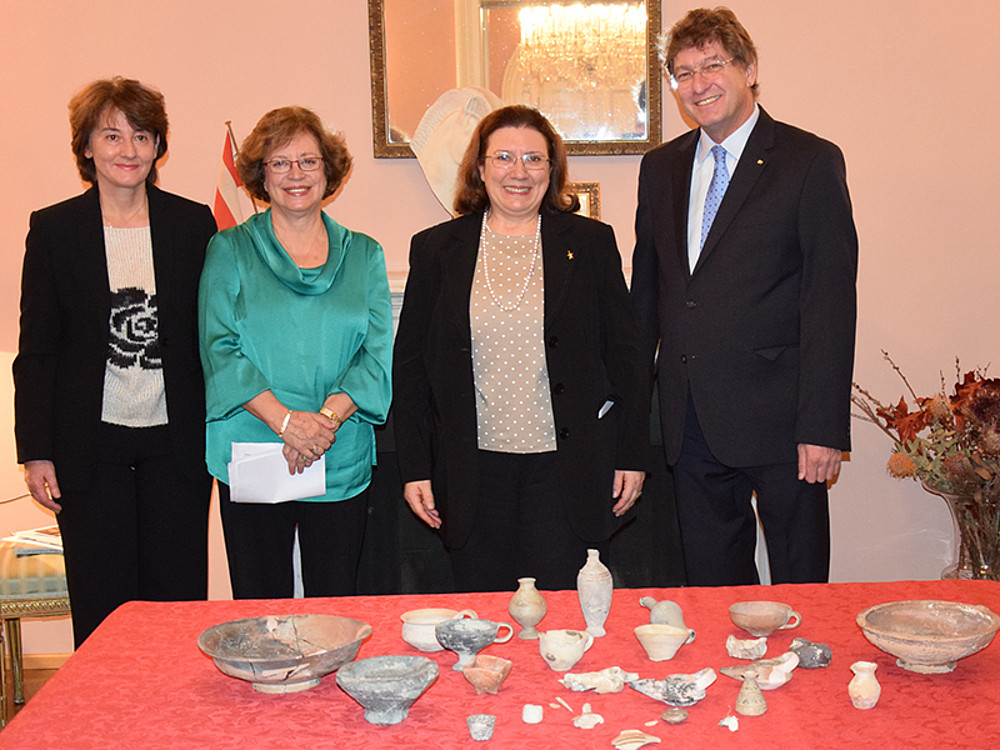
Übergabe in der griechischen Botschaft (v.l.): Direktorin des griech. BundesdenkmalamtVasiliki Papageorgiou, Generalsekretärin des griech. Ministeriums für Kultur und Sport Maria Andreadaki Vlazaki, Botschafterin Chryssoula Aliferi und Vizerektor Peter Scherrer. Foto: Georg Gstrein

Übergabe in der griechischen Botschaft (v.l.): Direktorin des griech. Bundesdenkmalamt Vasiliki Papageorgiou, Generalsekretärin des griech. Ministeriums für Kultur und Sport Maria Andreadaki Vlazaki, Botschafterin Chryssoula Aliferi und Vizerektor Peter Scherrer. Foto: Georg Gstrein

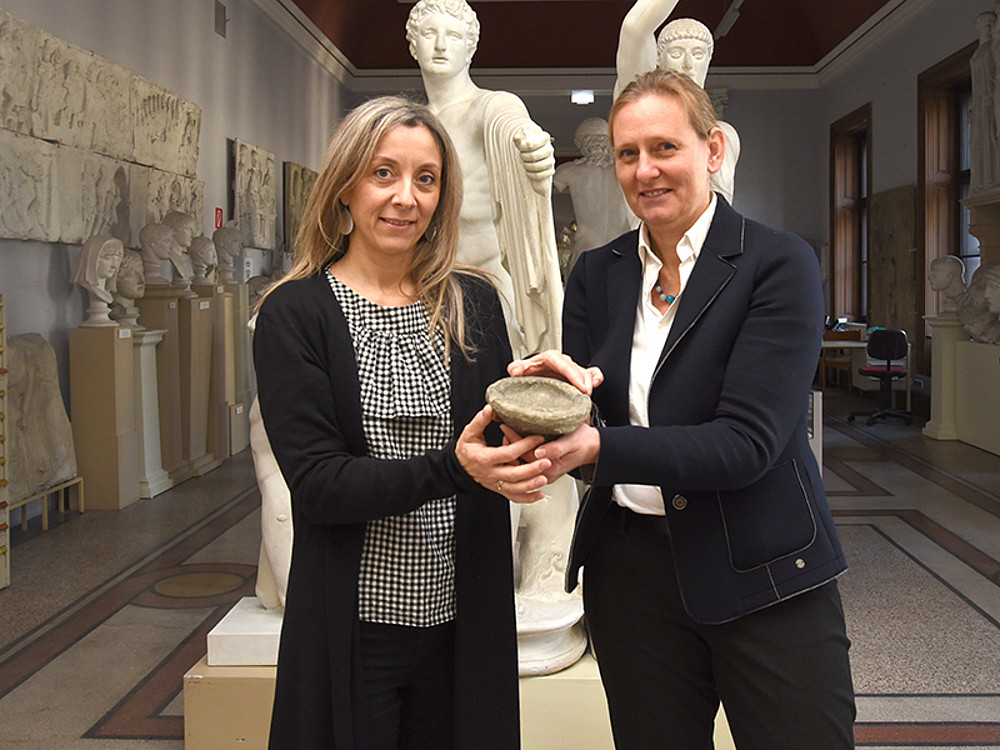
Maria Christidis (links) und Gabriele Koiner erforschten die Herkunft der antiken Artefakte, die nun an Griechenland restituiert wurden. Foto: Uni Graz/Tzivanopoulos ©Uni Graz/Tzivanopoulos
©Uni Graz/Tzivanopoulos

Maria Christidis (links) und Gabriele Koiner erforschten die Herkunft der antiken Artefakte, die nun an Griechenland restituiert wurden. Foto: Uni Graz/Tzivanopoulos

Institut für Archäologie restituierte NS-Raubgut an Griechenland

Mit dem Raub von Kulturgütern in der NS-Zeit setzte sich die Karl-Franzens-Universität in der jüngeren Vergangenheit intensiv auseinander. So durchleuchtete ein von den Vizerektoren Martin Polaschek und Peter Scherrer initiiertes und finanziertes Projekt die Bestände in der Universitätsbibliothek nach NS-Raubgut, um die Bücher an die Nachfahren der rechtmäßigen BesitzerInnen zu restituieren.
Auch die ArchäologInnen der Uni Graz gingen an ihrem Institut auf Spurensuche und erforschten die Herkunft einiger, nicht eindeutig zugewiesener Objekte.

Ausfindig gemacht wurde Stücke minoischer Keramik aus Knossos (Kreta), die aus einer britischen Grabung stammten und in den 1940er-Jahren über einen NS-Generalmajor als Mittelsmann an das Institut gelangten. Obwohl in den 1950er-Jahren ein griechischer Archäologe die Erlaubnis erteilt haben soll, die Gegenstände zu behalten, blieb der Erwerb nicht unumstritten.

Vizerektor Peter Scherrer, selbst Archäologe, setzte sich für eine Restitution an das Museum in Heraklion ein und initiierte die Rückgabe der insgesamt 26 Artefakte. Am 20. November 2017 war es soweit: Scherrer übergab mit den ArchäologInnen Gabriele Koiner und Maria Christidis, die ebenso wie Stephan Karl, Eleni Schindler-Kaudelka und Erwin Pochmarski über die Herkunft der kretischen Fundstücke forschten, die Sammlung an die griechische Botschafterin in Wien Chryssoula Aliferi.

created by Andreas Schweiger

Related news

In hot water: New Report reveals record losses in glaciers, permafrost and snow cover

Climate change is driving up temperatures not only in summer. Winters are also getting warmer – with dramatic consequences for glaciers, permafrost, snow cover and the freezing of lakes. The recently published cryosphere report provides specific figures for Austria. “Our monitoring shows a clear trend with record losses of ice and snow,” says project leader Wolfgang Schöner from the University of Graz.

Theologian at the University of Graz: What the excommunication of the Society of St Pius X

Following the schism involving the Society of St Pius X, there is a need for discussion. Bernd Hillebrand from the University of Graz explains why the Vatican took this step, what role anti-democratic tendencies play, and why the Society’s sacraments are no longer recognised as valid under canon law for Catholics with immediate effect.

“HeinrichBiCool”: University of Graz demonstrates the effects of green facades and roofs

The University of Graz has launched a pioneering project at the University Centre for Theology. Its name, “HeinrichBiCool”, says it all: a comprehensive system of green facades and roof will cool the building at Heinrichstraße 80 during the summer. At the same time, this will create a new habitat for plants and animals, helping to increase biodiversity. The accompanying monitoring programme will provide detailed data on the impact of the measures on indoor climate, energy consumption and biodiversity. The findings will lay a scientifically sound foundation for further projects aimed at making cities sustainable, climate-resilient and liveable. The partners in this project, funded by the Austrian Research Promotion Agency (FFG), are AEE INTEC – Institute for Sustainable Technologies, Technisches Büro Siegfried Stark, the landscape architecture and urban planning firm “studio boden”, and Ökoteam Graz.

When stress melts away in your mouth: nicotine pouches are widespread among Styrian students

Sociologists at the University of Graz, in collaboration with VIVID – the Centre for Addiction Prevention, have carried out a survey involving more than 600 participants. Around a quarter of them use these products. The ability to use them discreetly and flexibly is a key motivation.

Begin of page section:
Additional information:

University of Graz
Universitaetsplatz 3
8010 Graz
Austria
  • Contact
  • Web Editors
  • Moodle
  • UNIGRAZonline
  • Imprint
  • Data Protection Declaration
  • Accessibility Declaration
Weatherstation
Uni Graz

End of this page section. Go to overview of page sections

End of this page section. Go to overview of page sections

Begin of page section:

End of this page section. Go to overview of page sections

