



Begin of page section:
Page sections:

  • Go to contents (Accesskey 1)
  • Go to position marker (Accesskey 2)
  • Go to main navigation (Accesskey 3)
  • Go to sub navigation (Accesskey 4)
  • Go to additional information (Accesskey 5)
  • Go to page settings (user/language) (Accesskey 8)
  • Go to search (Accesskey 9)

End of this page section. Go to overview of page sections

Begin of page section:
Page settings:

English en
Deutsch de
Search
Login

End of this page section. Go to overview of page sections

Begin of page section:
Search:

Search for details about Uni Graz
Close

End of this page section. Go to overview of page sections


Search

Begin of page section:
Main navigation:

Page navigation:

  • University

    University
    • About the University
    • Organisation
    • Faculties
    • Library
    • Working at University of Graz
    • Campus
    Developing solutions for the world of tomorrow - that is our mission. Our students and our researchers take on the great challenges of society and carry the knowledge out.
  • Research Profile

    Research Profile
    • Our Expertise
    • Research Questions
    • Research Portal
    • Promoting Research
    • Research Transfer
    • Ethics in Research
    • Commission for Scientific Integrity
    Scientific excellence and the courage to break new ground. Research at the University of Graz creates the foundations for making the future worth living.
  • Studies

    Studies
    • Prospective Students
    • Students
    • Registration for Study Programme (Winter semester 2026/27)
  • Community

    Community
    • International
    • Location
    • Research and Business
    • Alumni
    The University of Graz is a hub for international research and brings together scientists and business experts. Moreover, it fosters the exchange and cooperation in study and teaching.
Topics
  • Sustainable University
  • Researchers answer
  • Work for us
Close menu

End of this page section. Go to overview of page sections

Begin of page section:
You are here:

University of Graz News Kopieren in 3D

End of this page section. Go to overview of page sections

Monday, 04 April 2016

Kopieren in 3D

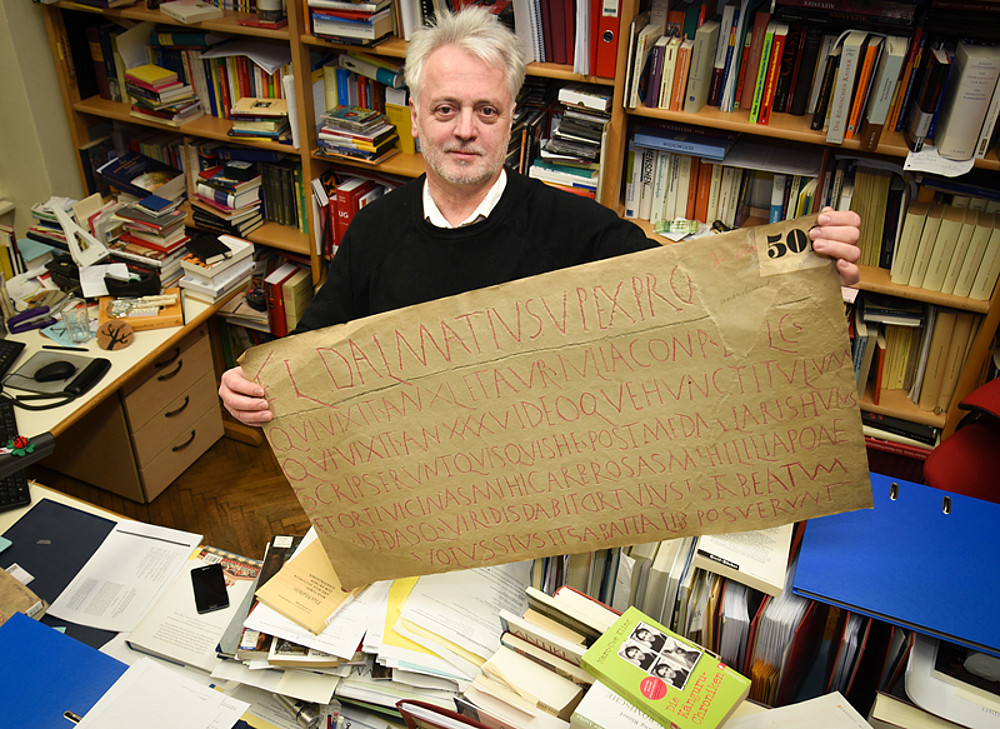
Althistoriker Peter Mauritsch mit einem Abklatsch aus der Sammlung der Universität Graz. Rund 1.200 solcher 3D-Kopien von Inschriften ruhen an der Uni Graz. Foto: Uni Graz/Tzivanopoulos

Althistoriker Peter Mauritsch mit einem Abklatsch aus der Sammlung der Universität Graz. Rund 1.200 solcher 3D-Kopien von Inschriften ruhen an der Uni Graz. Foto: Uni Graz/Tzivanopoulos

Nicht einmal was in Stein gemeißelt wird, ist für die Ewigkeit. Mit „Abklatschen“ versuchen ForscherInnen antikes Wissen zu sichern.

Die Abklatsch-Technologie ist einfach: Mit einem bartwischähnlichen Besen, einem Eimer Wasser und einem stark saugenden Papier konservieren ArchäologInnen und AlthistorikerInnnen griechische und römische Inschriften, die vor mehr als tausend Jahren in große Marmorblöcke gehauen wurden. „Besser gesagt: Wir legen das Papier an den Stein und klopfen mit dem nassen Besen darauf. Was wir bekommen, ist ein 3D-Abdruck der Schrift, im Fachjargon Abklatsch genannt“, erzählt Ass.-Prof. Dr. Peter Mauritsch. Die Technik ist alt: Bereits Ende des 19. Jahrhunderts arbeiteten ArchäologInnen und AlthistorikerInnen damit; sie konnte von modernen Technologien noch nicht abgelöst werden. Das Praktische daran ist, dass man auch im freien Feld, wo es kilometerweit keine Infrastruktur oder gar Strom gibt, Wissen sichern kann. Immer wieder bringen ForscherInnen diese händisch kopierten Inschriften von ihren Reisen mit an die Universität Graz.


Es ruhen rund 1.200 Abklatsche, größtenteils lateinische, aber auch griechische, in den Schränken des Instituts für Alte Geschichte und Altertumskunde. Inhaltlich variieren die in Graz aufbewahrten Kopien: Grabinschriften Angaben zu Familienverhältnissen und Herkunft, militärische Laufbahnen, Meilensteine mit Entfernungsangaben, Ehreninschriften für Beamte oder auch den Kaiser. In einem Projekt wurden nun die Abklatsche digitalisiert und stehen als Bild, in Umschrift und Übersetzung sowie mit Kommentar online der Wissenschaft und der interessierten Öffentlichkeit zur Verfügung. „Die Digitalisierung ermöglicht es, dass die Sammlung nun mit anderen Inschriftendatenbanken vernetzt werden kann“, führt Mauritsch aus. Fotografiert wurden sie mittels des Grazer Büchertisches von der Universitätsbibliothek Graz, gespeichert wurden sie im Geisteswissenschaftlichen Asset Management System GAMS, das vom Zentrum für Informationsmodellierung - Austrian Centre for Digital Humanities betreut und entwickelt wird.


Übrigens: Bis heute ist es nicht belegt, wer oder wann genau diese Sammlung an der Uni Graz angelegt hat bzw. angelegt wurde. Bekannt ist, dass es Anfang des 20. Jahrhunderts einen eigens dafür gezimmerten Schrank am Institut gab, der aber seinen Standort wechseln musste. Mauritsch sieht aber darin ein forschungsgeschichtlich interessantes Thema, das durchaus im Rahmen einer Masterarbeit in Angriff genommen werden könnte.


Online Plattform: http://gams.uni-graz.at/epsg

UNIZEIT Geschichte http://unipub.uni-graz.at/oazuzt/periodical/pageview/116801?query=abklatsch


created by Konstantinos Tzivanopoulos

Related news

"Mathematics explains the world"

How can life be quantified? And what can science reveal that remains hidden from the naked eye? The 14th European Conference on Mathematical and Theoretical Biology at the University of Graz is dedicated to these questions. From 13 to 17 July, around 1,300 researchers from all over the world will gather on campus to discuss models, biological processes and the future of data-driven medicine. Klemens Fellner, Dean of the Faculty of Natural Sciences and Mathematics and a mathematician, talks about the language that explains the world

Internationally up-to-date: University of Graz offers new degree programmes in art studies

From the Old Masters to AI art – three newly designed degree programmes offer students at the University of Graz fresh perspectives on artistic production. In addition to historical art, the programmes place a greater emphasis on contemporary and global developments. The registration period is open.

The Nazi elite school Napola: Historian seeks memories and personal documents

They were to be brought up to become the future elite of National Socialism: boys and girls aged ten and over who, following the ‘Anschluss’ of Austria to the German Reich, attended a so-called Napola (short for Nationalpolitische Lehranstalt; also known as NPEA, Nationalpolitische Erziehungsanstalt). There were nine such institutions in what is now Austria between 1939 and 1945.

Heat-resistant: Eva Preinfalk explains how cities can protect their residents

Certain demographic and some occupational groups are particularly vulnerable to high temperatures. A range of measures is needed to provide relief for everyone, explains climate economist Eva Preinfalk.

Begin of page section:
Additional information:

University of Graz
Universitaetsplatz 3
8010 Graz
Austria
  • Contact
  • Web Editors
  • Moodle
  • UNIGRAZonline
  • Imprint
  • Data Protection Declaration
  • Accessibility Declaration
Weatherstation
Uni Graz

End of this page section. Go to overview of page sections

End of this page section. Go to overview of page sections

Begin of page section:

End of this page section. Go to overview of page sections