Begin of page section:
Page sections:

  • Go to contents (Accesskey 1)
  • Go to position marker (Accesskey 2)
  • Go to main navigation (Accesskey 3)
  • Go to sub navigation (Accesskey 4)
  • Go to additional information (Accesskey 5)
  • Go to page settings (user/language) (Accesskey 8)
  • Go to search (Accesskey 9)

End of this page section. Go to overview of page sections

Begin of page section:
Page settings:

English en
Deutsch de
Search
Login

End of this page section. Go to overview of page sections

Begin of page section:
Search:

Search for details about Uni Graz
Close

End of this page section. Go to overview of page sections


Search

Begin of page section:
Main navigation:

Page navigation:

  • University

    University
    • About the University
    • Organisation
    • Faculties
    • Library
    • Working at University of Graz
    • Campus
    Developing solutions for the world of tomorrow - that is our mission. Our students and our researchers take on the great challenges of society and carry the knowledge out.
  • Research Profile

    Research Profile
    • Our Expertise
    • Research Questions
    • Research Portal
    • Promoting Research
    • Research Transfer
    • Ethics in Research
    • Commission for Scientific Integrity
    Scientific excellence and the courage to break new ground. Research at the University of Graz creates the foundations for making the future worth living.
  • Studies

    Studies
    • Prospective Students
    • Students
    • Post-registration Law
  • Community

    Community
    • International
    • Location
    • Research and Business
    • Alumni
    The University of Graz is a hub for international research and brings together scientists and business experts. Moreover, it fosters the exchange and cooperation in study and teaching.
Topics
  • Sustainable University
  • Researchers answer
  • Work for us
Close menu

End of this page section. Go to overview of page sections

Begin of page section:
You are here:

University of Graz News Teamwork: 100 pupils take part in maths competition at the University of Graz

End of this page section. Go to overview of page sections

Monday, 24 November 2025

Teamwork: 100 pupils take part in maths competition at the University of Graz

Group photo of the winners of the Naboj Junior Competition at the University of Graz

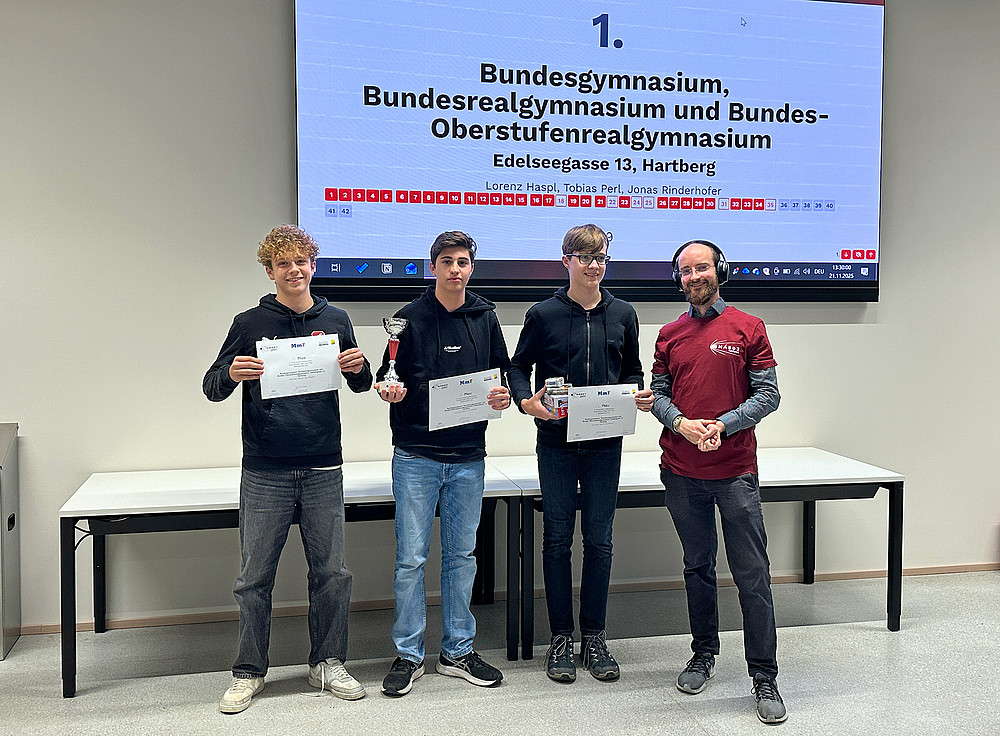
The fastest puzzlers at the University of Graz: Jonas Rinderhofer, Lorenz Haspl and Tobias Perl from BG/BRG/BORG Hartberg with co-organiser David Präsent. Photo: University of Graz

Four clever guts per group, increasingly tricky tasks, 120 minutes: these were the requirements for the international maths competition Náboj junior, which took place in Graz for the first time this year. The team from BG/BRG/BORG Hartberg was able to answer the most questions within the given limit - 29 - and thus won the competition.

The sum of six different positive integers is 22. What is their product? Or: It is so hot in the oven that the temperature in Fahrenheit would be exactly twice as high. How many degrees centigrade is it? The 25 Styrian teams from the 8th and 9th grades had to solve these and even more complex examples on 21 November at the University of Graz. They competed simultaneously with colleagues from numerous other European countries. "In the competition, we want to show possible applications of maths in everyday life. It's not about reproducing school material," explains Michael Fischer from the Department of Mathematics at the University of Graz, who brought the event to Austria. The participants need creativity and must be able to think outside the box. "Teamwork is very helpful for this. But there should also be at least one person who is quick at arithmetic," explains the researcher.

As soon as a group has solved an example, they are given the next one, with the level of difficulty constantly increasing. The thrill of competition and the desire to solve puzzles are a great motivation for many. "In some countries, there are even extra lessons in the afternoon, which the children attend voluntarily in order to be successful at Náboj," reports Fischer. Qualitative surveys have shown that such competitions increase the desire to do maths and give the subject a better image. "It's important to see in which areas you can apply maths. Many adults also enjoy solving Sudokus and didn't like the lessons."


>>Website of Náboj junior

created by Dagmar Eklaude

Related news

Studying at the University of Graz: How to enrol

Ready for a new chapter in your life with the start of your studies at the University of Graz in the winter semester 2026/27? Here you will find information on deadlines, admission procedures, registration, and everything else you need to successfully start your studies in the fall.

Europe Day: Strengthening international expertise with Arqus

On 9 May, the spotlight will be on Europe. At the University of Graz, European cooperation is also a tangible part of everyday student life – not least through the Arqus university alliance. Master’s and PhD students can currently register for the Arqus micro-credential in ‘Advanced Creative Thinking and Communication’.

A substantial community: the key role of soil crusts in the earth system

They are often overshadowed by the plant world: lichens, fungi, mosses and bacteria, which form unique communities on rocks and trees or as soil crusts. Bettina Weber from the University of Graz is bringing this biological alliance into the research spotlight. Her research shows that these communities form an essential part of the Earth’s critical zone and play a key role in the interactions between land and atmosphere. Bettina Weber was honoured by the European Geosciences Union for her groundbreaking research at the beginning of May.

The digital world of tomorrow: University of Graz works with people to shape the future

Digitalisation is supposed to make everything better: artificial intelligence that even organises travel. The car that drives itself. Robots that care for us in our old age. But what kind of future do people actually want? What role should technology play in this? The University of Graz is exploring these questions through a new research facility. At the Graz Sociodigital and Participatory Futures Studio – or GraSP Futures Studio for short – young and old work together with researchers to design visions of the future that also critically examine technical innovations.

Begin of page section:
Additional information:

University of Graz
Universitaetsplatz 3
8010 Graz
Austria
  • Contact
  • Web Editors
  • Moodle
  • UNIGRAZonline
  • Imprint
  • Data Protection Declaration
  • Accessibility Declaration
Weatherstation
Uni Graz

End of this page section. Go to overview of page sections

End of this page section. Go to overview of page sections

Begin of page section:

End of this page section. Go to overview of page sections