“The future is not a given; it can be shaped,” emphasises Juliane Jarke, Professor of Digital Society at the University of Graz. To what extent can we shape the world of tomorrow ourselves, given that technologies offer such promising opportunities? “The question of whether we even want AI in our society and our lives no longer arises,” says the sociologist and computer scientist, identifying a “dominant narrative” shaped by major tech corporations and economic interests.
Values and norms
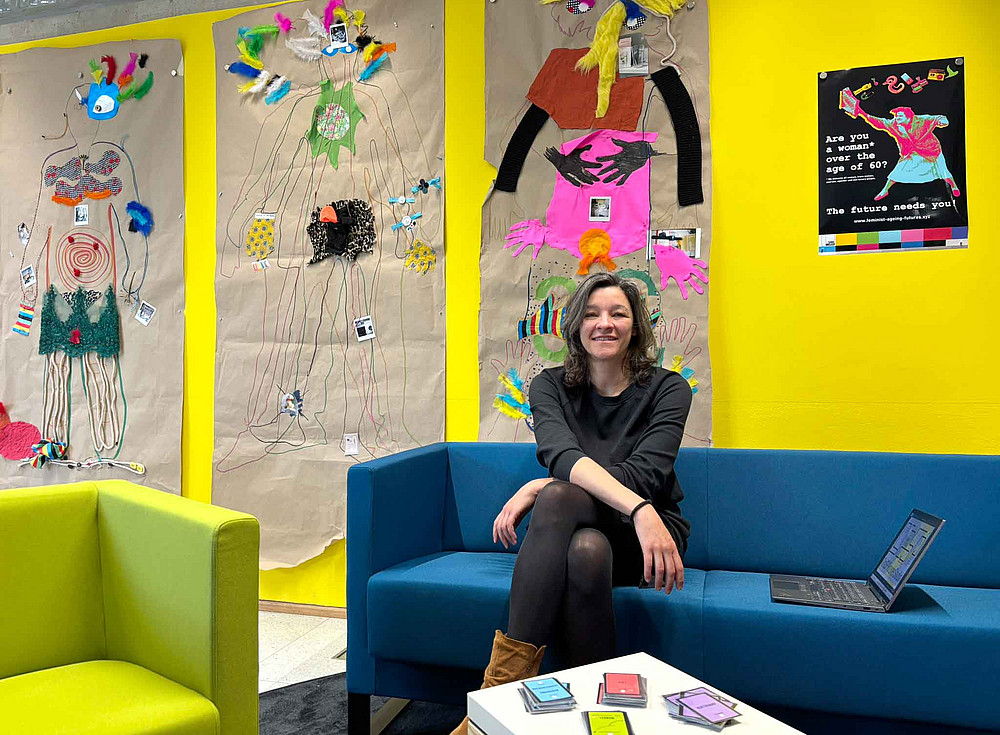
Of course, technological progress plays a crucial role in shaping social development. “But how do we want to live together and shape our future?” are central questions for Jarke. “What values, what norms and what institutions do we want to have?” The GraSP Futures Studio, which Jarke heads, aims to provide answers to these questions and offer critical perspectives. Her aim: “The facility should offer a space for free thought where reflection is possible and new ideas can emerge.” The design of the space also reflects this approach. It features flexible furniture and can be transformed in a few simple steps into a lecture theatre, a venue for workshops or larger events. The studio is accessible and equipped with aids for people with hearing and visual impairments. “This embodies participation, accessibility and collaborative design,” the researcher emphasises. Digital technologies and AI not only create new opportunities but can also exacerbate existing social inequalities. The aim is therefore to involve diverse stakeholders from across society in the research.
A thing from the future
The first workshops have already taken place. One of these – as part of the current University of Graz travelling exhibition “Democracy doesn’t have it easy” – involved students from Medienhak Graz. The task set for the young people was: Develop something from the future! “It was particularly interesting to reflect together on the role of the things and technologies they designed for community and cohesion. It allows for a critical yet constructive engagement with digital technologies,” summarises Jarke. A project funded by the Austrian Science Fund FWF on communicative AI and healthy ageing has shown that chatbots or AI companions for everyday life, which are actually intended to provide support, tend to be viewed rather ambivalently. “Building on this, we are exploring the question of whether technical aids are understood as support or whether they actually highlight the vulnerability associated with old age,” summarises Juliane Jarke.