



Begin of page section:
Page sections:

  • Go to contents (Accesskey 1)
  • Go to position marker (Accesskey 2)
  • Go to main navigation (Accesskey 3)
  • Go to sub navigation (Accesskey 4)
  • Go to additional information (Accesskey 5)
  • Go to page settings (user/language) (Accesskey 8)
  • Go to search (Accesskey 9)

End of this page section. Go to overview of page sections

Begin of page section:
Page settings:

English en
Deutsch de
Search
Login

End of this page section. Go to overview of page sections

Begin of page section:
Search:

Search for details about Uni Graz
Close

End of this page section. Go to overview of page sections


Search

Begin of page section:
Main navigation:

Page navigation:

  • University

    University
    • About the University
    • Organisation
    • Faculties
    • Library
    • Working at University of Graz
    • Campus
    Developing solutions for the world of tomorrow - that is our mission. Our students and our researchers take on the great challenges of society and carry the knowledge out.
  • Research Profile

    Research Profile
    • Our Expertise
    • Research Questions
    • Research Portal
    • Promoting Research
    • Research Transfer
    • Ethics in Research
    • Commission for Scientific Integrity
    Scientific excellence and the courage to break new ground. Research at the University of Graz creates the foundations for making the future worth living.
  • Studies

    Studies
    • Prospective Students
    • Students
    • Registration for Study Programme (Winter semester 2026/27)
  • Community

    Community
    • International
    • Location
    • Research and Business
    • Alumni
    The University of Graz is a hub for international research and brings together scientists and business experts. Moreover, it fosters the exchange and cooperation in study and teaching.
Topics
  • Sustainable University
  • Researchers answer
  • Work for us
Close menu

End of this page section. Go to overview of page sections

Begin of page section:
You are here:

University of Graz News Gut gelaufen

End of this page section. Go to overview of page sections

Friday, 04 November 2016

Gut gelaufen

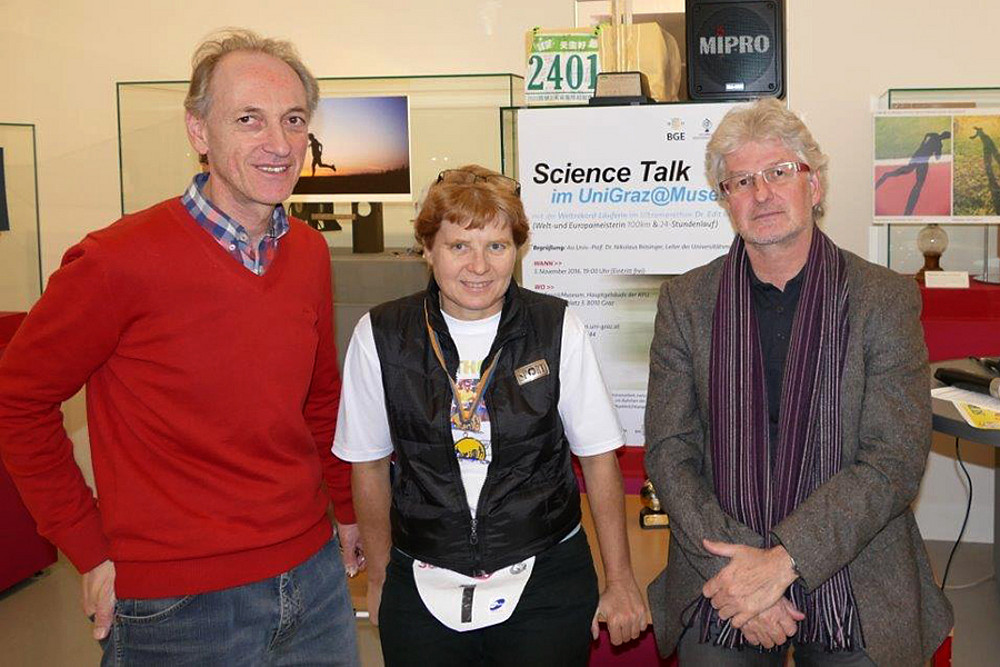
UniGraz@Museum-Kustos Franz Stangl und Uni-Museen-Leiter Nikolaus Reisinger begrüßten Weltrekord-Sportlerin Edit Bérces. Foto: Uni Graz/Schicker

UniGraz@Museum-Kustos Franz Stangl und Uni-Museen-Leiter Nikolaus Reisinger begrüßten Weltrekord-Sportlerin Edit Bérces. Foto: Uni Graz/Schicker

Ultramarathon- und Weltrekord-Sportlerin Edit Bérces zu Gast im UniGraz@Museum

Höher, weiter, schneller – was Menschen schaffen können, demonstriert die aktuelle Sonderausstellung „Weltrekorde im Sport“ im UniGraz@Museum auf anschauliche Art und Weise. Besonders hautnahe und spannende Einblicke in die Extremsportart „Ultramarathon“ vermittelte die ungarische Weltrekordläuferin Dr. Edit Bérces am 3. November 2016 bei einem Science-Talk im UniGraz@Museum.

Zu den härtesten Bewerben des „Ultramarathon“ zählen 24-Stunden-Läufe, von denen Edit Bérces über 20 im Laufe ihrer Karriere erfolgreich absolviert hat. Darunter fällt ihr Weltrekord aus dem Jahr 2002 in Verona, bei dem sie mehr als 250 Kilometer innerhalb von 24 Stunden zurückgelegt hat. Eine weitere Steigerung bilden 48-Stunden-Läufe, wobei sie mit 369,7 Kilometer ihre persönliche Bestmarke gelaufen ist.

Ursprünglich sah Bérces ihre sportliche Zukunft im Triathlon. Ihre mittelmäßigen Radzeiten und ihre außergewöhnlichen Laufergebnisse ließen sie jedoch zum Ultramarathon wechseln. „Meine Konkurrentinnen witzelten über mich und rieten mir die Radstrecke doch ebenfalls zu laufen“ schmunzelte Edit Bérces im Gespräch mit dem Kustos des UniGraz@Museum, Franz Stangl.

Retrospektiv ist für die ehemalige Spitzensportlerin klar, dass die mentale Stärke zweifellos den entscheidenden Faktor beim Ultramarathon darstellt. Weder der Verlust von Fußnägeln, etwas das bei diesen enormen Distanzen nichts Außergewöhnliches darstellt, noch Zahnprobleme konnten Edit Bérces davon abhalten, bis ins Ziel zu laufen.

Die Ausstellung „Weltrekorde im Sport“, die SchülerInnen des BG/BRG Oeversee gemeinsam mit Studierenden der Sportwissenschaft in Zusammenarbeit mit dem UniGraz@Museum gestaltet haben, ist noch bis 31. Jänner 2017 zu sehen. http://unigraz-at-museum.uni-graz.at

created by Andreas Schweiger

Related news

The Nazi elite school Napola: Historian seeks memories and personal documents

They were to be brought up to become the future elite of National Socialism: boys and girls aged ten and over who, following the ‘Anschluss’ of Austria to the German Reich, attended a so-called Napola (short for Nationalpolitische Lehranstalt; also known as NPEA, Nationalpolitische Erziehungsanstalt). There were nine such institutions in what is now Austria between 1939 and 1945.

Heat-resistant: Eva Preinfalk explains how cities can protect their residents

Certain demographic and some occupational groups are particularly vulnerable to high temperatures. A range of measures is needed to provide relief for everyone, explains climate economist Eva Preinfalk.

Baby health: University of Graz is seeking study participants to investigate early risk factors

Why does the body composition of babies vary so much? Some children gain a significant amount of fat mass within a few weeks, whilst others show hardly any change over the same period. “At the same time, initial observations suggest that fat distribution in all babies may follow a similar pattern, regardless of their total body fat,” explains Marco Höfler from the Institute of Movement Sciences, Sport and Health at the University of Graz. He is coordinating the research project ‘Small Bodies – Big Questions’, for which participants are currently still being sought: pregnant women and babies up to four weeks old.

In hot water: New Report reveals record losses in glaciers, permafrost and snow cover

Climate change is driving up temperatures not only in summer. Winters are also getting warmer – with dramatic consequences for glaciers, permafrost, snow cover and the freezing of lakes. The recently published cryosphere report provides specific figures for Austria. “Our monitoring shows a clear trend with record losses of ice and snow,” says project leader Wolfgang Schöner from the University of Graz.

Begin of page section:
Additional information:

University of Graz
Universitaetsplatz 3
8010 Graz
Austria
  • Contact
  • Web Editors
  • Moodle
  • UNIGRAZonline
  • Imprint
  • Data Protection Declaration
  • Accessibility Declaration
Weatherstation
Uni Graz

End of this page section. Go to overview of page sections

End of this page section. Go to overview of page sections

Begin of page section:

End of this page section. Go to overview of page sections