



Begin of page section:
Page sections:

  • Go to contents (Accesskey 1)
  • Go to position marker (Accesskey 2)
  • Go to main navigation (Accesskey 3)
  • Go to sub navigation (Accesskey 4)
  • Go to additional information (Accesskey 5)
  • Go to page settings (user/language) (Accesskey 8)
  • Go to search (Accesskey 9)

End of this page section. Go to overview of page sections

Begin of page section:
Page settings:

English en
Deutsch de
Search
Login

End of this page section. Go to overview of page sections

Begin of page section:
Search:

Search for details about Uni Graz
Close

End of this page section. Go to overview of page sections


Search

Begin of page section:
Main navigation:

Page navigation:

  • University

    University
    • About the University
    • Organisation
    • Faculties
    • Library
    • Working at University of Graz
    • Campus
    Developing solutions for the world of tomorrow - that is our mission. Our students and our researchers take on the great challenges of society and carry the knowledge out.
  • Research Profile

    Research Profile
    • Our Expertise
    • Research Questions
    • Research Portal
    • Promoting Research
    • Research Transfer
    • Ethics in Research
    • Commission for Scientific Integrity
    Scientific excellence and the courage to break new ground. Research at the University of Graz creates the foundations for making the future worth living.
  • Studies

    Studies
    • Prospective Students
    • Students
  • Community

    Community
    • International
    • Location
    • Research and Business
    • Alumni
    The University of Graz is a hub for international research and brings together scientists and business experts. Moreover, it fosters the exchange and cooperation in study and teaching.
  • Spotlight
Topics
  • Sustainable University
  • Researchers answer
  • Work for us
Close menu

End of this page section. Go to overview of page sections

Begin of page section:
You are here:

University of Graz News Grenzerfahrung

End of this page section. Go to overview of page sections

Friday, 05 April 2019

Grenzerfahrung

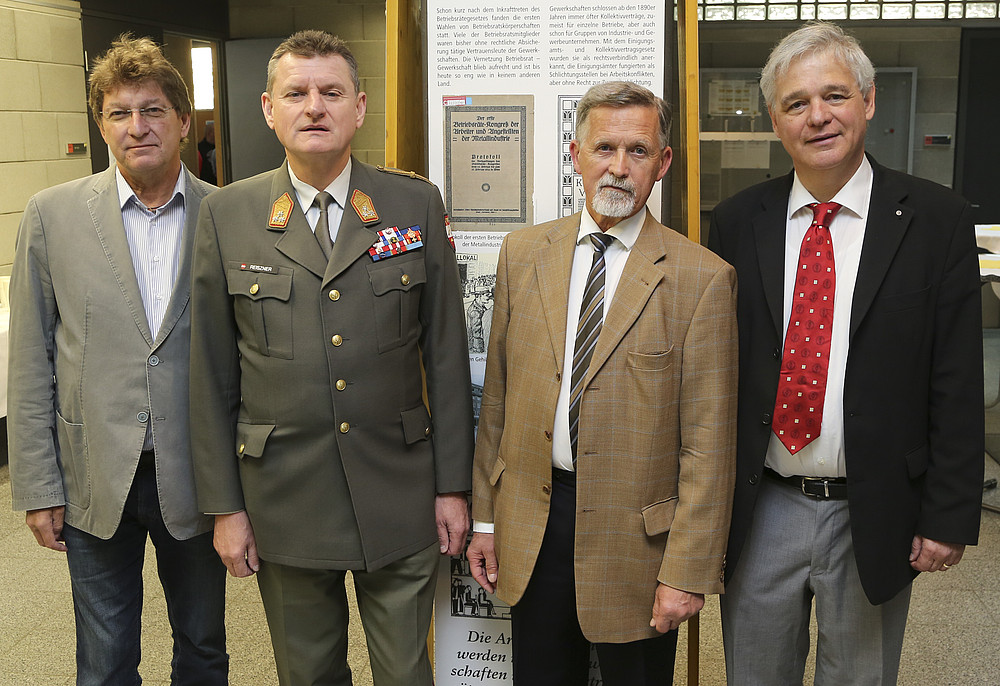
So lange es Menschen gibt, gibt es auch Grenzen. Dazu diskutierten unter anderem Peter Scherrer, Archäologe und Forschungs-Vizerektor, Generalleutnant Franz Reißner, Historiker Harald Heppner und Wolfgang Spickermann. (v.l.) Foto: Uni Graz/Tzivanopoulos

So lange es Menschen gibt, gibt es auch Grenzen. Dazu diskutierten unter anderem Peter Scherrer, Archäologe und Forschungs-Vizerektor, Generalleutnant Franz Reißner, Historiker Harald Heppner und Wolfgang Spickermann. (v.l.) Foto: Uni Graz/Tzivanopoulos

Universität Graz blickt auf Leben mit und an der Grenze von der Antike bis heute

Sie schienen in Europa beinahe überwunden und verschwunden. Seit 2015 werden sie wieder hochgezogen: Grenzen. Leben mit und an der Grenze machten WissenschafterInnen an der Universität Graz am 4. und 5. April 2019 zum Thema – quer durch die Jahrtausende: vom römischen Imperium über Grenzsicherung im Mittelalter bis hin zur Berliner Mauer und zum Adria-Konflikt zwischen Kroatien und Slowenien. 

Grenze ist mehr als nur hier und drüben. Das unterstreicht auch Historiker Harald Heppner: „Zum einen geht es um Unterscheidung, eben um Abgrenzung. Zum anderen aber wird auch der Bau von Brücken befördert. Denn Menschen wollen Grenzen überwinden.“ Grenzen seien daher auch eine Stimulanz gewesen, Alternativen zu suchen. „Eine Quelle der Inspiration“, so Heppner, die er speziell in ländlichen Regionen verortet. Am Beispiel des ehemaligen Jugoslawien und der Steiermark lasse sich das gut belegen. „Hier haben die Menschen immer versucht, zueinander zu finden.“ Davon wurden sie durch Grenzen aber auch vehement abgehalten. Der Eiserne Vorhang, an dem Menschen starben, prägte den Kontinent fast ein halbes Jahrhundert lang. 
Grenzen, so der Wissenschafter, sind dann ein Fehlgriff, „wenn sie ausschließlich aus Ratlosigkeit oder aus Schwäche hochgezogen wurden“. 
Heute ist das Thema aktueller denn je. Lässt sich die Vision eines grenzenlosen Europa überhaupt noch realisieren? Laut Heppner setzt das voraus, „dass alle guten Willens und bereit sind, damit verbundene Sachzwänge gemeinsam zu tragen“. Einzelne Staaten seien dazu weder ökonomisch noch mental in der Lage. 

Dass sich Grenzerfahrungen als roter Faden durch die Menschheitsgeschichte ziehen, veranschaulichten WissenschafterInnen im Rahmen der oben genannten Tagung an der Universität Graz – organisiert von Wolfgang Spickermann, Professor für alte Geschichte an der Universität Graz sowie Vorsitzender des Center for Military Studies, und Harald Heppner. Unter den Vortragenden war etwa Wolfgang Mueller, Professor für russische Geschichte an der Universität Wien, der über räumliche und mentale Abgrenzung zwischen Europa und Russland spricht. Der deutsche Historiker Winfried Heinemann zeichnete Spuren der Berliner Mauer im Stadtbild nach. Die Uni-Graz-Historikerin Sabine Jesner blickt auf die Habsburgische Militärgrenze. Weitere prominente TeilnehmerInnen waren Generalleutnant Franz Reissner, einer der höchsten Offiziere des Bundesheeres, sowie Manfried Rauchensteiner, der ehemalige Direktor des Heeresgeschichtlichen Museums und Erfolgsautor der österreichischen Militärgeschichte. 
created by Andreas Schweiger

Related news

Higher Education Strategy 2040: Austria’s universities on course for the future

Austria has 77 higher education institutions, which is above the EU average – but does this really make sense? The new Higher Education Strategy 2040 focuses on cooperation rather than mergers. As one of the six largest universities in Austria, the University of Graz plays a central role in this.

Climate research in Greenland: Old data provides new insights

The polar explorer and University of Graz professor Alfred Wegener left behind a unique collection of climate data from Greenland. A research team from the University of Graz is now analysing this 100-year-old treasure trove of data and comparing it with current measurements.

Diversity in nature and science: How we talk about plants and each other

Ginkgo, kiwi, hemp: they exist as male and female plants. Anyone who paid attention in biology class will confirm this. But is this categorisation, established by Carl von Linné almost 300 years ago, still valid today? An interdisciplinary team at the University of Graz is questioning these attributions and using this as a starting point to provide food for thought for gender-sensitive interaction between students, scientific and teaching staff.

Around the world in eight stops: the Long Night of Research at the University of Graz

On 24 April from 5 pm, you can take a short trip around the globe at the University of Graz, discovering pecularities of foreign countries or new local features in the entrance hall of the University Library. The itinerary takes you through introduced animal species, political attitudes and the omnipotence of algorithms. There will also be a programme in the historic reading hall, as well as at the UniGraz@Museum and the University Archive.

Begin of page section:
Additional information:

University of Graz
Universitaetsplatz 3
8010 Graz
Austria
  • Contact
  • Web Editors
  • Moodle
  • UNIGRAZonline
  • Imprint
  • Data Protection Declaration
  • Accessibility Declaration
Weatherstation
Uni Graz

End of this page section. Go to overview of page sections

End of this page section. Go to overview of page sections

Begin of page section:

End of this page section. Go to overview of page sections


