



Begin of page section:
Page sections:

  • Go to contents (Accesskey 1)
  • Go to position marker (Accesskey 2)
  • Go to main navigation (Accesskey 3)
  • Go to sub navigation (Accesskey 4)
  • Go to additional information (Accesskey 5)
  • Go to page settings (user/language) (Accesskey 8)
  • Go to search (Accesskey 9)

End of this page section. Go to overview of page sections

Begin of page section:
Page settings:

English en
Deutsch de
Search
Login

End of this page section. Go to overview of page sections

Begin of page section:
Search:

Search for details about Uni Graz
Close

End of this page section. Go to overview of page sections


Search

Begin of page section:
Main navigation:

Page navigation:

  • University

    University
    • About the University
    • Organisation
    • Faculties
    • Library
    • Working at University of Graz
    • Campus
    Developing solutions for the world of tomorrow - that is our mission. Our students and our researchers take on the great challenges of society and carry the knowledge out.
  • Research Profile

    Research Profile
    • Our Expertise
    • Research Questions
    • Research Portal
    • Promoting Research
    • Research Transfer
    • Ethics in Research
    • Commission for Scientific Integrity
    Scientific excellence and the courage to break new ground. Research at the University of Graz creates the foundations for making the future worth living.
  • Studies

    Studies
    • Prospective Students
    • Students
    • Registration for Study Programme (Winter semester 2026/27)
  • Community

    Community
    • International
    • Location
    • Research and Business
    • Alumni
    The University of Graz is a hub for international research and brings together scientists and business experts. Moreover, it fosters the exchange and cooperation in study and teaching.
Topics
  • Sustainable University
  • Researchers answer
  • Work for us
Close menu

End of this page section. Go to overview of page sections

Begin of page section:
You are here:

University of Graz News Für das Kulturerbe

End of this page section. Go to overview of page sections

Wednesday, 11 September 2019

Für das Kulturerbe

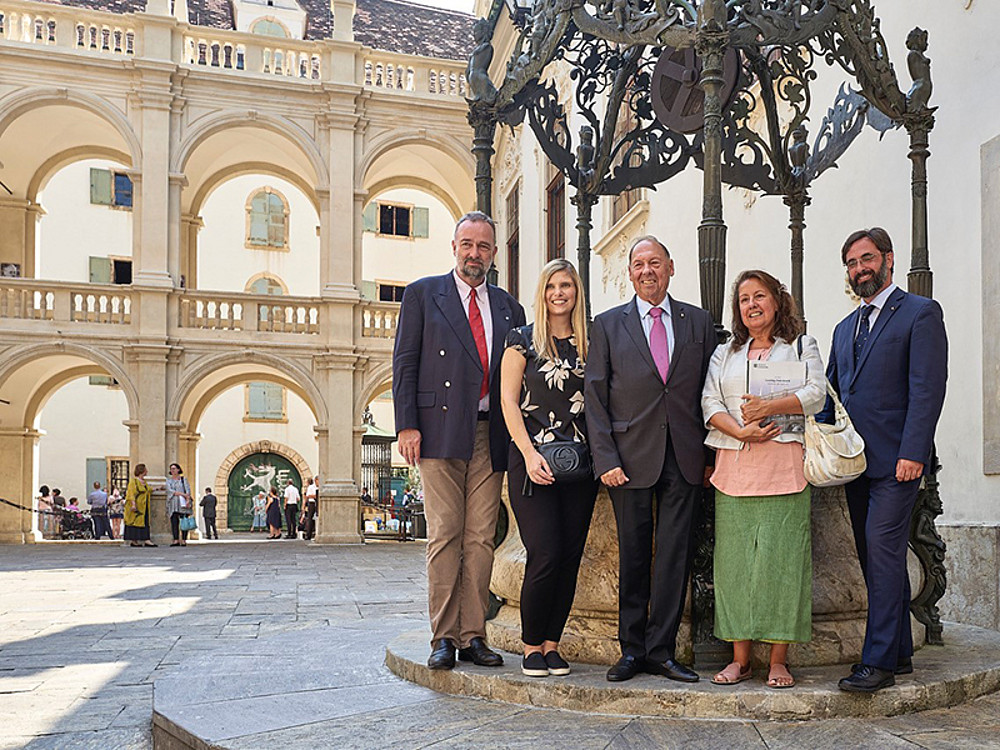
Karl Habsburg-Lothringen (Blue-Shield International), Eva Klein (Universität Graz), Günter Nebel (Sponsor), Margit Stadlober (Universität Graz) und Friedrich Schipper (Universität Wien). Fotos: Ester Wendt.

Karl Habsburg-Lothringen (Blue-Shield International), Eva Klein (Universität Graz), Günter Nebel (Sponsor), Margit Stadlober (Universität Graz) und Friedrich Schipper (Universität Wien). Fotos: Ester Wendt.

Die TeilnehmerInnen der Summer School 2019 vor dem Grazer Uhrturm.

Die TeilnehmerInnen der Summer School 2019 vor dem Grazer Uhrturm.

Interuniversitäre Summer School der Universitäten Graz, Salzburg und Wien

Das erfolgreiche Format der UNESCO-Summer-School zum Thema Kulturerbe wurde diesen Sommer bereits zum dritten Mal an der Universität Graz unter der Leitung von Eva Klein und Margit Stadlober in drei Universitätsstädten mit Weltkulturerbe abgehalten. Getragen wird die Ausbildung mit großzügiger Unterstützung der UNESCO-affinen Kulturgüterschutz-Organisation Blue Shield International, dessen Präsident Karl Habsburg-Lothringen auch diese Jahr wieder einen Förderscheck in der Höhe von 25.000 Euro für die Weiterführung dieses wertvollen Ausbildungsprogrammes, privat gesponsert von Primar Günter Nebel, überreicht hat. Bereits seit ihrem Beginn 2017 wird die Veranstaltung zusätzlich unterstützt vom Land Steiermark, dem Vizerektorat für Lehre der Karl-Franzens-Universität sowie der Forschungsstelle Kunstgeschichte Steiermark.

Das Format erfreut sich bei Studierenden aller Disziplinen großer Beliebtheit und wächst von Jahr zu Jahr.  Bewerben können sich Studierende von allen österreichischen Universitäten. Auch dieses Jahr konnten die AbsolventInnen der Summer School wieder mit einem Stipendium in der Höhe von je 500 Euro unterstützt werden, was zahlreich genutzt wurde.

Inhaltlich widmet sich die Sommerschule dem Phänomen des kulturellen Erbes auf vielerlei Ebenen, die sie mit ihren Studierenden besucht. In den empirischen Kulturwissenschaften geht man davon aus, dass Kulturerbe nicht einfach ist, sondern gemacht wird. Dieser Prozess, in den sämtliche Formen von Kommunikation eingebunden sind, wird auch Heritageifizierung genannt. Materielle wie immaterielle Kultur wird mit dem Prädikat Heritage ausgezeichnet, damit in ein neues höherwertiges Referenzsystem gestellt. Kulturelles Erbe als definierter Wert verbindet Vergangenheit und Zukunft im Sinne einer Gleichzeitigkeit des Ungleichzeitigen. Die Fragestellung nach der Ästhetik spricht zudem ein aktuelles Forschungsfeld der Kunst- und Designwissenschaft an, liefert aber auch stetes Diskussionsmaterial für die Bevölkerung.

In der Abgrenzung vom vermeintlich Anderen, sowohl räumlich, zeitlich als auch sozial, stellt es eine geeignete Projektionsfläche für die Ausbildung der eigenen Kultur dar und ist somit relevant bei der Herausbildung von Identitäten. Damit in Verbindung steht das Konzept des kulturellen Gedächtnisses, das den Kosmos auf ein breites Forschungsfeld öffnet, in das die Kommunikationswissenschaft zusehends vorstößt. Generell zeigt sich das Feld des kulturellen Erbes heute in zeitgemäßer Diversität. Sein Schutz und seine Bekanntmachung sind ein Auftrag an eine verantwortungsbewusste Gesellschaft, zu der die Summer School ihren Beitrag leisten will.

created by Eva Klein, Margit Stadlober & Gerhild Leljak

Related news

Staying fit during the holidays: summer sports on the University of Graz campus

The Kleeblattlauf is not the end of the fitness term. Following last year’s successful launch, the University of Graz is once again offering summer sports on campus this year. From 30 June to 16 July 2026, there will be a free exercise programme in the open air. On the shady Südwiese (between the main building and Universitätsplatz 2), anyone interested can get in shape in the afternoons with body workouts, fascia training and yoga.

Getting even hotter: Researchers predict global warming of 1.7 degrees by 2027

While Europe is currently sweltering in the heat, global temperatures are also rising towards concerning record levels. In 2026, Earth’s surface air temperature is expected to reach 1.62 degrees, and in 2027 even 1.71 degrees Celsius above pre-industrial levels. The long-term temperature rise – an average over a 20-year period – is predicted to exceed the 1.5-degree threshold of the Paris Agreement as of 2026 already. For the first time, researchers at the University of Graz have been able to make such a forecast so far in advance. The intensifying El Niño climate event favors forecast skill and thereby facilitates a reliable computation.

Forest fire at Rosenhain: Volunteer fire brigade carried out an evacuation drill at the Jesuit refectory

Thick smoke in the stairwell, flames at the edge of the forest, people missing in the Jesuit refectory at the University of Graz: at Rosenhain, the Graz Volunteer Fire Brigade carried out a drill simulating a scenario that is becoming increasingly realistic given the heat and drought

Full effort in the heat: the Sports Centre was in full swing at the Kleeblattlauf

On 19 June 2026, 2,000 runners and hundreds of supporters made their way to the Rosenhain for a sporting end-of-term event.

Begin of page section:
Additional information:

University of Graz
Universitaetsplatz 3
8010 Graz
Austria
  • Contact
  • Web Editors
  • Moodle
  • UNIGRAZonline
  • Imprint
  • Data Protection Declaration
  • Accessibility Declaration
Weatherstation
Uni Graz

End of this page section. Go to overview of page sections

End of this page section. Go to overview of page sections

Begin of page section:

End of this page section. Go to overview of page sections

