Begin of page section:
Page sections:

  • Go to contents (Accesskey 1)
  • Go to position marker (Accesskey 2)
  • Go to main navigation (Accesskey 3)
  • Go to sub navigation (Accesskey 4)
  • Go to additional information (Accesskey 5)
  • Go to page settings (user/language) (Accesskey 8)
  • Go to search (Accesskey 9)

End of this page section. Go to overview of page sections

Begin of page section:
Page settings:

English en
Deutsch de
Search
Login

End of this page section. Go to overview of page sections

Begin of page section:
Search:

Search for details about Uni Graz
Close

End of this page section. Go to overview of page sections


Search

Begin of page section:
Main navigation:

Page navigation:

  • University

    University
    • About the University
    • Organisation
    • Faculties
    • Library
    • Working at University of Graz
    • Campus
    Developing solutions for the world of tomorrow - that is our mission. Our students and our researchers take on the great challenges of society and carry the knowledge out.
  • Research Profile

    Research Profile
    • Our Expertise
    • Research Questions
    • Research Portal
    • Promoting Research
    • Research Transfer
    • Ethics in Research
    • Commission for Scientific Integrity
    Scientific excellence and the courage to break new ground. Research at the University of Graz creates the foundations for making the future worth living.
  • Studies

    Studies
    • Prospective Students
    • Students
  • Community

    Community
    • International
    • Location
    • Research and Business
    • Alumni
    The University of Graz is a hub for international research and brings together scientists and business experts. Moreover, it fosters the exchange and cooperation in study and teaching.
  • Spotlight
Topics
  • Sustainable University
  • Researchers answer
  • Work for us
Close menu

End of this page section. Go to overview of page sections

Begin of page section:
You are here:

University of Graz News Fruchtbar geforscht

End of this page section. Go to overview of page sections

Monday, 19 October 2020

Fruchtbar geforscht

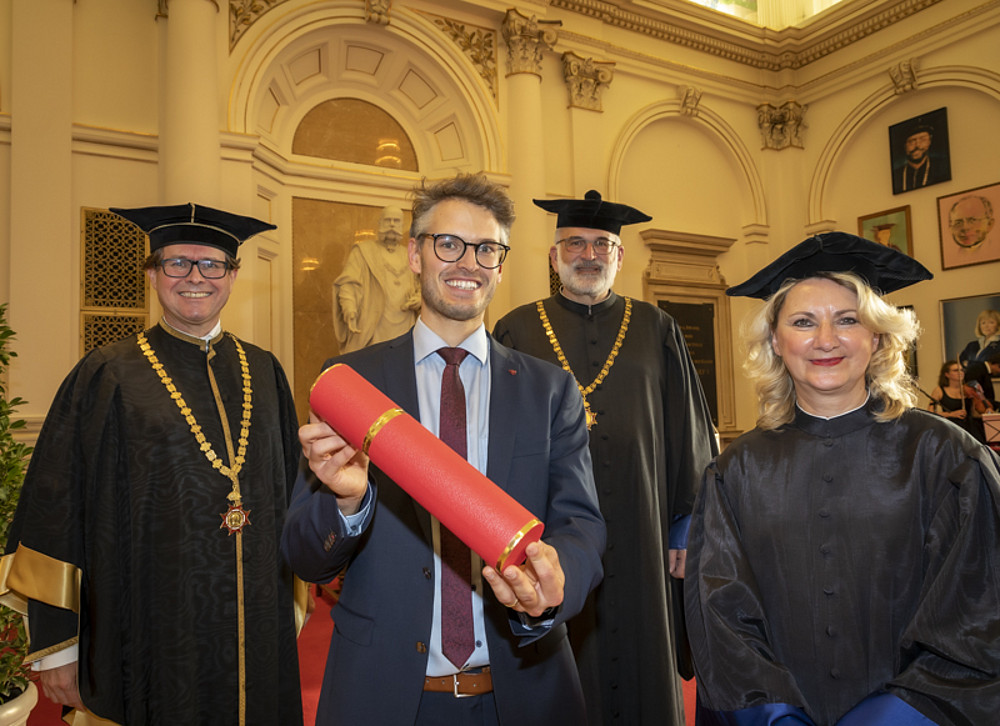
Rektor Martin Polaschek, sub-auspiciis-Promovend Gabriel Hofer-Ranz, Michael Walter, Dekan der Geisteswissenschaftlichen Fakultät, und Margit Reitbauer, Studiendekanin der Geisteswissenschaftlichen Fakultät (v.l.). Foto: Uni Graz/Lunghammer.

Rektor Martin Polaschek, sub-auspiciis-Promovend Gabriel Hofer-Ranz, Michael Walter, Dekan der Geisteswissenschaftlichen Fakultät, und Margit Reitbauer, Studiendekanin der Geisteswissenschaftlichen Fakultät (v.l.). Foto: Uni Graz/Lunghammer.

Ethiker Gabriel Hofer-Ranz promovierte sub auspiciis an der Universität Graz

Ausschließlich ausgezeichnete Leistungen von der Schule bis zur Doktorarbeit: Darauf blickt der 32-jährige Grazer Gabriel Hofer-Ranz zurück. Heute, am 19. Oktober 2020, promovierte er an der Universität Graz sub auspiciis praesidentis. Die Ehrenringe mit dem Wappen der Republik wird Bundespräsident Alexander van der Bellen allen diesjährigen Geehrten am 13. November in Wien überreichen.

Martin Polaschek, Rektor der Universität Graz, gratulierte dem Promovenden: „Exzellente Leistungen entstehen durch großen persönlichen Einsatz und aus dem inneren Antrieb, ein Thema umfassend, ausgewogen und kritisch zu bearbeiten. Diese Werte vermitteln wir allen unseren AbsolventInnen und würdigen entsprechendes Engagement gebührend.“ Gemeinsam mit Michael Walter, Dekan der Geisteswissenschaftlichen Fakultät, und Margit Reitbauer, Studiendekanin der Geisteswissenschaftlichen Fakultät, nahm Rektor Polaschek die Promotion des Absolventen der Philosophie vor.

Gabriel Hofer-Ranz hat in seiner Dissertation das so genannte Social Egg Freezing, also das vorsorgliche Einfrieren von unbefruchteten Eizellen ohne medizinische Indikation, einer ethischen Analyse unterzogen. Apple und Facebook boten diese Fertilitätsvorsorge ihren Mitarbeiterinnen erstmals 2014 kostenlos an und sorgten damit international für Aufsehen. In Österreich ist Social Egg Freezing aktuell verboten, in Deutschland und der Schweiz gibt es allerdings unterschiedliche oder gar keine Regelungen dazu. „Ich habe in meiner Dissertation – salopp formuliert – die Potenziale und Risiken dieser reproduktionsmedizinischen Technik einer Abwägung unterzogen“, schildert Hofer-Ranz.

Einerseits ermögliche Social Egg Freezing berufstätigen Frauen einen größeren Freiheitsspielraum für ihre Lebensgestaltung, insbesondere, da Ausbildungen heute oft länger dauern. „Andererseits stellt sich die Frage, wie sehr die Existenz dieser Technik einen latenten Druck zur Nutzung mit sich bringt und damit Kinder zusehends als Sand im wirtschaftlichen Getriebe wahrgenommen werden,“ erklärt der Forscher. Generell sieht Hofer-Ranz diese Art der Fertilitätsvorsorge als oberflächliche Lösung für ein größeres soziales Problem – nämlich dem der erschwerten Vereinbarkeit von Familie und Beruf für Frauen. Der Vater zweier kleiner Töchter resümiert: „Den perfekten Zeitpunkt für Kinder gibt es nicht. Und wenn man Entscheidungen existentieller Natur stets auf die lange Bank des Lebens schiebt, verlernt man, sie überhaupt zu treffen.“  

Der frisch gebackene sub-Auspiciis-Promovend in der Aula der Universität Graz. Foto: Uni Graz/Lunghammer.
created by Gerhild Leljak

Related news

Higher Education Strategy 2040: Austria’s universities on course for the future

Austria has 77 higher education institutions, which is above the EU average – but does this really make sense? The new Higher Education Strategy 2040 focuses on cooperation rather than mergers. As one of the six largest universities in Austria, the University of Graz plays a central role in this.

Climate research in Greenland: Old data provides new insights

The polar explorer and University of Graz professor Alfred Wegener left behind a unique collection of climate data from Greenland. A research team from the University of Graz is now analysing this 100-year-old treasure trove of data and comparing it with current measurements.

Diversity in nature and science: How we talk about plants and each other

Ginkgo, kiwi, hemp: they exist as male and female plants. Anyone who paid attention in biology class will confirm this. But is this categorisation, established by Carl von Linné almost 300 years ago, still valid today? An interdisciplinary team at the University of Graz is questioning these attributions and using this as a starting point to provide food for thought for gender-sensitive interaction between students, scientific and teaching staff.

Around the world in eight stops: the Long Night of Research at the University of Graz

On 24 April from 5 pm, you can take a short trip around the globe at the University of Graz, discovering pecularities of foreign countries or new local features in the entrance hall of the University Library. The itinerary takes you through introduced animal species, political attitudes and the omnipotence of algorithms. There will also be a programme in the historic reading hall, as well as at the UniGraz@Museum and the University Archive.

Begin of page section:
Additional information:

University of Graz
Universitaetsplatz 3
8010 Graz
Austria
  • Contact
  • Web Editors
  • Moodle
  • UNIGRAZonline
  • Imprint
  • Data Protection Declaration
  • Accessibility Declaration
Weatherstation
Uni Graz

End of this page section. Go to overview of page sections

End of this page section. Go to overview of page sections

Begin of page section:

End of this page section. Go to overview of page sections