Begin of page section:
Page sections:

  • Go to contents (Accesskey 1)
  • Go to position marker (Accesskey 2)
  • Go to main navigation (Accesskey 3)
  • Go to sub navigation (Accesskey 4)
  • Go to additional information (Accesskey 5)
  • Go to page settings (user/language) (Accesskey 8)
  • Go to search (Accesskey 9)

End of this page section. Go to overview of page sections

Begin of page section:
Page settings:

English en
Deutsch de
Search
Login

End of this page section. Go to overview of page sections

Begin of page section:
Search:

Search for details about Uni Graz
Close

End of this page section. Go to overview of page sections


Search

Begin of page section:
Main navigation:

Page navigation:

  • University

    University
    • About the University
    • Organisation
    • Faculties
    • Library
    • Working at University of Graz
    • Campus
    Developing solutions for the world of tomorrow - that is our mission. Our students and our researchers take on the great challenges of society and carry the knowledge out.
  • Research Profile

    Research Profile
    • Our Expertise
    • Research Questions
    • Research Portal
    • Promoting Research
    • Research Transfer
    • Ethics in Research
    Scientific excellence and the courage to break new ground. Research at the University of Graz creates the foundations for making the future worth living.
  • Studies

    Studies
    • Prospective Students
    • Students
  • Community

    Community
    • International
    • Location
    • Research and Business
    • Alumni
    The University of Graz is a hub for international research and brings together scientists and business experts. Moreover, it fosters the exchange and cooperation in study and teaching.
  • Spotlight
Topics
  • Our digital Advent calendar
  • Sustainable University
  • Researchers answer
  • Work for us
Close menu

End of this page section. Go to overview of page sections

Begin of page section:
You are here:

University of Graz News Forschungspreise

End of this page section. Go to overview of page sections

Friday, 18 November 2022

Forschungspreise

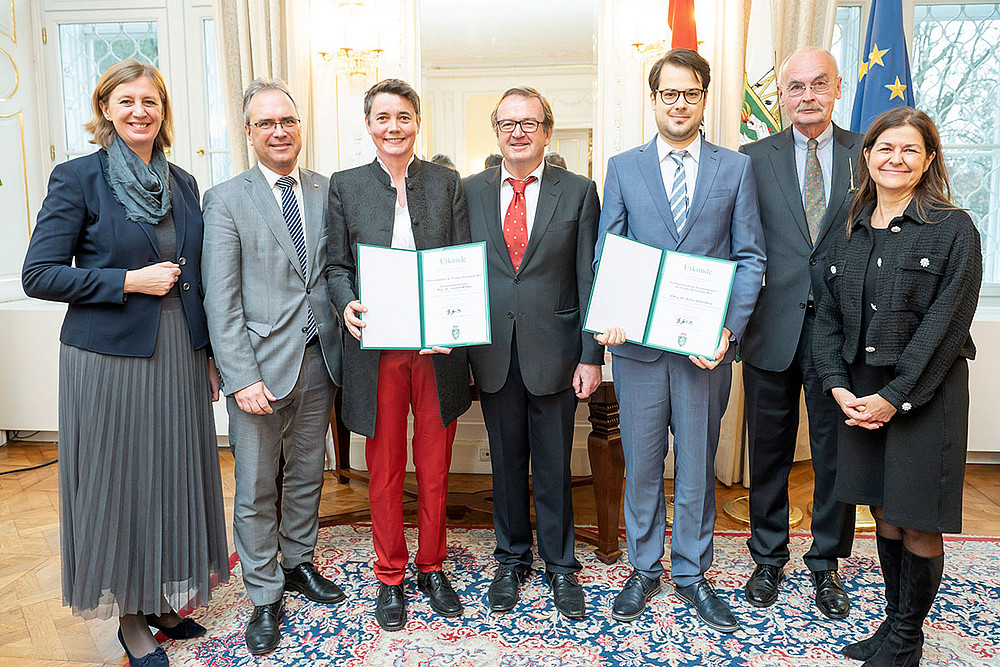
V.l.: Landesrätin Barbara Eibinger-Miedl, Rektor Peter Riedler, Preisträgerin Astrid Veronig, Laudator Arnold Hanslmeier, Preisträger Markus Roschitz, Laudator Dieter-Anton Binder, Landesrätin Doris Kampus. Foto Fischer ©Foto Fischer

V.l.: Landesrätin Barbara Eibinger-Miedl, Rektor Peter Riedler, Preisträgerin Astrid Veronig, Laudator Arnold Hanslmeier, Preisträger Markus Roschitz, Laudator Dieter-Anton Binder, Landesrätin Doris Kampus. Foto Fischer

Land Steiermark zeichnet Astrophysikerin und Historiker der Uni Graz aus

Sie hat die Sterne im Visier, er die Steiermark. Die Astrophysikerin Astrid Veronig beobachtete die Ausbrüche ferner Sonnen, der Historiker Markus Roschitz brachte neue Erkenntnisse über den Aufstieg der NSDAP in der Region Schwanberg ans Licht. Beide Wissenschafter:innen der Universität Graz wurden am 18. November 2022 von den Landesrätinnen Barbara Eibinger-Miedl und Doris Kampus ausgezeichnet. Astrid Veronig erhielt den Forschungspreis des Landes Steiermark, Markus Roschitz den Erzherzog-Johann-Forschungspreis, jeweils dotiert mit 12 000 Euro.

Ausbrüche
Unsere Sonne versorgt uns nicht nur mit Licht und Wärme, sie schleudert immer wieder auch magnetisierte Plasmawolken ins All. Auf der Erde machen sie sich als faszinierende Polarlichter bemerkbar. Sind die Ausbrüche besonders energiereich, können sie elektronische Systeme auf Satelliten lahmlegen oder sogar Stromausfälle auslösen. Astrid Veronig und ihr Team konnten mit einer neu entwickelten Methode nun auch auf anderen Sternen koronale Massenauswürfe nachweisen. „Wir beobachten die Sonne und Sterne im Licht der ultravioletten und Röntgenstrahlung, wo die Millionen Grad heiße Korona am meisten Strahlung aussendet“, erklärt die Astrophysikerin. „Wenn es zu Massenauswürfen kommt, also riesige Plasmawolken aus der Korona hinausgeschleudert werden, so bleiben in diesem Strahlenkranz Verdunkelungen zurück, die wir nachweisen können“, erklärt die Astrophysikerin.
>> mehr dazu

Umbrüche
Große politische Entwicklungen werden im Kleinen greifbar. In seinem Buch „Die NSDAP in der Region Schwanberg 1930–1938. Eine Mikrostudie“ zeigt der Historiker Markus Roschitz detailliert und anschaulich, wie sich die NSDAP im ländlichen Raum in der Südweststeiermark etablieren konnte. Seine Forschungen, für die er bislang unbekannte Quellen und Bildmaterialien heranzog, stellen eine modellhafte Beschreibung und Analyse dieses Gebiets in jener Zeit dar und brachten neue Erkenntnisse über die damaligen politischen, wirtschaftlichen und gesellschaftlichen Verhältnisse der Region Schwanberg. Roschitz schildert unter anderem den gescheiterten Putschversuch im Juli 1934, die darauffolgende Strategieänderung der lokalen NS-Organisation, die Situation der paramilitärischen „österreichischen Legionäre“, die Gegenmaßnahmen des autoritär regierten Staates sowie weitere wesentliche Ereignisse bis zur nationalsozialistischen Machtübernahme im März 1938, eingebettet in die allgemeinen historischen Entwicklungen.
>> zum Buch

created by Gudrun Pichler

Related news

Semester abroad without barriers: University of Graz wins award for promoting inclusion

The University of Graz has been awarded the Internationalization Award for its new inclusion initiative. Students with fewer opportunities now also receive financial support for their semester abroad outside Europe.

Fair distribution: Researchers determine just greenhouse gas budgets for all EU regions

Ten years ago, on 12 December 2015, the Paris Climate Agreement was signed at the UN Climate Conference. In order to limit global warming to well below two degrees, only a certain amount of CO2 may be emitted worldwide. While the focus was originally on national emission targets, more than 200 subnational regions and almost 300 cities have now adopted their own targets. But how many emissions are they fairly entitled to? Researchers at the University of Graz have now developed transparent criteria for fair distribution at the subnational level for the first time and determined corresponding greenhouse gas budgets for all European regions. The paper was published today in the scientific journal Nature Communications.

Chemical Christmas show at the University of Graz: An explosive evening at the Schauspielh

At the beginning of December, the University of Graz transformed the theater into a laboratory: as part of “Chemical Life,” teacher training students staged a chemical Christmas show for Styrian school classes—complete with ethanol rockets, nitrogen snow, and glowing effects. An evening designed to inspire interest in studying chemistry.

Train by train: Koralm railway accelerates exchange between the Universities

Lectures at the University of Klagenfurt in the morning, seminars at the University of Graz in the afternoon: Austria's longest tunnel and a journey time of around 45 minutes make it easy. The Koralm railway increases the speed of networking between the two university locations. The collaboration builds on existing cooperation - for example in the areas of teacher training, Slavic studies and as employers, the universities are well coordinated.

Begin of page section:
Additional information:

University of Graz
Universitaetsplatz 3
8010 Graz
Austria
  • Contact
  • Web Editors
  • Moodle
  • UNIGRAZonline
  • Imprint
  • Data Protection Declaration
  • Accessibility Declaration
Weatherstation
Uni Graz

End of this page section. Go to overview of page sections

End of this page section. Go to overview of page sections

Begin of page section:

End of this page section. Go to overview of page sections