Begin of page section:
Page sections:

  • Go to contents (Accesskey 1)
  • Go to position marker (Accesskey 2)
  • Go to main navigation (Accesskey 3)
  • Go to sub navigation (Accesskey 4)
  • Go to additional information (Accesskey 5)
  • Go to page settings (user/language) (Accesskey 8)
  • Go to search (Accesskey 9)

End of this page section. Go to overview of page sections

Begin of page section:
Page settings:

English en
Deutsch de
Search
Login

End of this page section. Go to overview of page sections

Begin of page section:
Search:

Search for details about Uni Graz
Close

End of this page section. Go to overview of page sections


Search

Begin of page section:
Main navigation:

Page navigation:

  • University

    University
    • About the University
    • Organisation
    • Faculties
    • Library
    • Working at University of Graz
    • Campus
    Developing solutions for the world of tomorrow - that is our mission. Our students and our researchers take on the great challenges of society and carry the knowledge out.
  • Research Profile

    Research Profile
    • Our Expertise
    • Research Questions
    • Research Portal
    • Promoting Research
    • Research Transfer
    • Ethics in Research
    • Commission for Scientific Integrity
    Scientific excellence and the courage to break new ground. Research at the University of Graz creates the foundations for making the future worth living.
  • Studies

    Studies
    • Prospective Students
    • Students
    • Post-registration Law
  • Community

    Community
    • International
    • Location
    • Research and Business
    • Alumni
    The University of Graz is a hub for international research and brings together scientists and business experts. Moreover, it fosters the exchange and cooperation in study and teaching.
Topics
  • Sustainable University
  • Researchers answer
  • Work for us
Close menu

End of this page section. Go to overview of page sections

Begin of page section:
You are here:

University of Graz News Cosmetics in the environment: University of Graz proves danger to ants

End of this page section. Go to overview of page sections

Monday, 02 March 2026

Cosmetics in the environment: University of Graz proves danger to ants

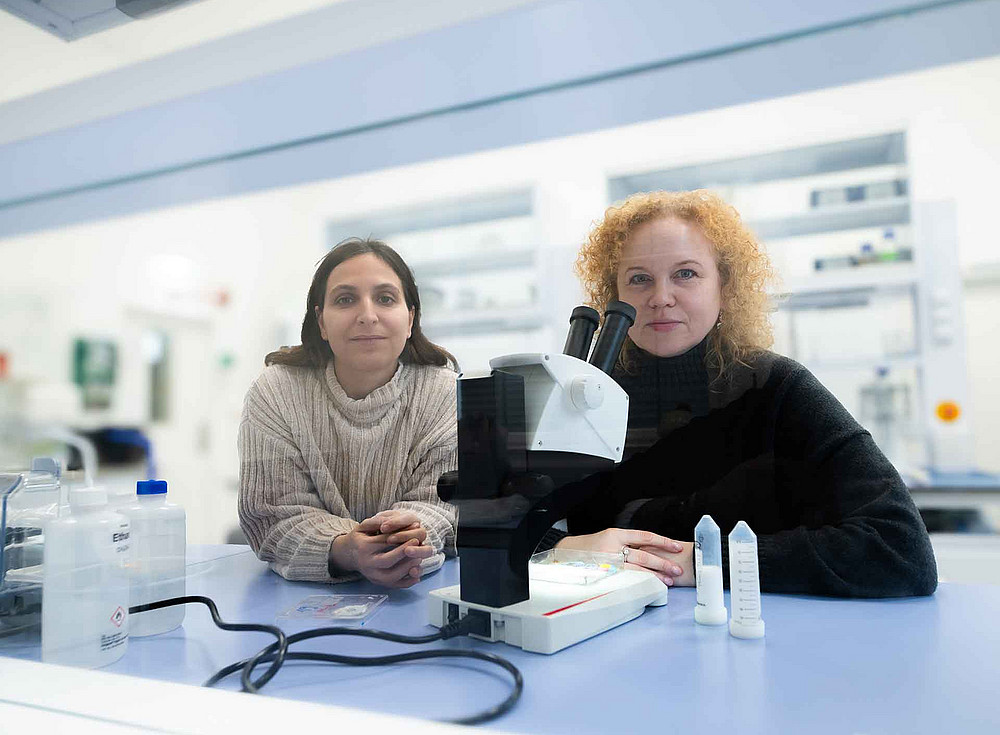
Dalial Freitak (right) and Danae Nyckees ©Uni Graz/Tzivanopoulos

Dalial Freitak (right) and Danae Nyckees are dealing in their research with the effects of environmental pollution on ants. Photo: University of Graz/Tzivanopoulos

Titanium dioxide, which is found in cosmetics, for example, is increasingly entering the environment in the form of nanoparticles. This could also put insects at risk. If ants ingest the substance in combination with the pesticide glyphosate, it disturbs the development of their offspring. Scientists at the University of Graz are drawing attention to the negative consequences of this toxic cocktail.

“A large amount of titanium dioxide (TiO2) and glyphosate has been released into the environment in recent years,” says biology doctoral student Danae Nyckees. Especially the chemical compound TiO2, which is found in sun creams, lotions and toothpaste, but also in paints, enters nature as nanoparticles via wastewater and improperly disposed waste. A team of biologists and chemists from the University of Graz has investigated the effects of the pollutant on insects using the ant species Cardiocondyla obscurior as an example.

The animals, which are found in both the tropics and Europe, ingest tiny particles of the substance through their food. “It has a negative effect on microorganisms in their gut,” confirms Dalial Freitak, head of the Insect Health Research Group at the University of Graz. Titanium dioxide also affects the number of offspring and may potentially increase the effects of the herbicide glyphosate, adds Danae Nyckees.
“Pollutants do not always immediately increase the mortality rate,” say Freitak and Nyckees, referring to the long-term effects of environmental toxins. Further research is needed. “We know far too little about the interactions between harmful substances,” emphasise the two scientists.

The study was conducted in close cooperation with Reinhard Sittinger, Raquel Gonzalez de Vega and David Clases from the Department of Chemistry at the University of Graz and recently published in the journal “Environmental Science and Pollution Research”.


created by Andreas Schweiger

Related news

Record of reported species: Styria wins the global City Nature Challenge

Observers in Styria recorded 4,660 different animals, plants and fungi as part of the international City Nature Challenge between 24 and 27 April 2026. This saw the region take first place in the "species" category. Ostrava in the Czech Republic made the most observations, with just under 140,000, whilst the San Francisco Bay Area had the highest number of participants, namely 3,019.

Studying at the University of Graz: How to enrol

Ready for a new chapter in your life with the start of your studies at the University of Graz in the winter semester 2026/27? Here you will find information on deadlines, admission procedures, registration, and everything else you need to successfully start your studies in the fall.

Europe Day: Strengthening international expertise with Arqus

On 9 May, the spotlight will be on Europe. At the University of Graz, European cooperation is also a tangible part of everyday student life – not least through the Arqus university alliance. Master’s and PhD students can currently register for the Arqus micro-credential in ‘Advanced Creative Thinking and Communication’.

A substantial community: the key role of soil crusts in the earth system

They are often overshadowed by the plant world: lichens, fungi, mosses and bacteria, which form unique communities on rocks and trees or as soil crusts. Bettina Weber from the University of Graz is bringing this biological alliance into the research spotlight. Her research shows that these communities form an essential part of the Earth’s critical zone and play a key role in the interactions between land and atmosphere. Bettina Weber was honoured by the European Geosciences Union for her groundbreaking research at the beginning of May.

Begin of page section:
Additional information:

University of Graz
Universitaetsplatz 3
8010 Graz
Austria
  • Contact
  • Web Editors
  • Moodle
  • UNIGRAZonline
  • Imprint
  • Data Protection Declaration
  • Accessibility Declaration
Weatherstation
Uni Graz

End of this page section. Go to overview of page sections

End of this page section. Go to overview of page sections

Begin of page section:

End of this page section. Go to overview of page sections