Begin of page section:
Page sections:

  • Go to contents (Accesskey 1)
  • Go to position marker (Accesskey 2)
  • Go to main navigation (Accesskey 3)
  • Go to sub navigation (Accesskey 4)
  • Go to additional information (Accesskey 5)
  • Go to page settings (user/language) (Accesskey 8)
  • Go to search (Accesskey 9)

End of this page section. Go to overview of page sections

Begin of page section:
Page settings:

English en
Deutsch de
Search
Login

End of this page section. Go to overview of page sections

Begin of page section:
Search:

Search for details about Uni Graz
Close

End of this page section. Go to overview of page sections


Search

Begin of page section:
Main navigation:

Page navigation:

  • University

    University
    • About the University
    • Organisation
    • Faculties
    • Library
    • Working at University of Graz
    • Campus
    Developing solutions for the world of tomorrow - that is our mission. Our students and our researchers take on the great challenges of society and carry the knowledge out.
  • Research Profile

    Research Profile
    • Our Expertise
    • Research Questions
    • Research Portal
    • Promoting Research
    • Research Transfer
    • Ethics in Research
    • Commission for Scientific Integrity
    Scientific excellence and the courage to break new ground. Research at the University of Graz creates the foundations for making the future worth living.
  • Studies

    Studies
    • Prospective Students
    • Students
    • Registration for Study Programme (Winter semester 2026/27)
  • Community

    Community
    • International
    • Location
    • Research and Business
    • Alumni
    The University of Graz is a hub for international research and brings together scientists and business experts. Moreover, it fosters the exchange and cooperation in study and teaching.
Topics
  • Sustainable University
  • Researchers answer
  • Work for us
Close menu

End of this page section. Go to overview of page sections

Begin of page section:
You are here:

University of Graz News Erinnerung

End of this page section. Go to overview of page sections

Tuesday, 15 September 2020

Erinnerung

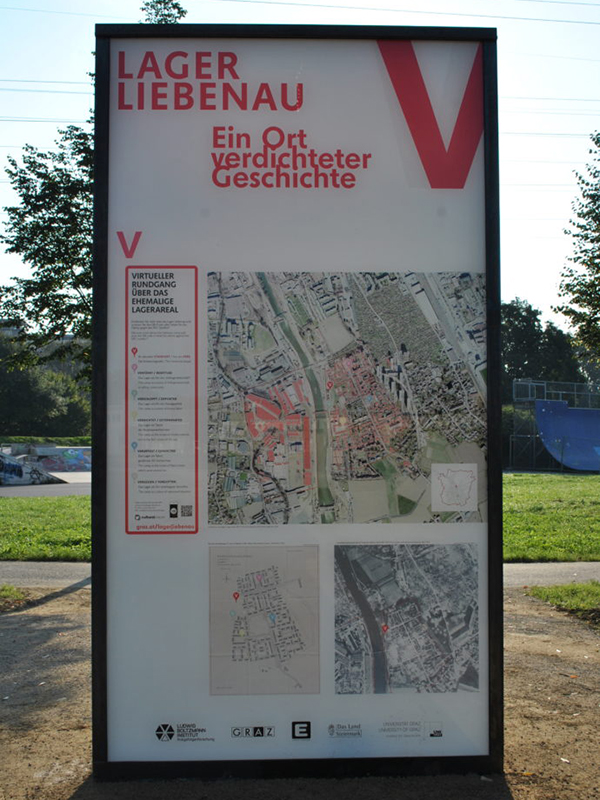
Die Gedenktafel am Areal des ehemaligen Lagers Liebenau erinnert an die Vergangenheit des Ortes. Foto: BIK/Dieter Bacher.

Die Gedenktafel am Areal des ehemaligen Lagers Liebenau erinnert an die Vergangenheit des Ortes. Foto: BIK/Dieter Bacher.

Lager Liebenau: Gedenktafel als Zeichen gegen das Vergessen

Das so genannte „Lager Liebenau“ war das größte Zwangsarbeiterlager in Graz während der Zeit des Nationalsozialismus. Es diente als Zwischenstation für ungarische JüdInnen auf ihren Todesmärschen nach Mauthausen, mindestens 34 Menschen wurden hier nachweislich ermordet. 75 Jahre nach Ende des Zweiten Weltkriegs erinnert nun eine Gedenktafel an die Vergangenheit dieses Orts. Stadt, Land und die Universität Graz sowie das Ludwig-Boltzmann-Instituts für Kriegsfolgenforschung (LBI) haben sich gemeinsam für die Errichtung eingesetzt.

Die ursprünglich für April 2020 geplante Präsentation der Tafel musste coronabedingt verschoben werden, nicht zufällig wurde allerdings der 11. September als neuer Termin gewählt: am 11. September 1947 hatte in Graz der Prozess gegen vier ehemalige Wächter begonnen. Danach geriet das Lager allerdings rasch in Vergessenheit, das Areal wurde für Wohnhäuser und öffentliche Einrichtungen zugänglich gemacht.  In den vergangenen Jahren stieg jedoch das öffentliche Interesse am Lager Liebenau wieder, das teils durch private Initiativen, teils durch Forschungen der Zeithistorikerin Barbara Stelzl-Marx (Universität Graz und LBI) vorangetrieben wurde. Im Rahmen der Vorarbeiten für das Murkraftwerk gaben die Energie Steiermark und die Stadt im Jahr 2011 schließlich eine umfassende wissenschaftliche Aufarbeitung zum Lager Liebenau in Auftrag. Inzwischen ist das ehemalige Lagerareal als Bodenfundstätte deklariert. Offen ist die Frage, ob noch Opfer unter der Erde liegen.

Die Gedenktafel hat auch eine digitale Dimension: eine App ermöglicht einen virtuellen Rundgang durch das Lager, eine Filmdokumentation liefert zusätzlich weitere Hintergrundinformationen. Projektleiterin Barbara Stelzl-Marx betonte bei der Präsentation: „Wie das Vergessen verhindert werden kann, ist eine Diskussion, der sich jede Generation erneut stellen muss. Die Erinnerungstafel mit digitalem Rundgang ist ein wichtiges Zeichen am ehemaligen Lager Liebenau, das zur Auseinandersetzung mit diesem dunklen Kapitel der Grazer Zeitgeschichte einlädt. Die lange verdrängten Spuren des Holocaust vor unserer Haustür werden somit sichtbar gemacht.“


Der digitale Rundgang per App: https://www.culturalplaces.com/de/tour/lager-tour
Filmdokumentation von Markus Mörth: www.graz.at/lagerliebenau
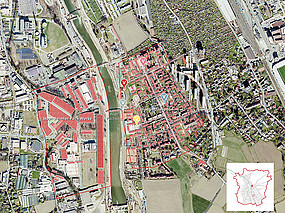


Luftbild des ehemaligen Lagerareals. Foto: Stadtvermessung Graz/Luftbildarchiv und Roman Klug, Universität Graz.
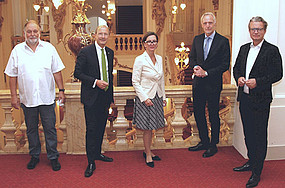
Die InitiatorInnen der Gedenktafel: Rainer Possert (Verein Gedenkinitiative Graz-Liebenau), Urs Harnik (Energie Steiermark), Zeithistorikerin Barbara Stelzl-Marx, Kulturstadtrat Günter Riegler und Kulturlandesrat Christopher Drexler. Foto: BIK/Evgenija Nazaruk.
Die InitiatorInnen der Gedenktafel: Rainer Possert (Verein Gedenkinitiative Graz-Liebenau), Urs Harnik (Energie Steiermark), Zeithistorikerin Barbara Stelzl-Marx,
Kulturstadtrat Günter Riegler und Kulturlandesrat Christopher Drexler. Foto: BIK/Evgenija Nazaruk.
created by Gerhild Leljak

Related news

Staying fit during the holidays: summer sports on the University of Graz campus

The Kleeblattlauf is not the end of the fitness term. Following last year’s successful launch, the University of Graz is once again offering summer sports on campus this year. From 30 June to 16 July 2026, there will be a free exercise programme in the open air. On the shady Südwiese (between the main building and Universitätsplatz 2), anyone interested can get in shape in the afternoons with body workouts, fascia training and yoga.

Getting even hotter: Researchers predict global warming of 1.7 degrees by 2027

While Europe is currently sweltering in the heat, global temperatures are also rising towards concerning record levels. In 2026, Earth’s surface air temperature is expected to reach 1.62 degrees, and in 2027 even 1.71 degrees Celsius above pre-industrial levels. The long-term temperature rise – an average over a 20-year period – is predicted to exceed the 1.5-degree threshold of the Paris Agreement as of 2026 already. For the first time, researchers at the University of Graz have been able to make such a forecast so far in advance. The intensifying El Niño climate event favors forecast skill and thereby facilitates a reliable computation.

Forest fire at Rosenhain: Volunteer fire brigade carried out an evacuation drill at the Jesuit refectory

Thick smoke in the stairwell, flames at the edge of the forest, people missing in the Jesuit refectory at the University of Graz: at Rosenhain, the Graz Volunteer Fire Brigade carried out a drill simulating a scenario that is becoming increasingly realistic given the heat and drought

Full effort in the heat: the Sports Centre was in full swing at the Kleeblattlauf

On 19 June 2026, 2,000 runners and hundreds of supporters made their way to the Rosenhain for a sporting end-of-term event.

Begin of page section:
Additional information:

University of Graz
Universitaetsplatz 3
8010 Graz
Austria
  • Contact
  • Web Editors
  • Moodle
  • UNIGRAZonline
  • Imprint
  • Data Protection Declaration
  • Accessibility Declaration
Weatherstation
Uni Graz

End of this page section. Go to overview of page sections

End of this page section. Go to overview of page sections

Begin of page section:

End of this page section. Go to overview of page sections