Begin of page section:
Page sections:

  • Go to contents (Accesskey 1)
  • Go to position marker (Accesskey 2)
  • Go to main navigation (Accesskey 3)
  • Go to sub navigation (Accesskey 4)
  • Go to additional information (Accesskey 5)
  • Go to page settings (user/language) (Accesskey 8)
  • Go to search (Accesskey 9)

End of this page section. Go to overview of page sections

Begin of page section:
Page settings:

English en
Deutsch de
Search
Login

End of this page section. Go to overview of page sections

Begin of page section:
Search:

Search for details about Uni Graz
Close

End of this page section. Go to overview of page sections


Search

Begin of page section:
Main navigation:

Page navigation:

  • University

    University
    • About the University
    • Organisation
    • Faculties
    • Library
    • Working at University of Graz
    • Campus
    Developing solutions for the world of tomorrow - that is our mission. Our students and our researchers take on the great challenges of society and carry the knowledge out.
  • Research Profile

    Research Profile
    • Our Expertise
    • Research Questions
    • Research Portal
    • Promoting Research
    • Research Transfer
    • Ethics in Research
    • Commission for Scientific Integrity
    Scientific excellence and the courage to break new ground. Research at the University of Graz creates the foundations for making the future worth living.
  • Studies

    Studies
    • Prospective Students
    • Students
    • Post-registration Law
  • Community

    Community
    • International
    • Location
    • Research and Business
    • Alumni
    The University of Graz is a hub for international research and brings together scientists and business experts. Moreover, it fosters the exchange and cooperation in study and teaching.
Topics
  • Sustainable University
  • Researchers answer
  • Work for us
Close menu

End of this page section. Go to overview of page sections

Begin of page section:
You are here:

University of Graz News Electrons and AI: New approaches to the search for new medicines

End of this page section. Go to overview of page sections

Tuesday, 24 March 2026

Electrons and AI: New approaches to the search for new medicines

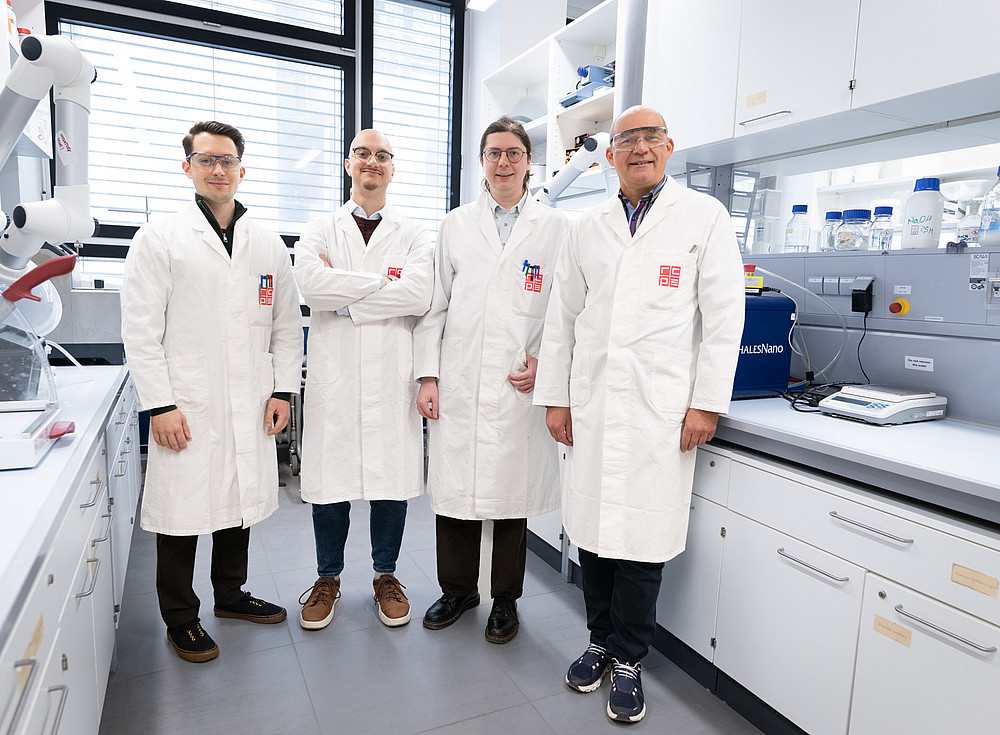
Four people in white lab coats are standing side by side in a bright chemistry laboratory. They are looking towards the camera; three have their arms hanging by their sides, whilst one person has their arms crossed. To the left and right, laboratory equipment, shelves, cables and several labelled bottles can be seen; daylight streams into the laboratory through large windows in the background. ©Uni Graz/Angele

Eduardo Rial-Rodriguez, Gabriele Laudadio, Florian Wagner and Oliver Kappe are using AI in the search for new drugs. Photo: University of Graz/Angele

Researchers at the University of Graz are revolutionising the development of new medicines by combining electrochemistry and artificial intelligence. Thanks to smart optimisation, the search for new active ingredients will in future be faster, more sustainable and safer.

A chemistry laboratory full of delicate powders and liquids is often the starting point in the search for new medicines. This is because discovering new active ingredient molecules requires complex reaction chains involving substances that can be highly problematic. An alternative to this is electrochemistry. It uses electrons to trigger chemical reactions and thus specifically produce new molecules that could later be used in medicines.

That sounds simple, but it is very challenging, as Gabriele Laudadio explains: “It’s like a highly complex jigsaw puzzle. We have to optimise a multitude of parameters.” What are the right electrodes, and what current strength is required? The researcher at the Institute of Organic Chemistry at the University of Graz aims to solve this puzzle. “To do this, we have to carry out hundreds of trials using the trial-and-error method until we succeed.”

AI-Optimiziation

To improve this process, he is now taking a new approach together with scientists from the Research Centre for Pharmaceutical Engineering (RCPE) and Merck KGaA: combining chemistry with artificial intelligence. Using what is known as Bayesian optimisation, the series of experiments is optimised to such an extent that only 20 to 30 attempts are required. But it is not just the time spent in the laboratory that is reduced. “We also gain certainty that we have found the optimal conditions for our experiment,” explains Laudadio.

“We have been able to prove that this approach works and can actually produce molecules in this way.” Numerous further steps and test series are still required before drugs can be produced using this method. But: “This method represents a huge step forward for the development of new active ingredients,” the researcher is convinced.

This process is not only faster, but also much more environmentally friendly and safer than the previous approach. There is no hazardous waste and energy consumption is reduced. “Very soon we will have drugs in initial clinical trials that have been developed using AI systems. We are currently witnessing the beginning of a scientific revolution,” Laudadio is convinced.

Interested? You can gain an insight into the world of molecules through a Bachelor’s degree in Chemistry, Pharmaceutical Sciences or Molecular Biology.

The Paper 

Electrochemical self-optimization for the synthesis of densely functionalized molecules; Eduardo Rial-Rodríguez, Florian L. Wagner, Thomas Fuchß, Alena Sommer, Johannes Krieger, Hans-Michael Eggenweiler, C. Oliver Kappe, Gabriele Laudadio. https://doi.org/10.1016/j.chempr.2026.102952

created by Roman Vilgut

Related news

Studying at the University of Graz: How to enrol

Ready for a new chapter in your life with the start of your studies at the University of Graz in the winter semester 2026/27? Here you will find information on deadlines, admission procedures, registration, and everything else you need to successfully start your studies in the fall.

Europe Day: Strengthening international expertise with Arqus

On 9 May, the spotlight will be on Europe. At the University of Graz, European cooperation is also a tangible part of everyday student life – not least through the Arqus university alliance. Master’s and PhD students can currently register for the Arqus micro-credential in ‘Advanced Creative Thinking and Communication’.

A substantial community: the key role of soil crusts in the earth system

They are often overshadowed by the plant world: lichens, fungi, mosses and bacteria, which form unique communities on rocks and trees or as soil crusts. Bettina Weber from the University of Graz is bringing this biological alliance into the research spotlight. Her research shows that these communities form an essential part of the Earth’s critical zone and play a key role in the interactions between land and atmosphere. Bettina Weber was honoured by the European Geosciences Union for her groundbreaking research at the beginning of May.

The digital world of tomorrow: University of Graz works with people to shape the future

Digitalisation is supposed to make everything better: artificial intelligence that even organises travel. The car that drives itself. Robots that care for us in our old age. But what kind of future do people actually want? What role should technology play in this? The University of Graz is exploring these questions through a new research facility. At the Graz Sociodigital and Participatory Futures Studio – or GraSP Futures Studio for short – young and old work together with researchers to design visions of the future that also critically examine technical innovations.

Begin of page section:
Additional information:

University of Graz
Universitaetsplatz 3
8010 Graz
Austria
  • Contact
  • Web Editors
  • Moodle
  • UNIGRAZonline
  • Imprint
  • Data Protection Declaration
  • Accessibility Declaration
Weatherstation
Uni Graz

End of this page section. Go to overview of page sections

End of this page section. Go to overview of page sections

Begin of page section:

End of this page section. Go to overview of page sections