Begin of page section:
Page sections:

  • Go to contents (Accesskey 1)
  • Go to position marker (Accesskey 2)
  • Go to main navigation (Accesskey 3)
  • Go to sub navigation (Accesskey 4)
  • Go to additional information (Accesskey 5)
  • Go to page settings (user/language) (Accesskey 8)
  • Go to search (Accesskey 9)

End of this page section. Go to overview of page sections

Begin of page section:
Page settings:

English en
Deutsch de
Search
Login

End of this page section. Go to overview of page sections

Begin of page section:
Search:

Search for details about Uni Graz
Close

End of this page section. Go to overview of page sections


Search

Begin of page section:
Main navigation:

Page navigation:

  • University

    University
    • About the University
    • Organisation
    • Faculties
    • Library
    • Working at University of Graz
    • Campus
    Developing solutions for the world of tomorrow - that is our mission. Our students and our researchers take on the great challenges of society and carry the knowledge out.
  • Research Profile

    Research Profile
    • Our Expertise
    • Research Questions
    • Research Portal
    • Promoting Research
    • Research Transfer
    • Ethics in Research
    • Commission for Scientific Integrity
    Scientific excellence and the courage to break new ground. Research at the University of Graz creates the foundations for making the future worth living.
  • Studies

    Studies
    • Prospective Students
    • Students
    • Registration for Study Programme (Winter semester 2026/27)
  • Community

    Community
    • International
    • Location
    • Research and Business
    • Alumni
    The University of Graz is a hub for international research and brings together scientists and business experts. Moreover, it fosters the exchange and cooperation in study and teaching.
Topics
  • Sustainable University
  • Researchers answer
  • Work for us
Close menu

End of this page section. Go to overview of page sections

Begin of page section:
You are here:

University of Graz News The university meets and dances

End of this page section. Go to overview of page sections

Tuesday, 10 December 2024

The university meets and dances

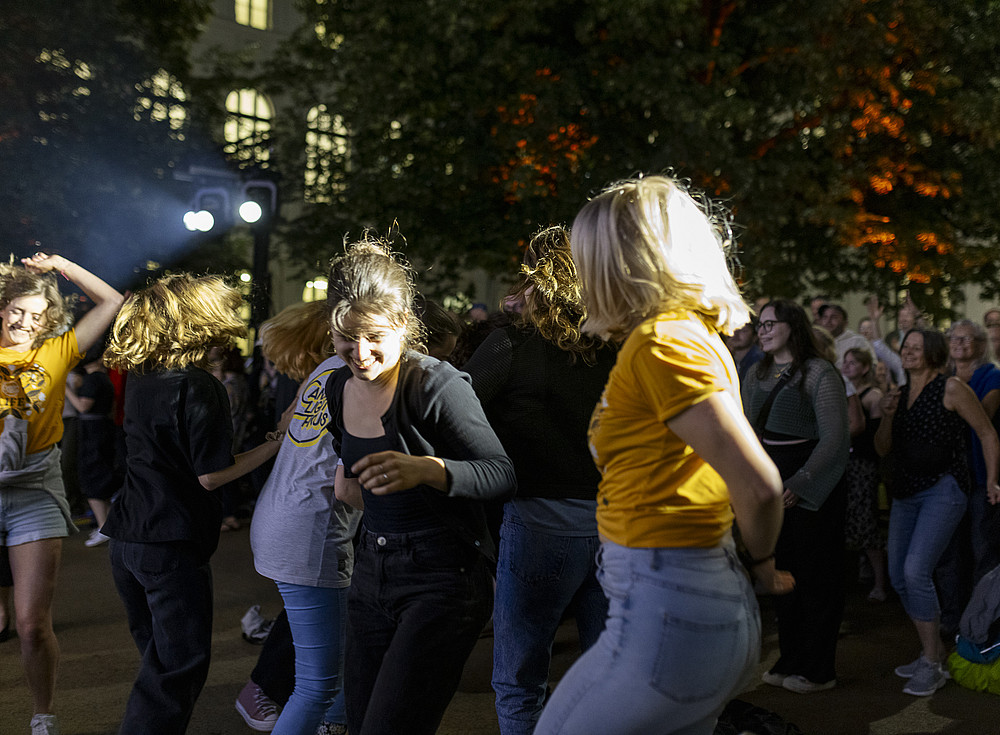
Dancing people in the courtyard ©Uni Graz / Kanizaj

On 23 May 2025 there will be dancing again at the Uni-Fest. Photo: Uni Graz/Kanizaj

The University of Graz has long been more than just a place of research and teaching. It is a hub for dialogue and thus the venue for many - now also climate-friendly "green" - events. Hundreds of events have already been announced for 2025. These include two major scientific congresses, each of which is expected to attract more than 1,000 participants. The International Association for German Studies will meet in July and the European Association for Research on Learning and Instruction in August. All those who would like to experience the campus through music, dance and in a completely different way should mark 23 May 2025 in red in their diaries: The university festival is back on the programme.

Numerous hands and departments at the University of Graz work together to ensure that both internal and external events are organised professionally. Gabriela Pirsch and Sabine Bodinger from Event Services give us a look behind the scenes.

How many events are organised at the University of Graz on average each year?
Gabriela Pirsch: We process around 1200 enquiries a year. In addition, the Events Service receives almost 3,500 calls and almost 13,000 emails every year.

Which location on campus is requested particularly often?
Sabine Bodinger: A lot of enquiries concern the auditorium. The Festsaal in the Meerscheinschlössl and the Alumni lecture theatre in conjunction with the foyer of the University Library are among the top three locations. Last year alone, Andi Neuner and his colleagues organised 750 set-ups and take-downs.

Which events attract a lot of visitors?
Pirsch: The University Festival last June attracted 3000 guests. With around 2,000 visitors each, the Open Day, the Excellence Fair and the Welcome Weeks are among the major events that take place regularly.

Surely there must be a lot of logistics involved? What do you need to consider when organising an event?
Pirsch: You need to start planning well in advance and involve the event service in the preparations right from the start. For example, the rooms have to be reserved. A major event also affects many other university departments, from UniIT to the electricians and fire protection to security and public relations.

The University of Graz recently received a licence for green events and meetings. What does that mean?
Bodinger: The university is authorised to license an event as a green event or meeting, such as a congress, on request - now without an external agency. Certain criteria must be met for this. These include, for example, sustainable mobility, the use of energy-saving lighting and accessibility.

⇒ Find out more about the event service
 

created by Interview: Andreas Schweiger

Related news

Complying with the norm: Why Do Standards Shape Our Lives, Elisabeth Staudegger?

Standards determine whether a sheet of paper fits in a printer or whether a charging plug can power multiple devices. These standards shape our everyday lives. But who actually sets these standards? Where are the weaknesses, and how could science help to improve them? Elisabeth Staudegger, Head of the ‘Law and IT’ Department at the Institute for Legal Foundations at the University of Graz, host the Academic Standards Day on 16 June. Here she relays how sciences can contribute to the topic of standardisation and reveals her personal favourite standard.

More body awareness than a culture war

In Italy, sex education lessons will in future only be permitted with parental consent, and will be banned entirely in nurseries and primary schools. At the same time, Pride Month highlights why knowledge about the body, relationships, boundaries and diversity is important for young people. A study by the University of Graz shows how important knowledge about the body, contraception, relationship skills and protection against violence is

Will Austria win the World Cup? Mathematician reveals calculation method

Michael Fischer uses the football tournament as a practical example for highschool lessons.

Survival strategies: How plants respond to drought

According to Geosphere Austria, this spring was the driest in Austria since records began around 170 years ago. The low rainfall put particular pressure on the agricultural sector. And climate change is set to make the situation even worse in the coming decades. We asked Johannes Liesche, a professor at the Department of Biology at the University of Graz, how plants react to water shortages and how they survive periods of drought.

Begin of page section:
Additional information:

University of Graz
Universitaetsplatz 3
8010 Graz
Austria
  • Contact
  • Web Editors
  • Moodle
  • UNIGRAZonline
  • Imprint
  • Data Protection Declaration
  • Accessibility Declaration
Weatherstation
Uni Graz

End of this page section. Go to overview of page sections

End of this page section. Go to overview of page sections

Begin of page section:

End of this page section. Go to overview of page sections